

YOUR CART IS CURRENTLY EMPTY
What is a plinth? Plinths, pedestals and podiums explained
Published
Quick answer
A plinth is a solid block that something stands on. In architecture it is the stone block under a column or statue; in a shop, gallery or exhibition stand it is a box-shaped base that lifts a product to the height people look at. A pedestal is also a base for an object, usually taller and more column-like, while a podium is a platform or stand for a person, such as a speaker or a prize winner.
What is a plinth?
The Cambridge Dictionary defines a plinth as "a square block, especially of stone, on which a column or a statue stands". The word came into English in the late 16th century, from Latin plinthus and Greek plinthos, meaning "tile, brick, squared stone" (Oxford Learner's Dictionaries).
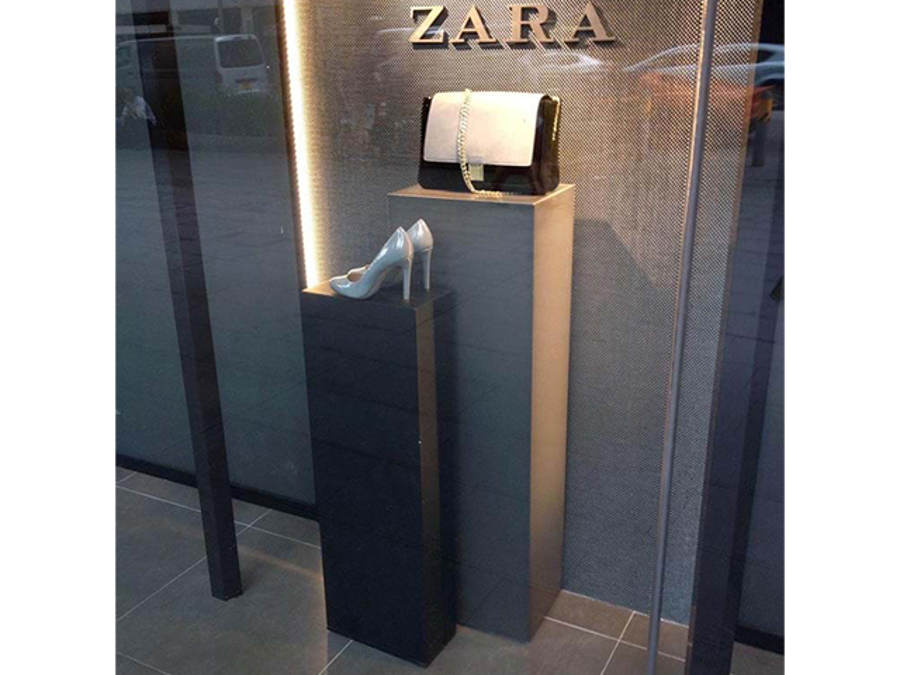
In display work the meaning is the same idea in a lighter material. A display plinth is a free-standing box, usually square or round, that raises one object off the floor and gives it space. That might be a product at its launch, a trophy, a sample for visitors to pick up, or an artwork. Our standard display plinth is 400mm square and 900mm high.
Plinth vs pedestal vs podium
The three words overlap. The simplest test is what goes on top: an object (plinth or pedestal) or a person (podium).
| Plinth | Pedestal | Podium | |
|---|---|---|---|
| Dictionary meaning | "A block of stone on which a column or statue stands" (Oxford Learner's) | "The base that a column, statue, etc. rests on" (Oxford Learner's) | "A small platform that a person stands on when giving a speech or conducting an orchestra" (Oxford Learner's) |
| What sits on it | An object | An object | A person, or a speaker's notes |
| Typical shape | Square or rectangular block | Taller and slimmer, often a column | Low platform, a stepped winners' stand, or a lectern |
| Word origin | Greek plinthos, "tile, brick, squared stone" | Italian piedestallo, from piè, "foot" | Greek podion, from pous, "foot" |
| Display use | Product launches, retail windows, exhibition stands | Single hero products, art, window features | Presentations, award ceremonies, sports presentations |
Plinth vs pedestal. In everyday use they are almost interchangeable. Cambridge describes a pedestal as "a base for a statue, or a base for a column", and also as "a long, thin column that supports a statue". If the base is a solid block, call it a plinth. If it is tall and slender, pedestal is the more natural word. Round display bases are often sold as pedestals.
Podium vs plinth. A podium is for people. Oxford Learner's lists three senses: a platform for a speaker or conductor, "three platforms of different levels on which winners stand", and, in North American English, "a stand for holding a book, notes, computer, etc." when giving a talk. Cambridge adds that "a podium is also a lectern". If you are briefing a speaker's stand, ask for a lectern to avoid confusion.
Display plinths vs architectural plinths
An architectural plinth is part of a structure. It is the stone block at the foot of a column or under a statue, built to carry load and to stay where it is.
A display plinth is furniture. It is built to be moved, repositioned and often reused across campaigns. It is usually a hollow box made from acrylic, timber board or metal framing, and finished to suit the brand. What the two share is the job: they separate the object from its surroundings and tell people it matters.
Standard plinth heights and what each suits
Our timber and showcase plinths come in standard widths of 300mm, 400mm, 500mm and 600mm square, in heights from 100mm to 1,200mm. Other sizes are made to order.
| Height (D2G sizes) | General guidance on what it suits |
|---|---|
| 100mm to 400mm | Low risers for large items, mannequin bases, or the front row of a group |
| 900mm (our standard) | A single product at a comfortable viewing height, standing |
| 1,000mm to 1,200mm | Small items that need to sit closer to eye level, or the back row of a group |
The second column is general guidance, not a rule. Size the top to the object, not to the space around it: a small item on a broad plinth tends to look stranded. For a range of products, a plinth kit gives matched plinths in two or more heights so every item stays visible.
Plinth materials: acrylic, timber, metal, mirror
The material changes the look, the weight and how much the plinth can carry. The figures below are from our current product pages.
| Material | Construction | Load guide | Production lead time |
|---|---|---|---|
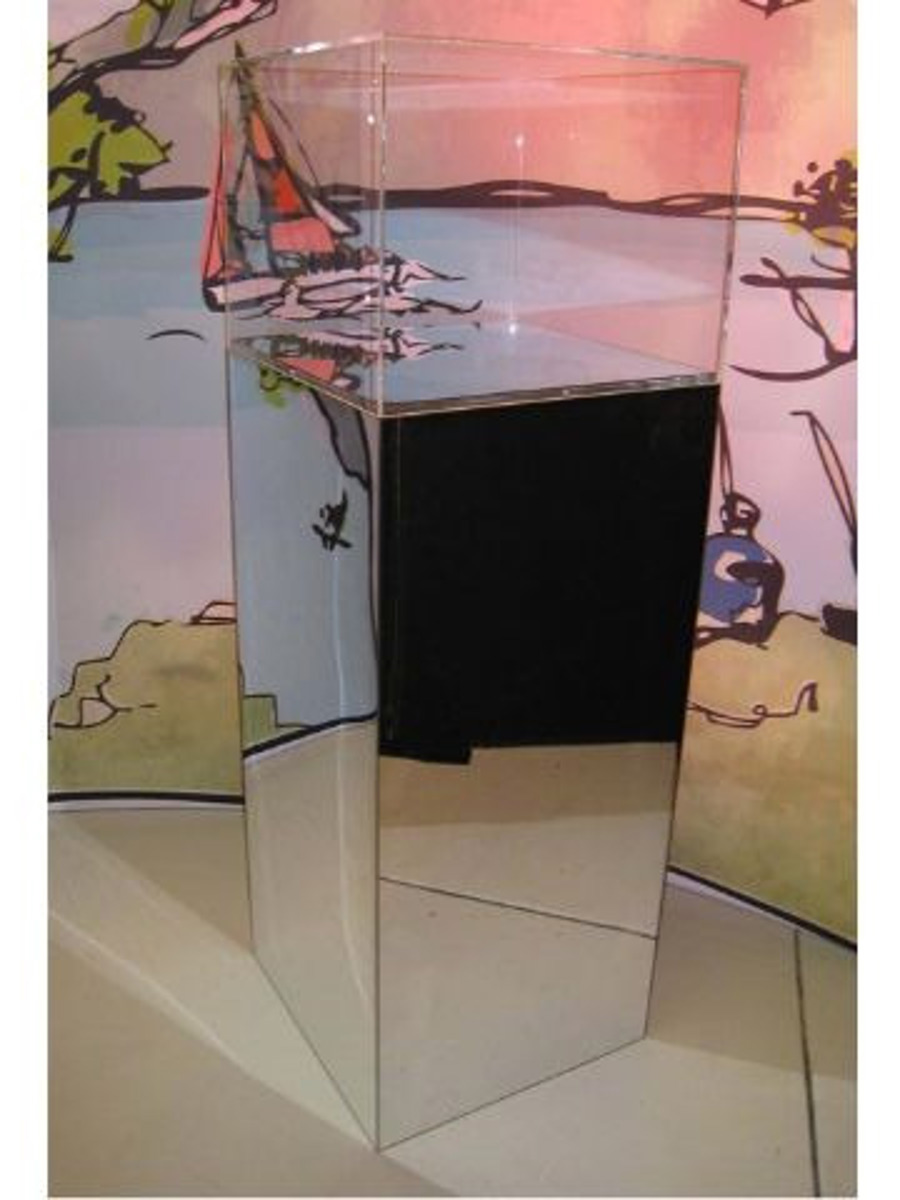
| Acrylic | 6mm acrylic, laser cut, mitred corners; white, black, clear, frosted, tinted or mirror finish | About 20kg on a 400 x 400mm plinth up to 1,000mm high | 1.5 weeks (custom builds about 2 weeks) |
| Laminated timber | 16mm moisture-resistant MDF with a melamine finish | Up to 150kg | 1.5 weeks |
| Metal frame | 25 x 25mm black anodised aluminium frame with a 12mm melamine MDF top | Up to 20kg | 1.5 weeks |
- Acrylic suits premium retail, showrooms and corporate spaces. It isn't especially heavy (a 400 x 400 x 900mm plinth weighs about 11.5kg), but it is best suited to places where it won't be moved constantly. Mirror acrylic is offered as a finish.
- Timber is the workhorse for heavy products and repeat use. It is designed for indoor use and carries a 5-year warranty on non-graphic components for the original owner, which doesn't cover mistreatment or normal wear and tear.
- Metal frame plinths give an open, minimal look that suits fashion and cosmetics retail. Tops come in 320mm, 420mm, 520mm and 600mm square, and the standard size starts from $258 excluding GST and freight.
Lead times run from order (and print-ready artwork, where needed); freight is extra.
Where plinths are used: launches, galleries, retail, events
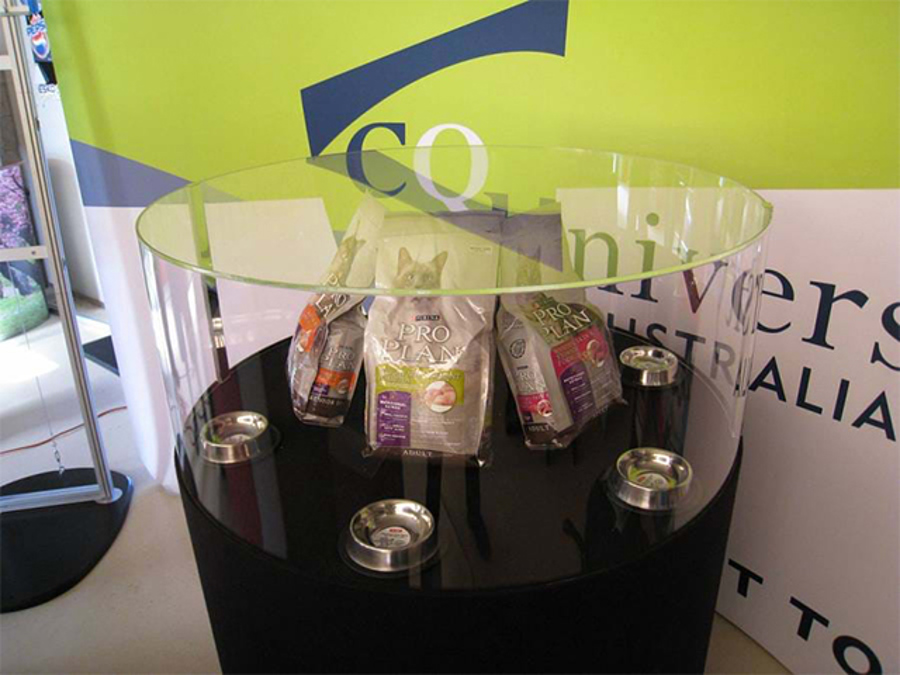
- Product launches and activations. One plinth for the hero product, often branded with a printed wrap or a laser-cut logo.
- Galleries, jewellery and phone retail. Showcase plinths add a clear acrylic case, also called a vitrine, with a lockable door or security screws to keep hands off. Production is 2.5 weeks and pricing is quoted per job.
- Retail windows and floors. Grouped plinths at stepped heights keep attention on the stock.
- Exhibition stands and events. Our portable and super-compact plinths fold down flat, so they travel easily from one show to the next. The portable plinth takes up to 70kg.
- Presentations. A portable lectern is the "podium" most speakers mean. Ours is 400mm square and 1,200mm high at the rear and folds flat, with no tools needed.
Choosing a plinth
- Start with the object. Note its footprint, height and weight. Weight decides the material: acrylic or metal frame for light items (around 20kg for either), the portable plinth for up to 70kg, and timber for anything heavier, up to 150kg. Timber plinths weigh around 15kg at an average size, which also makes them steadier in busy public areas.
- Set the height. Use the table above, and check sightlines from where people will approach.
- Decide on protection. Add a showcase if the item is valuable or shouldn't be touched.
- Plan the branding. Plinths can carry printed graphics on any face, vinyl or foil lettering, laser-cut 3D logos and internal lighting.
- Think about transport. If the plinth travels to several events, choose a portable model or plan cases for it.
When the standard sizes don't fit, we make custom pedestals, plinths and podiums in-house from acrylic, timber, MDF, laminated board, steel, aluminium, polypropylene and other plastics, including winners' podiums built to size.
Frequently asked questions
What is the base of a statue called? A plinth or a pedestal. The Cambridge and Oxford Learner's dictionaries define both words as the base that a statue or column stands on.
Is it plinth or plynth? Plinth. "Plynth" is a common misspelling.
Are a plinth and a pedestal the same thing? Close enough that suppliers often use both words for the same product. A plinth tends to be a solid block; a pedestal tends to be taller and slimmer.
Next step
Browse our display plinths by material. If none of the standard sizes fits, send us what you're displaying, how heavy it is, the space it will go in and whether it needs to travel, and we'll suggest a size and finish. Call 1300 240 250 or use the enquiry form on any plinth page.