

YOUR CART IS CURRENTLY EMPTY
Live cooking demonstrations: portable kitchens, food safety and sales
Published
Quick answer
A live cooking demonstration needs three things settled before the kitchen arrives: the venue's permission to cook, the local council's food business notice or permit, and the venue's sign-off on your cooking fuel. At ICC Sydney, induction needs the fewest extra approvals, while gas needs its own approval at all four venues we checked. Build the kitchen around a sink, a hot zone and a serving zone, keep an extinguisher and fire blanket within reach, and plan the session so every tasting ends with the product in the shopper's hand.
Where cooking demonstrations work
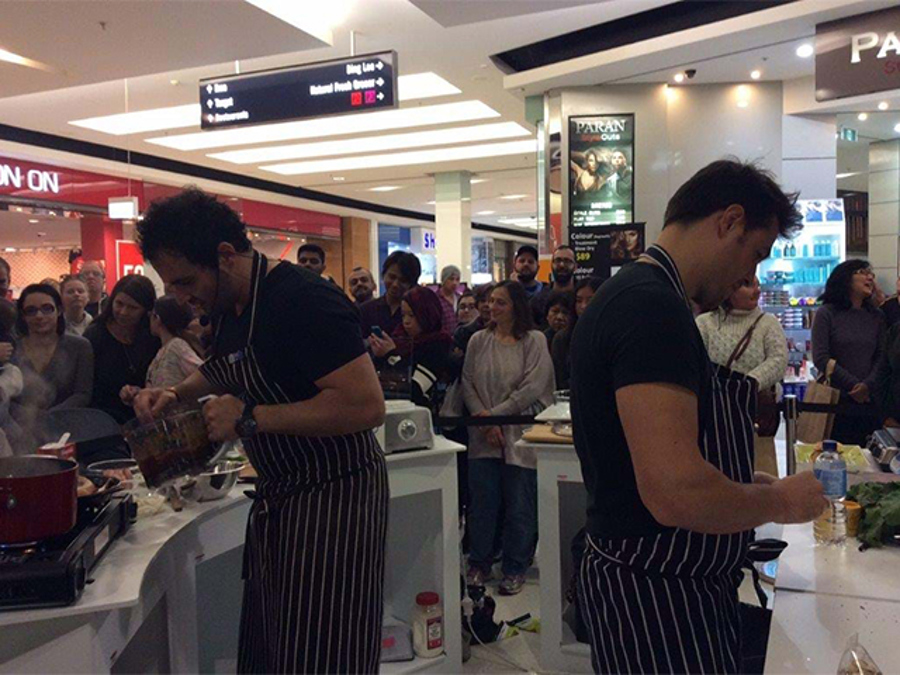
Cooking theatre suits any product that changes when it is cooked: sauces, proteins, cookware, appliances. The usual venues are:
- Shopping centre concourses, where a crowd builds around a chef or presenter. Approval comes from centre management, so ask them early what they need.
- Supermarkets, usually a smaller demo table rather than a full kitchen. If you cook on our Retail Demonstrator table, a popular supermarket demo table, we recommend adding a heat diffuser and a splash guard.
- Trade and consumer shows, where convention centres publish their own cooking rules (see below).
Get the venue's permission to cook
Each of the convention centres we checked sets its own conditions for cooking or sampling on a stand. Here is what four of them publish:
| Venue | What it says about cooking |
|---|---|
| ICC Sydney | Permission needed. Form due 14 days before the hiring period. Gas needs a separate Hazardous Substances and LPG permit. Sampling also needs a City of Sydney temporary food stall permit number. Only electric reheating at its Cutaway venue. |
| BCEC, Brisbane | "Cooking of food by exhibitors is prohibited unless approved by the BCEC Executive Chef and Safety Manager." LP gas cylinders indoors "will be avoided wherever possible and permits apply". |
| Gold Coast Convention and Exhibition Centre | Approval for a cooking demonstration needed no later than 21 days before the event. |
| Adelaide Convention Centre | Food or drink samples need prior approval from the centre. LP gas needs approval no later than 14 days before the event. Additional fire extinguishers are required for cooking installations. |
Shopping centres and retailers set their own conditions, so ask each one for its requirements in writing before you specify the kitchen.
Induction, electric or gas?
The fuel decides how hard approval will be.
- Induction. ICC Sydney's cooking permit says induction cooktops "in general, will not require filtration / exhaust when cooking for sampling purposes." With no flame and no gas permit, it is the simplest of the three to get approved there.
- Electric. ICC Sydney doesn't require exhaust for electric ovens on steam settings, or for a domestic bench-top fryer up to 5 litres. Deep fryers over 5 litres, multiple fryers or high-volume frying do need air filtration or exhaust.
- Gas. At ICC Sydney, gas grills and ovens must be rated for indoor use, and LPG brings its own permit. At BCEC, each appliance using LP gas needs a minimum 4kg CO2 or 4kg dry chemical fire extinguisher.
ICC Sydney also says that "Commercial or high-volume cooking regardless of equipment used will require air filtration / exhaust." Plan small sampling batches rather than full meals and you are more likely to avoid extraction altogether.
Fire safety on the stand
ICC Sydney's cooking permit is one of the most detailed public checklists, and it makes a useful starting point for other venues:
- a powder fire extinguisher, ABE type, rated 3A-40B, minimum 2.5kg, plus a 1.8m x 1.8m fire blanket at the stand, "with staff trained in its use"
- all equipment tested and tagged to AS/NZS 3760
- hot surfaces never left unattended, with hot-surface signs beside every cooking surface
- naked flames and hot surfaces placed so patrons can't knock them over or reach them
- sharp implements kept out of attendees' reach
- non-slip, protective flooring in the cooking area, and spills cleaned up immediately
- no fats or oils poured into the venue's drains.
Check the extinguisher type and size with each venue, because requirements differ.
Food safety for a cooking demo
A demo that gives food away is still a food business. FSANZ's Safe Food Australia guide says a food business "includes the handling of food for sale or the sale of any food, even if it occurs only once", and that "'Sale' includes any gain to the business from providing the food". FSANZ's temporary food premises guidance says:
- notify your local council before you start
- keep potentially hazardous food at 5°C or colder, or 60°C or hotter
- cook food to safe temperatures, for example 75°C for poultry and minced meat
- keep raw food separate from ready-to-eat food
- use a drinking-quality water supply
- check with the council whether your team needs food safety training or a certified food safety supervisor.
For hand washing, the same guide says food handlers must use hand wash facilities when handling exposed food or food contact equipment. Where there is no mains water, a container with a tap or a portable hand wash stand may do; as a guide for a small stall, it generally recommends at least 20 to 25 litres of water a day. For tastings, it suggests single-use utensils, a container for used ones and a sign to stop double dipping. Keep ingredient and allergen details on hand: ICC Sydney requires them to be available for food samples.
For hot and cold holding times on a sampling station, see our guide to in-store food sampling.
The kitchen unit: zones, sinks and power
Lay the kitchen out in the order food moves: raw prep, cooking, plating, serving. Keep the public on the serving side only.
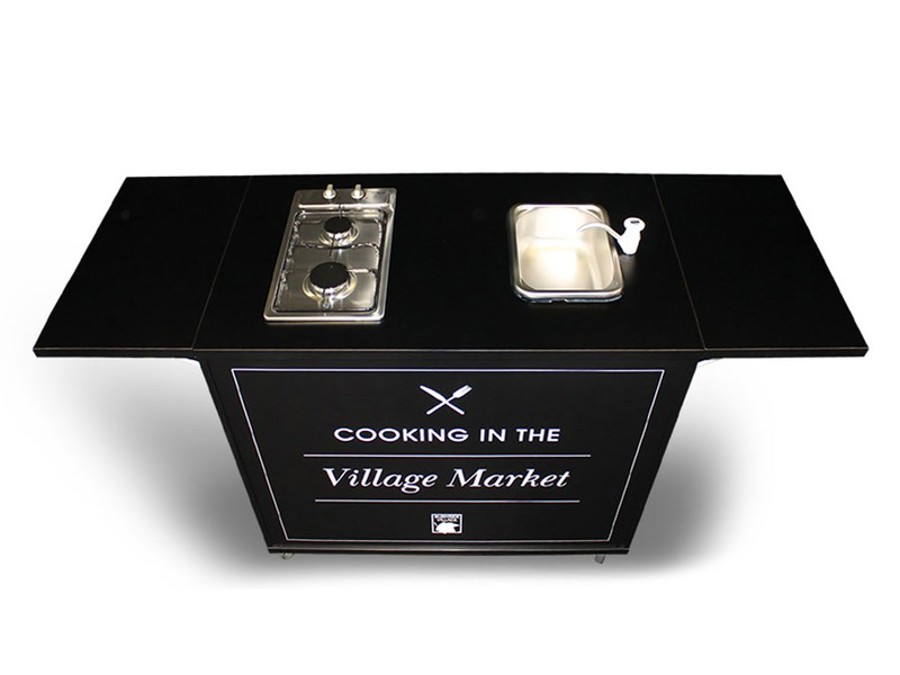
Our portable kitchens are built to each client's specification. The base unit is a 1.8m x 700mm melamine carcass on castors with two locking rear doors, from $4,864 plus GST and freight, with a standard production time of 2.5 weeks from order and print-ready artwork. Options include:
- gas or electric cooktops, sinks with taps and in-built bains marie
- on-board fridges or freezers, and on-board battery power
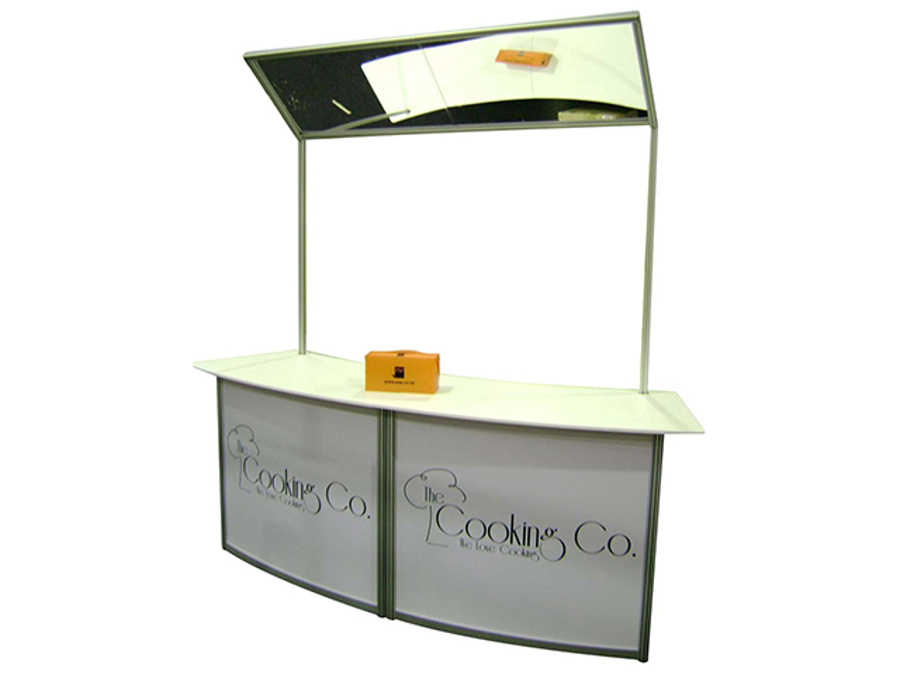
- overhead angled viewing mirrors, so the crowd can see into the pan
- safety splash guards, lighting, fold-out wings and canopies
- microphones and speakers for the presenter.
Confirm with the venue what power you will have before you choose appliances. Where it is limited, on-board battery power or a simpler menu may suit better. For choosing the unit itself, read our portable kitchen buyer's guide.
Running the show
- Script short sessions. Pick a dish that is ready in minutes and repeat it on a published timetable, so passers-by know when the next one starts.
- Make it visible. An overhead mirror or a camera on a screen lets people at the back see the pan.
- Separate roles. One person cooks and talks; another plates, hands out tastings and answers questions.
- Dress the team. Branded aprons, caps and serving boards from our cooking demonstration merchandise range make the crew easy to spot.
Turning the demo into sales
A tasting is only worth it if it leads somewhere.
- Put the product within reach. Stock beside the kitchen, or tell people exactly which aisle it's in.
- Give a reason to buy today. A recipe card, an offer or a bundle with the ingredients used in the demo.
- Capture details only with consent, and only if you have a plan to use them.
- Record each session: tastings handed out, sales during and after, and what people asked about.
Next step
See our portable bars and kitchens, then send us your venue, dates and menu through the enquiry form or call 1300 240 250. We'll recommend a kitchen to suit the venue and the menu.