

YOUR CART IS CURRENTLY EMPTY
How to plan an airport activation in Australia
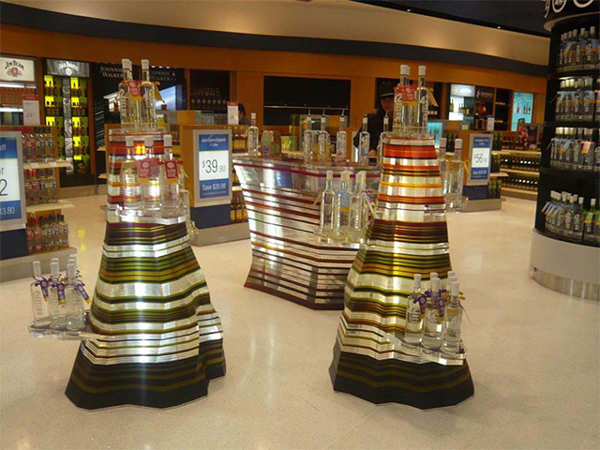
An airport terminal gives your brand hours of a traveller's time, but it isn't a shopping centre with a departure board. The airport, not the local council, approves what goes in. Your crew may need security passes, and every tool, product and panel that goes past security has to be screened first.
Each airport sets its own process, so treat this page as a list of questions to confirm with yours. The examples come from guidance that Sydney, Melbourne, Brisbane and Adelaide airports publish on their own websites.
#1 - Book the site through the airport
Airports sell activation space directly or through an appointed media partner. Sydney Airport runs it through its Brand Connect team, which covers advertising, brand partnerships and activations, pop-up retail, and events and conferences. Enquiries go to brandconnect@syd.com.au, with an overview of the enquiry, your campaign objectives, your organisation and contact details. Melbourne and Brisbane airports say an out-of-home media company manages their terminal advertising, including promotional zones and experiential or brand activation opportunities, so enquiries start there.
Sydney Airport's pop-up retail page and its site cards show what a site comes with:
- Sites: 5 in T1 International, 4 in T2 and 2 in T3.
- Footprints: about 12 to 24m² (for example 4m x 3m, 6m x 3.7m or 8m x 3m).
- Rates: from $3,000 to $7,500 + GST per week, negotiable on the number of sites and length of stay. Percentage rent may apply.
- Approval: every card says the site is subject to Sydney Airport approval, and one T1 card adds that sites can't be placed on hold.
#2 - Find out which side of security your site is on
This one answer changes your passes, your deliveries and your build. Sydney Airport's Commercial Tenancy Guide describes landside as the public areas "before security screening", where tenants "don't require secure zone access". Past the screening point is the sterile area, where screened passengers wait for their flights. Sydney Airport's Security Awareness Guide says: "All persons and goods must not enter the sterile area until they have been screened and cleared at a security screening point."
Sydney's site cards mark one T1 departures site and the T1 arrivals forecourt as landside. For any other site, ask the airport which side of screening it sits on before you design anything.
#3 - Sort out passes for your crew
Sydney Airport's Security Awareness Guide says anyone entering the sterile area to work must properly display an Aviation Security Identification Card (ASIC) or a Visitor Identification Card (VIC).
- ASIC. Sydney Airport issues a grey ASIC to people who need to enter secure areas such as the sterile area. An ASIC shows the holder has undergone a security check, so ask early whether anyone on your crew already holds one.
- VIC. A VIC covers crew without an ASIC, but not on their own. At Sydney, an ASIC holder must supervise them in secure areas, the sponsor must be there when the VIC is issued, and it can't run past 28 days unless an ASIC application is lodged. At Brisbane Airport, you present with the ASIC holder who will escort you and bring original government-issued photo ID.
- Escorts. Adelaide Airport's site rules for contractors say a VIC holder "must be under supervision by a valid ASIC holder at all times" in areas not open to the public.
When you book the site, ask who will escort your crew and how visitor passes are arranged.
#4 - Plan for every tool and product going through screening
Screening is where an airport install needs the most planning. Sydney Airport's security program for sterile area tenants lists the prohibited items, which include tools a display crew would normally carry:
- box cutters, utility knives, pointed metal scissors, drills, saws, hammers, screwdrivers, pliers and wrenches
- aerosol containers, including cans of spray paint
- cable ties and duct or gaffer tape.
These can only go in as approved tools of trade. Sydney's Security Awareness Guide says a VIC holder can't carry them in the sterile area unless an ASIC holder is supervising at all times. Adelaide Airport asks for tools of trade to be "kept to a minimum", logged in a register, and accounted for on the way out. It warns that "Any missing tools may instigate an evacuation" of the Terminal 1 sterile area.
Your stock and display parts are screened too. The same program says all goods entering the sterile area in T1, T2 and T3 "must be security screened" and will be x-rayed. Goods-screening hours vary by terminal and day. Check Sydney Airport's storage and goods-screening information and confirm your delivery window with the airport before booking transport.
At Sydney's international terminal, powders, liquids, aerosols and gels over 100 ml are restricted at screening, but stock to be sold or given away past security is exempt (it's still screened). If you plan to hand out samples from sampling and demonstration kit, ask the airport how the sample stock will be screened before you order it.
This is where the choice of display pays off. Many of our portable display solutions for airports go up without tools, which means less to declare and less to keep track of once you're through screening.
#5 - Check whether your build counts as works
A build that fixes to the terminal or looks like a fit-out may count as building works. Sydney Airport's Commercial Tenancy Guide says works on its land are assessed by Airport Building Control under the Airports Act 1996, so "local council planning approval is not required". Even minor works must be confirmed as exempt before they start, and contractors need an approved Airport Works Plan (AWP): "Works without a valid AWP will be stopped." Sydney's AWP page adds that this includes deliveries, site inspections, photography and site measures.
Melbourne Airport is similar: "all works require a PERCOW" (Permit to Commence Work) unless exempt, after Airport Building Control has reviewed them. Brisbane Airport's domestic terminal fit-out guideline says pop-up tenancies also need to apply for approval or an exemption. Ask early whether your design counts as works.
#6 - Design to the site's height and power limits
Sydney's site cards set the same height limit on every site: 1,400mm for a solid structure and 2,400mm for an open (skeletal) one, with the T1 arrivals forecourt reviewed case by case. Power is a 10 amp supply, with data available at most sites; the T3 sites have four 10 amp outlets, with a 20 amp maximum. In practice that means low counters and plinths, open frames rather than solid walls above 1.4m, and screens that run comfortably on the supply listed.
Sydney's presentation rules for retail tenants show what else airports watch: no pull-up banners or A-frame signs outside a tenancy without permission, and stock "never placed within one meter of a fire sprinkler." Agree any extras as part of your booking.
Our custom portable displays can be made to any size, so we can build to a site's footprint and height limit. Standard production is 1.5 weeks from order and print-ready artwork. For screens, see our digital signage range.
#7 - Bump in when the terminal is quiet
Expect early starts and late nights. Adelaide Airport generally limits contractor works to 7am to 4pm, may require some Terminal 1 work during the 11pm to 6am curfew, and bans large tools and materials from escalators. Brisbane Airport's domestic terminal guideline doesn't allow deliveries of materials through its southern loading dock between 05:00 and 21:00, and at the northern dock deliveries must be planned with the airport a week before they arrive. At Sydney, retailers meet their own delivery drivers at the loading dock, and a driver without an ASIC leaves stock on the dock for the retailer to move.
Plan where the van unloads, which screening point the kit goes through and when, who escorts the crew, and how long the install takes.
Our installation and pack-down team can manage the install and come back for the pack-down. Send us the airport, the site card and your dates, or call 1300 240 250, and we'll plan a display that suits the site and the screening process.