

YOUR CART IS CURRENTLY EMPTY
How to get floor graphics approved in centres, stores and venues
Floor graphics are allowed in many shopping centres and stores, but rarely without conditions, and at least one convention centre bans adhesive graphics on its floors outright. The published rules and safety guidance we found come down to three things: whoever controls the floor has to approve the graphic, it shouldn't change the grip underfoot, and it has to come up cleanly at the end, with no tape marks or glue left behind.
Below are the published rules of two national centre owners, a regional centre, a supermarket chain and three convention centres, plus Safe Work Australia's guidance, and the seven things to sort out before you order. Rules differ from site to site and change over time, so confirm them with the centre, store or venue before anything goes to print.
#1 - Find out who controls the floor
Shopping centre common mall. The walkways belong to the centre, so a floor decal outside your site is usually something the centre sells or approves. Stockland's S Connect page suggests pairing pop-ups with in-centre advertising and signage, including "proximity placements such as floor decals", and Vicinity Centres' advertising page lists floor decals among its static media. Ask the centre's media or casual leasing team how they are booked.
Your own site in a centre. Inside a licensed site, the centre's own guidelines apply. Vicinity Centres' Fitout Guidelines for operational centres list, among the signage allowed for pop-up kiosks in the common mall, floor decals in "Removable Self-Adhesive Vinyl that must be produced to Centre requirements and removed on departure." Ask for those requirements before artwork starts. For other centre rules on banners, power and bump-in, see our guide to shopping centre display rules.
Supermarkets. Display approval and decals can be separate processes. Woolworths' display guidelines for suppliers note that "Wobblers, Fins and Decals are managed via" a separate Woolworths team rather than the display approval process. Ask your Woolworths contact who signs off floor decals before you design them. For the displays themselves, see how to get POS displays approved by Australian supermarkets.
Convention and exhibition centres. The venue's rules apply as well as the organiser's, and Brisbane Convention & Exhibition Centre doesn't allow adhesive graphics on its floors at all (see #5). Check before you design a floor graphic for a stand.
#2 - Specify a slip-resistant, removable material
Two properties matter most: grip and clean removal.
Our adhesive floor vinyl is coated in a tough, textured floor laminate that gives a slip-resistant finish, and every grade, indoor or outdoor, has a non-slip coating. The adhesive can be a long-term type, or a short-term type for events that is made to come off without leaving residue.
Tell us how long the graphic has to stay down when you ask for a quote, because short events and long campaigns call for different adhesives.
#3 - Match the grip of the floor around it
A decal changes the surface underfoot over a small area. Safe Work Australia's guide to managing the risks of slips, trips and falls doesn't mention floor graphics, but it advises avoiding "sudden transitions in floor surface texture where possible". On slip-resistant treatments applied to part of a floor, it says "you should aim for the localised area to be the same as the surrounding floor, so that there will be a consistent level of grip when walking over the whole surface." The same thinking applies to a decal.
The guide lists two Australian Standards on slip resistance: AS 4586:2013, which classifies new pedestrian surface materials, and AS 4663:2013, which measures the slip resistance of existing surfaces. If a centre, store or venue asks for a slip rating, ask exactly which classification and test it wants, and put that requirement in writing with your order.
Grip also changes in use. The same guide names wear and tear, damage and contamination in high-traffic areas, and poor cleaning, as common reasons a floor stops giving enough grip. Check graphics in busy or wet spots, such as entries and food areas, through the campaign.
#4 - Suit the graphic to the floor surface
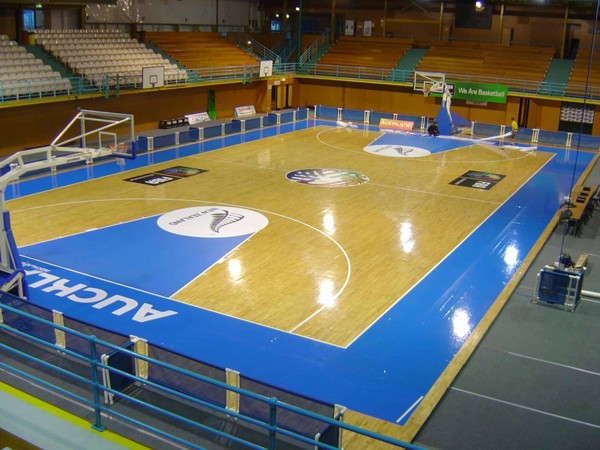
Adhesive vinyl needs a smooth surface. Ours can go on any smooth floor, and it is used in showrooms, foyers, shopping malls, supermarkets, exhibitions and on sports courts. On a hard floor, check that the surface is smooth and its seal coat is sound before you commit, because removal is where damage happens (see #5).
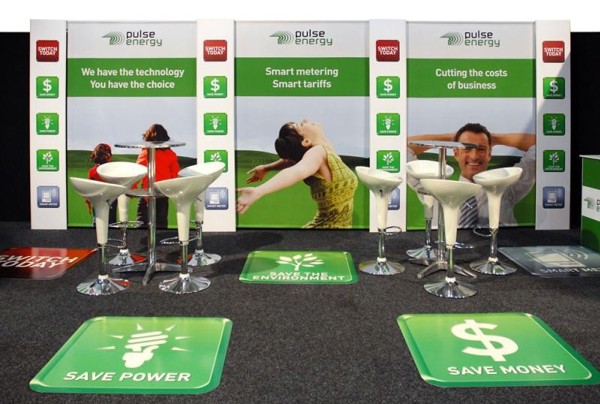
On carpet, in a hall or on a stand, ask us what will work for the site, or consider printing the floor itself. Our exhibition flooring guide compares printed carpet, carpet tiles and raised floors.
For a whole branded floor rather than a decal, printed floor vinyl comes on a roll in widths of 2m, 2.5m or 3.2m, from 1m to 30m long, and rolls out over the area. It needs a clean, flat, smooth surface without significant imperfections.
#5 - Plan the removal before you install
Most of the published rules are really about the end of the job.
- Brisbane Convention & Exhibition Centre. Its event safety and design guidelines say: "Adhesive stickers, signs, graphics, posters or other items may not be used on BCEC floor surfaces, walls or glazing."
- ICC Sydney. Its exhibition manual asks exhibitors to make sure "any adhesives used on exhibition hall floors is removed without causing damage", with costs charged for damage or extra cleaning.
- Gold Coast Convention and Exhibition Centre. Its event planning and safety guidelines charge for repairs if flooring is damaged, or if it is "marked and requires additional cleaning", including to remove tape residue.
- Dalby Shoppingworld, Queensland. Its casual leasing terms say "No tape is to be used on the Centre floors", because tape can damage the seal coat when it comes off.
- Vicinity Centres. Floor decals must be removed on departure, and the retailer must make good any damage to the site.
Before install day, confirm the adhesive suits that floor, agree who will lift the graphics and when, and photograph the floor before the graphics go down and after they come up.
#6 - Place graphics where people walk, not where the floor changes
- Keep clear of level changes. Where floor transitions can't be avoided, Safe Work Australia's guide wants changes in floor level clearly marked with contrasting colours or other visual cues, and names step edges and the start and end of ramps as places that need visual contrast. A decal laid over one can hide that edge, so keep graphics on flat, even floor.
- Lay it flat and seal the edges. A lifted corner is a trip hazard. At GCCEC, exhibitors and their contractors share responsibility "to ensure that floor coverings within their area does not create hazards".
- Keep the message short. A floor graphic is read looking down while walking, so one image and a few large words work better than a paragraph.
#7 - Work back from the install date
- Adhesive floor vinyl: standard production time of 1.5 weeks.
- Printed floor vinyl: standard production time of 2.5 weeks.
Both times start from your order and print-ready artwork, so allow extra time for delivery. Both products are quoted to your requirements, and adhesive vinyl can be cut to almost any size or shape, including profile-cut outlines. Installation is available if you need it. Add the centre's, store's or venue's approval time on top, and ask for their requirements before artwork is signed off.
See how we work with brands on shopping centre campaigns, or send us the site, floor type, sizes and dates and we'll quote floor graphics to suit. Call 1300 240 250.