

YOUR CART IS CURRENTLY EMPTY
How to choose a material for outdoor banners and signs
For outdoor event signage, the material decides how the sign copes with wind, how long it lasts and what happens to it afterwards. As a rule of thumb, mesh is the choice for exposed fences and large banners in wind, PVC (vinyl) for tough, weatherproof banners and barrier graphics, polyester fabric for graphics you want to reuse and pack small, and corflute for short-run rigid signs such as directional boards.
Below, we compare the four, then cover fixing and finishing, and what to do with each one when the event is over.
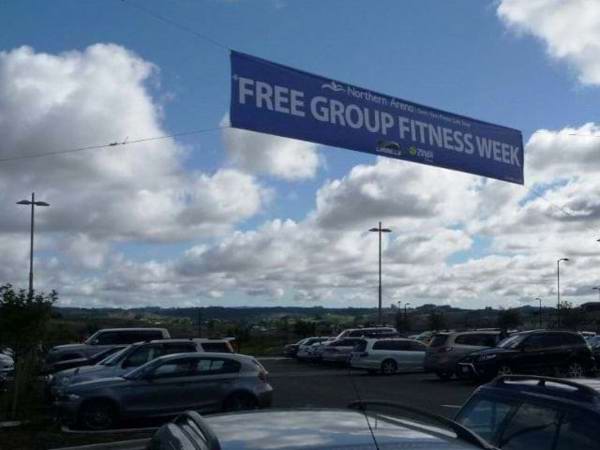
Outdoor print materials at a glance
| Material | What it is | In wind | Reuse | End of life | Typical uses |
|---|---|---|---|---|---|
| Mesh | Open-weave polyester, often PVC-coated | Lets part of the wind through | Good if stored dry | Hard to recycle when PVC-coated | Fence banners, scaffold wraps, large exposed banners |
| PVC (vinyl) | PVC-coated polyester fabric, solid face | No holes, so the whole face takes the wind | Good: durable and water tight | Hard to recycle | Banners with eyelets, barrier graphics, backdrops |
| Polyester fabric | Polyester textile, dye-sublimation printed | Depends on the frame and fixing | Very good: folds small, can be washed | Textiles can't go in household recycling bins | Flags, marquee canopies and walls, framed displays |
| Corflute | Fluted polypropylene sheet | Rigid board, needs firm fixing | Limited: best for one campaign | Recyclable where drop-off facilities exist | Directional signs, short-run boards |
Mesh
Mesh is a coated polyester fabric with an open weave, so wind passes through the holes rather than pushing on a solid face. One media manufacturer's data sheets list air flow through of 25%, 37% and 40% for three different grades, so check the figure for the exact material quoted, not "mesh" in general.
- Choose it for exposure. Long fence runs, scaffold and building wraps, and big banners on open sites are where mesh earns its place.
- Expect a softer image. The holes let light and background through, so keep text large and avoid fine detail.
- Check the media spec. The same data sheets offer a PVC backing that stops ink spraying through the holes during printing, so ask us how your mesh banner will be printed and which side reads best.
PVC (vinyl)
PVC banners are a polyester base fabric coated in PVC, which makes them water tight, durable and strong. The catch outdoors is that the face is solid: with no holes for air to pass through, the whole banner takes the wind, and that load goes into the eyelets, the ties and whatever the banner is fixed to.
- Choose it for durability. We supply PVC and mesh banners as well as fabric graphics. Banners that will be handled, rolled and rehung, and graphics that sit low to the ground where they get knocked, suit PVC.
- Keep it out of open wind where you can. Fix it to a structure with plenty of tie points, or move to mesh for large exposed banners.
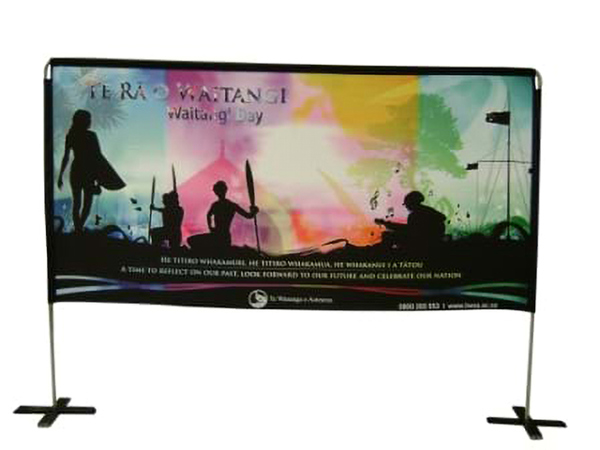
- Use it on barriers. Our cafe and event barriers carry graphics printed on outdoor banner vinyl with UV-stable inks, on a steel frame with wide feet, in 1m and 2m widths.
Fabric (polyester)
Our flags and marquee canopies are dye-sublimation printed. The dyes are baked into the fabric, so the colour is fast and the print can't be scratched off in handling.
- Choose it for reuse. Fabric folds small, travels light and can be machine washed cold, so one set of graphics can work a whole season of events.
- Know what it's rated for. Our Gazebo 2 Go marquee canopies and side walls use a close-mesh 600 denier polyester that is water resistant and fire retardant. Water resistant isn't waterproof, so plan cover for stock in heavy rain, and if an event asks for fire test paperwork, raise it when you order.
- Expect wear in constant use. Our flag FAQs put the life of a flag flown constantly at between 6 and 9 months, and up to two years if it is looked after. Event flags used only now and then can be expected to last far longer.
Corflute
Corflute is a fluted polypropylene sheet, familiar from political and for-sale signs. Our guide to outdoor signage describes it as "lightweight for short-term campaigns and directional signs", where a flat, stiff panel is easier to read than a banner.
- Fix it firmly. A rigid board on a stake or fence still catches the wind, so use enough fixings that it can't flap or twist.
- Plan for a short life. Treat it as a one-event or one-campaign material, and plan what happens to it afterwards (see below).
Fixing and finishing
How a banner is finished matters as much as what it is printed on.
- Eyelets. The usual finish for banners tied to a fence, wall or frame. Space them so the load spreads along the whole edge, not just the corners.
- Pole pockets. A sewn sleeve along the top or bottom edge takes a pole or tube, which keeps the banner flat and even.
- Cable ties. The simplest way to hold a banner to a fence or frame through its eyelets. Pull them firm rather than bar-tight, check them through the day and replace any that snap.
- Fence banners. Temporary fences have their own standard. AS 4687.2:2022, the Australian Standard for temporary fencing and temporary pedestrian barriers, adds guidance on wind actions, and includes clauses on additional accessories for fences and on "coverings and additional accessories (e.g. banners and signs)" for pedestrian barriers. Ask the fence hire company before you add banners, because even mesh adds wind load and the fence may need extra bracing, and use mesh on long or exposed runs.
- Barriers as signage. Where you control the perimeter, a free-standing steel cafe barrier carries a printed panel on both sides and moves easily when the layout changes.
Large banners can often be printed in one piece. Our in-house team prints large-format graphics in one piece up to 3.2m wide (the maximum depends on the material), and the length can run longer. Mesh banners are printed by a supplier; we work with you to supply them. See our in-house printing page.
Recycling and end of life
Be honest about where each material ends up, because "recyclable" depends on facilities, not just the plastic.
- PVC and mesh. The Vinyl Council of Australia says PVC-coated polyester fabric, used for banners and billboard skins, is hard to recycle because it combines two plastics, and that in Australia "virtually all this material goes to landfill after years of service". It estimates 1.2 million square metres of billboard skins are landfilled every year. Reuse is the better path: keep artwork generic enough to rehang, and store banners dry and rolled between events.
- Polyester fabric. RecyclingNearYou says clothing and textiles can't go in household recycling bins and must be dropped off at designated collection points. In practice, fabric's advantage is reuse: wash it, store it and run it again.
- Corflute. It is polypropylene, plastic identification code 5. The ACT Government's Recyclopaedia says corflute must not go in the household recycling bin, but can be dropped off at its resource management centres for recycling, clean and free of stakes, nails and cable ties. Check what your local council or waste contractor accepts before the campaign ends.
For hardware rather than print, see our page on how to recycle a pull-up banner.
For more on outdoor kit, browse our portable outdoor displays. For PVC banners, flags or printed barriers, tell us where the signage is going and how long it needs to last. Call 1300 240 250 or send us an enquiry.