

YOUR CART IS CURRENTLY EMPTY
How to choose plinths for a product launch
For a product launch, choose the plinth in this order: the finish that suits the product and the camera, the weight it has to carry, how it will be lit, and whether the product needs to sit under a clear case. Then work back from the launch date, because most plinths are made to order and showcases take longer than plain plinths.
Size comes first, and our plinth sizes guide covers heights, top sizes and groups in detail. In short, the usual starting point is a plinth 400mm square and 900mm high. This page picks up from there, with the six decisions that make a launch plinth look right on the night and in the photos afterwards.
#1 - Pick the finish for the product, not the room
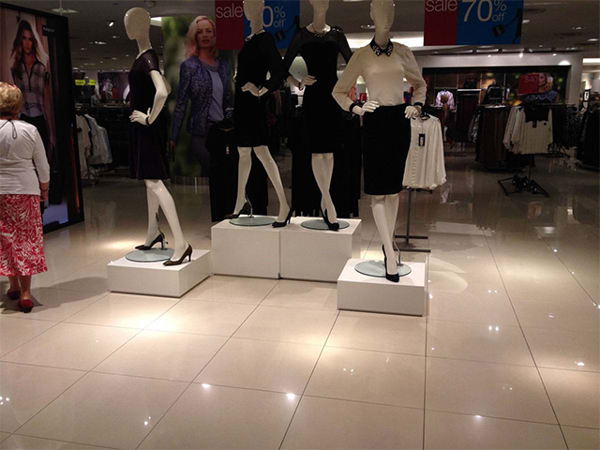
The finish is what people see first, and it sets the tone for the product sitting on it. Here's how our main finishes compare, including the rough load each one is built for.
- Acrylic. Clean and modern, and our usual choice for showrooms and premium brands. We build floor-standing acrylic plinths from 6mm acrylic in white, black or clear, with frosted, gloss black, silver or gold mirror and tinted finishes also available. Corners are cut on an angle and mitred rather than butt-joined, so the edges look clean, which matters most with clear acrylic. A 400mm square plinth up to 1,000mm high takes roughly 20kg, and we can build in thicker acrylic for heavier products.
- Painted timber. The gallery look. These are made from 16mm moisture-resistant MDF and roll-painted in satin white or black, with custom paint colours at extra cost. They take up to 150kg, so they suit heavy products, but a painted finish may need repainting every few years, depending on how it is used.
- Laminated timber. The same 16mm MDF body and 150kg load, finished in melamine laminate instead of paint. The surface is tough, easy to wipe clean and has a low sheen, so it reflects very little light under venue lighting or a camera flash. Satin white and black are standard, and other solid colours and woodgrains are available.
- Metal frame. A slim black anodised aluminium frame with a melamine-faced top, for a minimal, open look. It is the lightest-looking option but takes up to 20kg, so it suits smaller products. Tops can be changed to mirror, a block colour, printed or woodgrain.
- Mirror. Mirror acrylic over an acrylic structure. It reflects the room and the product, and suits galleries, florists and contemporary showrooms where the presentation has to be at its most stylish. Gold mirror is available, and some mirror finishes can be curved. Allow roughly 15kg for a 400mm square plinth up to 1,000mm high.
These weights are rough guides, and the real limit depends on the size of the item on top. For a heavy product, timber takes the most (up to 150kg) and portable plinths take up to 70kg (see #5). If your product is heavier than the figure for the finish you want, talk to us before you order: we can make plinths to take more weight.
#2 - Add the brand without crowding the product
A launch plinth usually carries the brand as well as the product. Keep it to one face or one line so the product stays the hero. Options across our range include:
- printed graphics on one or more faces
- computer-cut vinyl or metallic foil lettering
- laser-cut 3D logos or lettering standing off the face
- a printed or branded top.
For a plinth that has to change message between events, a printed stretch-fabric sleeve on a portable plinth lets you swap the branding without replacing the plinth (more on that in #5).
#3 - Light the product, not just the room
Venue and showroom lighting is set for the whole space, so a plinth without its own light can look flat, especially at an evening launch. You have two ways to fix it.
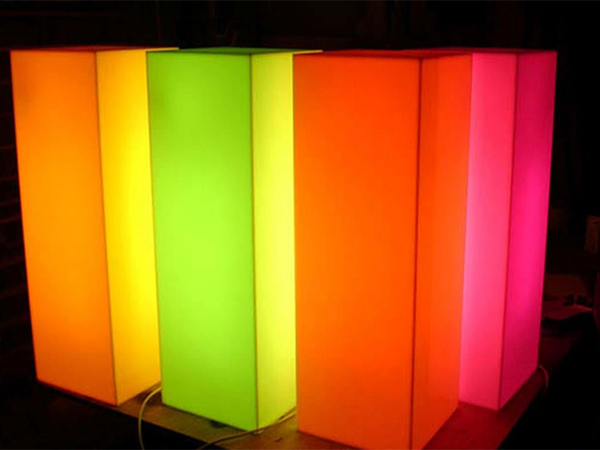
Light from inside. Our illuminated plinths use LED modules inside the plinth. Light can shine up through a frosted or tinted acrylic top onto the product, or out through the sides as well. A click-wheel remote can be supplied, so the light can hold one colour, flash, fade or change from one colour to another, and be set to suit the brand. Acrylic is the most popular body for this, because the right acrylic lets light through every face.
Power it to suit the venue. A rechargeable battery pack inside the plinth means no cables running across the floor, and it can be recharged overnight during a multi-day show. For a permanent display, ask for a mains-powered module that plugs straight into the wall.
Portable plinths can also take gooseneck lights that shine down onto the top, which suits products that look better lit from above.
#4 - Put valuable products under a showcase
If the product is expensive, a prototype or easily handled, put it under a clear acrylic showcase on top of the plinth. It keeps hands off without hiding the product.
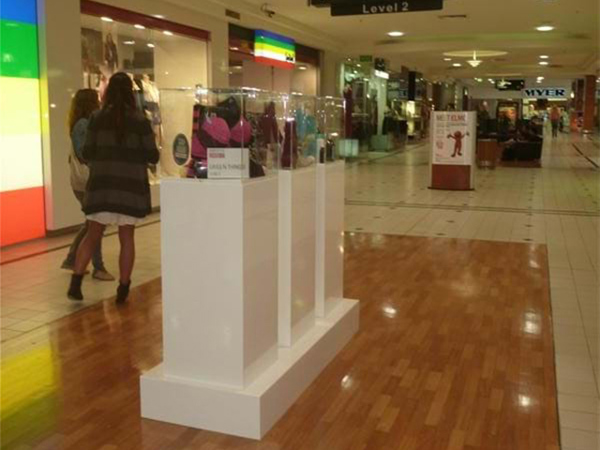
- Size the case to the product. It should be only a little taller than the tallest item inside. On a 400mm square, 900mm high plinth, a case about 300 or 400mm high is typical.
- Use a solid base. A showcase sits best on a heavy acrylic or timber plinth.
- Match security to the setting. Cases can have a lockable door, be fixed to the plinth with security screws, or simply slide over the base where the risk is low.
See our showcase plinths for the standard and custom options.
#5 - Plan for transport, handling and reuse
A plinth that looks perfect in the showroom can arrive at the venue scratched. Think about how it travels and how often it will be used.
- Acrylic and mirror scratch. Don't drag products across the top. Clean with water and a mild detergent; our acrylic plinths come with a microfibre cloth.
- Timber is heavy. An average-size timber plinth weighs around 15kg. It's built for indoor use and can go outdoors for a short event, but shouldn't be left outside for long, as the timber will absorb water.
- Portable plinths are built to travel. Our portable plinths have a 5mm polypropylene base that folds flat, and a standard 400mm square, 900mm high plinth weighs 3.7kg yet takes up to 70kg. One person can put one together in under two minutes, several fit in a single carry bag, and a four-sided printed fabric sleeve slips over the base so the branding can change between launches.
If the plinths will travel to more than one launch, portable is usually the practical choice. If they will stay in a showroom or flagship store, acrylic or timber gives the more permanent finish. For a one-off launch, you can also hire our portable plinths anywhere in Australia instead of buying them.
#6 - Work back from the launch date
Most plinths are produced after you order, so production time has to go into the launch plan.
- Acrylic, timber, metal, mirror, illuminated and portable plinths: a standard production time of 1.5 weeks.
- Custom-built acrylic plinths: typically around two weeks. Some acrylic plinths in popular sizes and colours are held in our warehouse, so ask before you plan around a build.
- Showcase plinths: 2.5 weeks.
Production time starts when you place the order and, where graphics are involved, when print-ready artwork is ready. Allow extra time for delivery, which varies by postcode. So for a launch with showcases and printed graphics, have print-ready artwork signed off at least 2.5 weeks before the plinths need to be dispatched, then add freight time on top.
If none of the standard designs fit, custom plinths can be built to your specifications in steel, aluminium, timber, MDF, acrylic and other materials.
To see the full range, browse our display plinths, or tell us the product, its weight and the launch date and we'll recommend a plinth to suit. Call 1300 240 250 or send us an enquiry.