

YOUR CART IS CURRENTLY EMPTY
Pop-up shops and kiosks: a planning guide for brand teams
Published
Quick answer
A shopping-centre pop-up kiosk needs a site booked through centre management, a freestanding branded display that fits the footprint and the height limit (1.5m is common), and approvals: a licence agreement, a dimensioned layout plan, a certificate of currency for public liability (commonly $20 million) and test-and-tag on every electrical item. Plan about eight weeks out, set up and pack down outside trading hours, and staff the site for every core trading hour. Rules differ by centre, so confirm each one with centre management. Our free pop-up shop equipment checklist covers every item.
What is a pop-up shop?
A pop-up shop is a temporary branded retail space that trades for a set period and then packs away. For a brand team, it puts a product in front of shoppers without a permanent lease: a launch, a seasonal range, a new market test or a sampling run. In a shopping centre, the site is booked through centre management's casual leasing team.
Pop-ups come in four broad types:
| Type | What it is | Typical brand use |
|---|---|---|
| Mobile pop-up | A kit that moves from centre to centre | Roadshows and regional tours |
| Interactive pop-up | Built around screens, a game or a live demo | Product demonstrations and data capture |
| Temporary retail pop-up | A kiosk or vacant store that sells | Launches, seasonal ranges, Christmas trade |
| Branded pop-up | A fully branded space focused on experience | Awareness, sampling and campaign launches |
Decide the objective before the format: sales, trial, data or launch. A sales kiosk needs a counter, EFTPOS and lockable storage. A trial-led pop-up needs room to sample. Data capture needs tablets and a privacy collection notice: under the Australian Privacy Principles, reasonable steps to notify people are taken at or before the time you collect their details, or as soon as practicable after. Set the measure at the same time (units sold, samples handed out, sign-ups) so you can compare one centre with the next.
Pop-up kiosk, pop-up stall or vacant store?
Westfield's BrandSpace team groups its pop-up spaces into kiosks, vacant stores and roaming. Those three formats are a useful way to compare options at any centre. If you've already settled on a kiosk, our short shopping centre pop-up kiosk checklist covers the essentials on one page.
| Format | What the centre provides | What you bring | Best for |
|---|---|---|---|
| Kiosk or pop-up stall (casual mall site) | A marked floor space in the mall, with power at many sites. At one centre every site is 3m x 3m with a 1.5m height limit | Walls, counter, signage, storage, lighting | Sales, sign-ups, sampling, launches |
| Vacant store | A shopfront for a set period. Any fixtures listed may cost extra to hire | Fit-out, window graphics, point of sale | Longer runs and ranges that need browsing |
| Roaming | Permission to sample or hand out offers through the centre, booked separately (at Westfield, through BrandSpace, at a charge) | Sampling cart or trolley, uniforms | Sampling and offers |
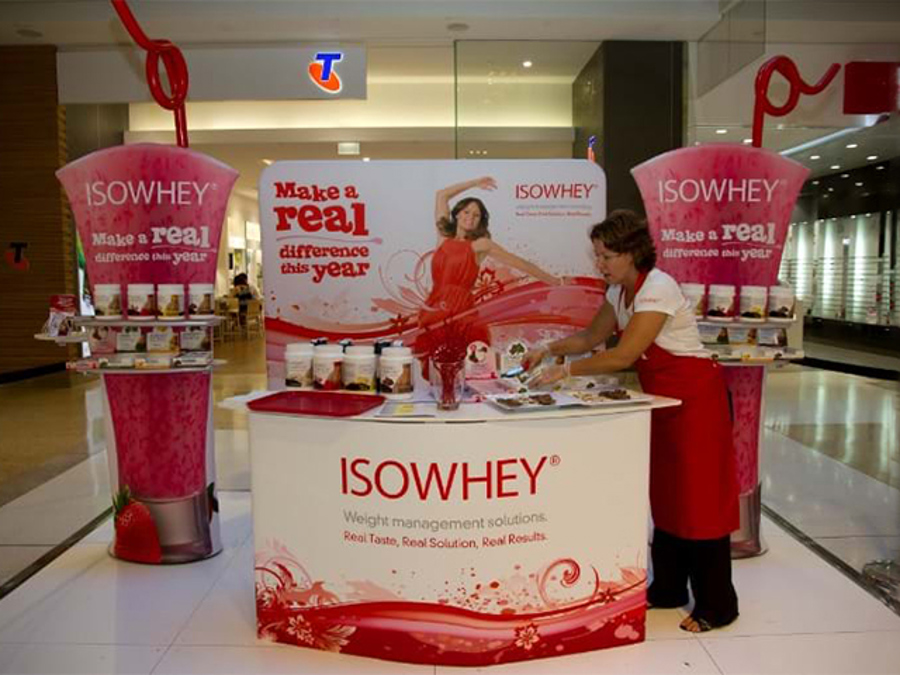
Street tenancies and event precincts sit outside centre rules. Check with the local council or the event organiser.
Pop-up stalls in shopping centres: the rules to design around
Centre owners publish guidelines for casual mall sites. These examples come from those guidelines, some of them several years old. Design the kit around them, then confirm the rules for your centre.
- Height. 1.5m is a common limit. At Westfield, nothing is displayed on top of kiosk fixtures above 1,400mm.
- Footprint. Keep everything inside the marked site, including chairs, stands and signs. Keep clear of balustrades and handrails (one centre asks for at least 1m from a balustrade, another for 900mm from a handrail).
- Freestanding only. Nothing fixed to the centre. Keep walkways, shopfronts and fire exits clear.
- Signage. Professionally printed. Westfield doesn't approve handwritten signs, paper signs fixed to kiosk fixtures, or signs put up with sticky tape, Blu-Tack or Velcro, and A-frames outside your space are not allowed.
- Lighting and sound. Westfield doesn't approve flashing or strobing LEDs, rope lights or Christmas-tree type lights on kiosks, and kiosk music should only be heard close to the kiosk.
- Staff. Sites must be staffed throughout core trading hours, unless the centre has approved an unstaffed static display. At Westfield, kiosk staff should be able to touch their fixtures with an outstretched arm at any time, and may not approach shoppers outside the site to attract business.
Pop-up shop design: laying out the space
Good pop-up shop design starts with the job the space has to do, then fits it to the rules above. Work through it in this order:
- One clear message. Shoppers walk past in seconds, so the main wall carries the brand, the product and one offer, large enough to read from across the mall. Keep the detail for the counter and handouts.
- The hero product at eye level. Put the product you most want people to try or buy where they see it first, on a plinth or shelf rather than on the floor.
- An open front. Keep the side facing the busiest foot traffic open, with the counter set back or to one side, so people can step in without feeling cornered.
- Room for the activity. Sampling, demos and sign-ups each need standing room for staff and shoppers, all inside the marked site.
- Storage out of sight. Lockable storage inside the counter or behind a wall keeps spare stock and bags from cluttering the space.
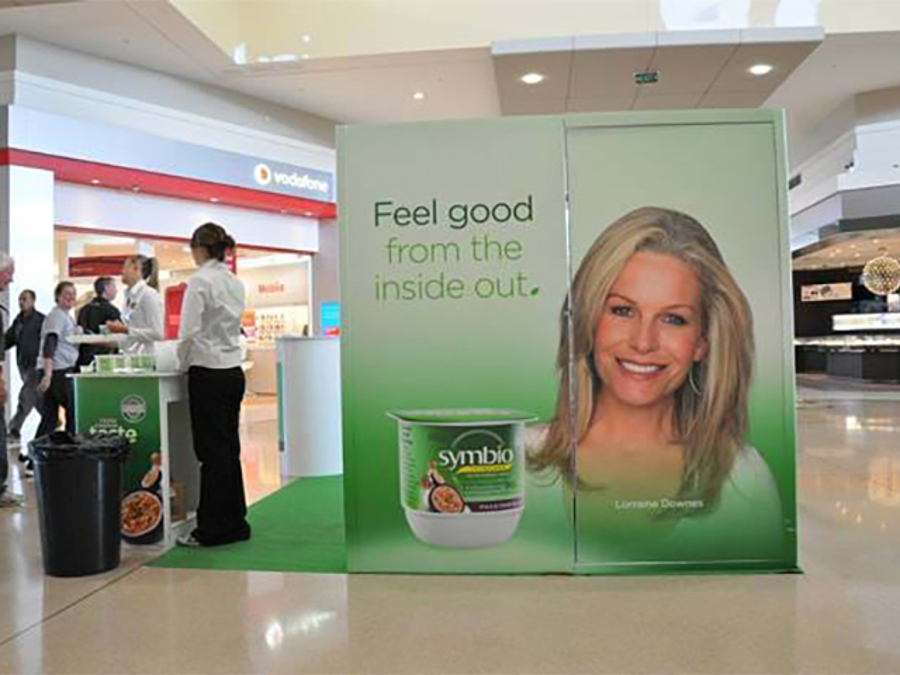
- Graphics on every side people see. On an open mall floor shoppers arrive from several directions, so print the sides and back they'll see as well as the front.
Sketch the layout on the site's dimensions and height limit before you order anything. We can draw it up with the dimensions the centre needs for its approval.
Approvals and paperwork for a shopping centre pop-up
Missing paperwork usually delays a booking. Have these ready:
- Licence agreement. Casual sites are let under a licence agreement. One operator issues it together with the tax invoice.
- Display approval. Photos or renders of the concept and products, and a layout plan with dimensions. Some centres also ask to see your product first, to check it doesn't conflict with permanent retailers.
- Public liability. A certificate of currency, commonly for at least $20 million, in the same name as the business on the booking.
- Electrical safety. Every lead, power board and appliance tested and tagged. Centres we checked ask for a qualified electrician.
- Extras where they apply. Council permits for food, safety data sheets for hazardous materials, and state trade promotion rules if you run a prize draw. In NSW, for example, an authority is needed if the total prize value exceeds $10,000.
We can build the equipment, supply the photos, drawings and dimensions the centre needs to review it, and install it on site, so your team can focus on the campaign. The approval decision is the centre's.
Pop-up kits and custom pop-up shops: hire, buy or build
Fashion, product-launch and retail pop-up kits all start from the same choice: hire for a one-off, buy a modular kit you can reuse, or build a custom pop-up shop.
| Option | What you get | Suits |
|---|---|---|
| Shopping centre hire packages | Registration, foot traffic and consultant kits for casual leasing spaces, branded with your artwork, to hire or purchase | Short campaigns and one-off pop-ups |
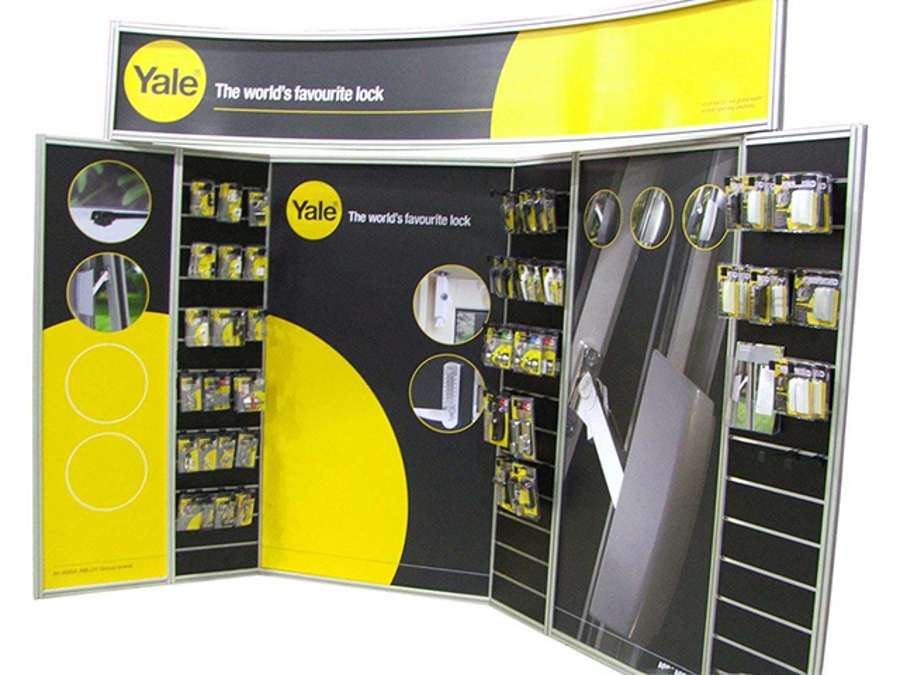
| Shopping centre pop-up displays | Double-sided walls 1.4 to 1.5m high and 0.8m to 6m wide, in straight, curved or S-shaped frames. Price includes hardware, double-sided graphics and a carry bag. From $1,765 (excludes GST and freight). Standard production 1.5 weeks from order and print-ready artwork | Touring kits and repeat activations |
| Custom design and build | A pop-up designed and produced at our Sydney facility. A custom build typically takes about 5 weeks | Flagship launches and unusual footprints |
The modular walls go up without tools in minutes, and the fabric graphics are made to be changed, so one kit can carry several campaigns. Double-sided graphics reach shoppers approaching from either direction, which matters on an open mall floor. Add shelving or a slat wall for product, as some centres ban stock on the floor.
Pop-up kit guide: download the checklist
Our pop-up shop equipment checklist is a three-page A4 PDF for brand teams. It has 10 tick-box sections: site facts, structure and walls, counters and point of sale, lighting and power, screens and tech, signage, flooring, storage and stock, staff kit, and approvals. It ends with a timeline from eight weeks out to bump-out. Rules that vary by centre are flagged, so you know what to confirm.
Download the pop-up shop equipment checklist (PDF, 3 pages)
Pop-up planning timeline
A planning guide, not a centre rule. Each centre sets its own deadlines, so confirm them with centre management. For peak retail moments such as Back to School, Easter, Mother's Day, Black Friday or Christmas, enquire as early as you can.
| When | Book or confirm |
|---|---|
| 8 weeks out | Choose the format and shortlist centres. Ask centre management for the site pack, bump-in pack and rates. Brief your display supplier |
| 6 weeks out | Lock the site and dates. If the pop-up is a custom build, order it now (about 5 weeks). Confirm power, the height limit and any fixtures supplied. Check your insurance wording with your broker |
| 4 weeks out | Submit the concept, layout plan and product list for approval. Finalise artwork and order the stand and graphics |
| 2 weeks out | Send the certificate of currency (one centre needs it no less than two weeks before you occupy the site). Test and tag. Book freight and roster staff |
| 1 week out | Lodge the signed licence agreement where it's due (one centre: no less than 5 business days before). Confirm bump-in time, loading dock and security access |
| Bump-in day | Set up outside trading hours. One centre owner recommends a Monday morning, ahead of busier end-of-week trade |
| Bump-out | Pack down outside trading hours, remove everything and make good |
Find the right contact for each centre in our shopping centre managers directory.
Bump-out and make-good
Licence terms typically require you to remove the display and all fittings, return the site to the condition it was in before set-up, make good any damage and take away all rubbish. Some centres charge you for floor damage, and one warns that tape on its floors can damage the seal coat. Photograph the site at bump-in and again at bump-out, and leave the centre's contact details with the team packing down.
Delivering your pop-up
Displays 2 Go designs, manages, builds, delivers and installs pop-ups for brands, from a single double-sided wall to a custom-built space, out of our Sydney production facility. While your pop-up runs, we can help on site or after hours with the equipment we supplied. See our shopping centre work, then send your centre, dates and footprint through our contact page, email sales@displays2go.com.au or call 1300 240 250, and we'll recommend a kit that fits the centre's rules.