

YOUR CART IS CURRENTLY EMPTY
Commercial display vs consumer TV for events and retail
Published
Quick answer
Use a commercial display for any screen that runs all day, faces a bright space or sits within reach of the public. Commercial panels are rated for 16 or 24 hours a day, carry warranties written for business use and can lock their controls. A domestic TV warranty may exclude signage use altogether. A standard TV can do the job for a short indoor event where someone on the stand switches it on and off, but check whether its warranty covers business use.
Commercial display vs consumer TV: the short answer
Both can show an excellent picture. The difference is what each is built and warranted to do. You may also see them called industrial and domestic LCD screens. Five points matter most for a stand, store or foyer screen.
| Consumer (domestic) TV | Commercial display | |
|---|---|---|
| Operating hours | Built for home viewing, where a TV may be on 2 to 4 hours a day | Stated on the spec sheet, typically 16/7 or 24/7 |
| Warranty | One manufacturer's Australian TV warranty: 1 year, and it excludes damage from commercial use, including signage | Written for business use, for example 3 years, sometimes capped by hours of use |
| Brightness | Made for a living room | 400 to 500 nits on standard panels, 700 nits or more for bright spaces |
| Controls | Varies by model, so check the manual | Panel buttons can be locked and the remote restricted with a PIN |
| Playback and control | Built for broadcast and streaming | Built-in scheduling, LAN and RS-232C control, a set image if the signal drops |
Duty cycle: 16/7 and 24/7 ratings
Commercial spec sheets state how long a panel is designed to run each day. A 16/7 panel is rated for 16 hours a day, seven days a week. A 24/7 panel is rated to run around the clock. To cope with those hours, commercial screens use heavier-duty parts, and some add burn-in protection and extra cooling.
Two current 55-inch panels from one manufacturer show the spread:
| Rating | Typical brightness | Rated panel life |
|---|---|---|
| 16/7 | 400 nits | 30,000 hours minimum |
| 24/7 | 500 nits | 50,000 hours minimum |
Match the rating to the job:
- Trade show stand, 9am to 5pm: 8 hours a day. A 16/7 panel has plenty of margin.
- Shop window lit 7am to 11pm: 16 hours a day. That is the limit of a 16/7 rating, so choose 24/7 if the hours may stretch.
- Transport hub, hospital foyer or 24-hour site: choose 24/7.
Brightness for halls, malls and windows
Brightness is measured in nits (candelas per square metre). Standard commercial panels sit around 400 to 500 nits, which suits an office or a store away from windows. Bright exhibition halls and sunlit centre concourses call for 700 nits or more, the top of one major maker's current standard signage range. Window-facing models, built to be read from the street, run at 2,500 to 4,000 nits.
For viewing distance, text size and window screens in more detail, see our guide to digital signage screen size and brightness.
Warranty and what voids it
Read the warranty before you put a domestic TV to work. One major manufacturer's Australian TV warranty gives 1 year on LCD, LED and OLED televisions. It excludes damage caused by using the product for commercial purposes, "including displaying timetables, signage or other static display". It also excludes burned-in images caused by showing one image for an extended period, which is exactly what a static logo or price board does.
Commercial warranties are written around usage instead. The same manufacturer's Australian warranty card for commercial large-format displays gives one range 3 years or 17,520 hours, based on 16 hours a day for 3 years, and another range 3 years with no limit on usage. A current 24/7 signage panel sold in Australia offers an optional extended warranty of up to 5 years in total, ending early if the screen reaches 50,000 hours of use.
Australian Consumer Law. A business that buys goods to help run it, for less than $100,000, has consumer rights under the consumer guarantees. A warranty can't exclude them, and they may apply after the warranty period ends. How long a guarantee lasts depends partly on "how a consumer is likely to use it" and "the amount of use it could reasonably expect to tolerate". A TV run all day as signage is a different case from one in a lounge room, so ask your supplier, in writing, what is covered for your use. For more, check with the ACCC.
Inputs, control lock and playback
In a shop or on a stand, the public can reach the screen. Commercial panels let you lock the buttons on the panel and restrict the remote with a PIN, so nobody can change the input or volume. On a domestic TV, check the manual before you rely on any lock.
Commercial spec sheets also list these working features:
- Built-in scheduling plays local content to a timetable without a separate PC.
- LAN and RS-232C ports let a control system or your IT team switch screens on and off and check them remotely.
- A set image when there's no signal, such as your logo instead of a blank "no input" screen.
Portrait mounting and VESA
Turning a screen vertical suits menu boards, wayfinding and full-length product images. Portrait use can change the operating limits. One current 16/7 signage panel is approved for portrait, but its maximum operating temperature drops from 40°C to 35°C in portrait. Check that the spec sheet lists portrait before you mount a screen on its side.
Mounts and stands attach to the screen through the VESA Flat Display Mounting Interface (FDMI) hole pattern on the back. For screens from 31 to 90 inches, the standard covers displays weighing up to 113.6kg. Patterns vary by model: a current 55-inch signage panel uses 300 x 300mm, and a 46-inch window display uses 400 x 400mm. Match the mount to both the hole pattern and the screen weight.
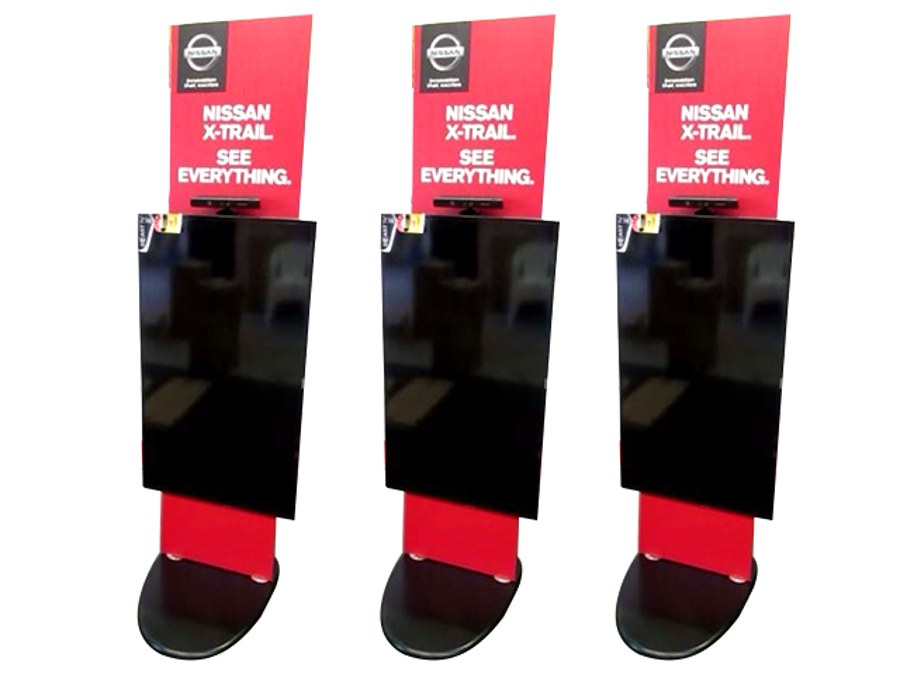
Our TV 2 Go exhibition TV stand comes with a universal TV mounting bracket. It holds LED TVs up to 55-inch or LCD TVs up to 43-inch, and the product page shows a TV mounted in portrait.
When a standard TV is fine
A commercial panel isn't always worth the cost. If the job needs neither touch nor long unbroken running hours, a standard TV usually costs much less. That typically means:
- a short indoor event, such as a two- or three-day trade show
- a hall or room away from windows and skylights
- staff on the stand to switch it on and off each day
- a looped video rather than a static image held for hours.
Even then, the warranty exclusion quoted above covers commercial use in general, not only signage. If you hire the TV, that warranty tells you to refer any claim to the rental or leasing company, so check what the hire terms cover.
We supply standard TVs to buy or hire, mounted to a display wall, on a TV stand or on their own. The most popular size is 43-inch, and other sizes are available. Lead time is around 1 week, and pricing is quoted to your requirements.
Buy, hire or bundle
- Hire suits a single show or a launch. Standard TVs, screens and kiosks are all available to hire.
- Buy for a permanent store installation, or when one screen is used at show after show. Our digital flat panels are non-touch screens for menu, welcome and information boards, in sizes from 12 inches up to stadium screens. They can be IP65-certified for outdoor use and run from an optional content management system. They are quoted to specification, with a typical lead time of around 7 weeks once it is agreed. They are rated for 24/7 use.
- Bundle the screen with its stand, branding and content. Supply your video, slide deck or web content, and we set it to play on a loop or a schedule and check it works before dispatch. A TV 2 Go stand starts from $1,286 (excluding GST and freight) and lets you bring your own TV to each show.
Next step
Compare the options in our digital signage and LED displays range. Or tell us where the screen will go, its daily running hours and how bright the space is, and we'll recommend a standard TV or a commercial panel. Call 1300 240 250.