

YOUR CART IS CURRENTLY EMPTY
Digital signage for displays: screen size, brightness and players
Published
Quick answer
Size a digital signage screen from the farthest person who needs to read it, and set brightness by the light around it. Indoor commercial screens run at about 500 to 700 nits, while screens that face out through a shop window are made at 2,500 to 4,000 nits. Use a commercial panel rated for long hours, not a domestic TV. Choose the player by how often content changes: a looped file for one event, or a content management system (CMS) for scheduled updates across sites.
Screen size by viewing distance
Screen size should come from the viewing distance and the smallest text on screen, not from what fits the wall. The AV industry standard for this is AVIXA's Display Image Size for 2D Content (DISCAS). It uses a viewing ratio: the farthest viewer's distance divided by the image height. The further back your audience stands, the larger the smallest text must be as a share of the image height.
The standard's Basic Decision Making table sets the smallest text at no less than 2% of image height when the viewing ratio is between 3 and 4, and 4% when it is between 7 and 8. Applied to common 16:9 screens mounted horizontally:
| Screen (16:9, horizontal) | Image height (approx.) | Farthest viewer up to 4 times image height | Smallest text | Farthest viewer up to 8 times image height | Smallest text |
|---|---|---|---|---|---|
| 43" | 535mm | 2.1m | 11mm | 4.2m | 22mm |
| 55" | 685mm | 2.7m | 14mm | 5.4m | 28mm |
| 65" | 809mm | 3.2m | 17mm | 6.4m | 33mm |
| 75" | 934mm | 3.7m | 19mm | 7.4m | 38mm |
| 86" | 1,071mm | 4.2m | 22mm | 8.5m | 43mm |
Image heights are calculated from the diagonal. Distances are rounded down and text heights rounded up, so the table stays on the safe side. Check the spec sheet for the exact active area.
- Write for the back of the crowd. If people must read an offer from 5.4m away, a 55" screen needs text at least 28mm high. If it won't fit, cut copy, not type size.
- Turn the screen vertical to gain height. A 55" screen in portrait has an image height of about 1,218mm, nearly 80% more than the same screen mounted horizontally.
- Check fixed installs properly. AVIXA publishes a free DISCAS calculator for permanent store or foyer screens.
Brightness: nits for indoor, window and outdoor screens
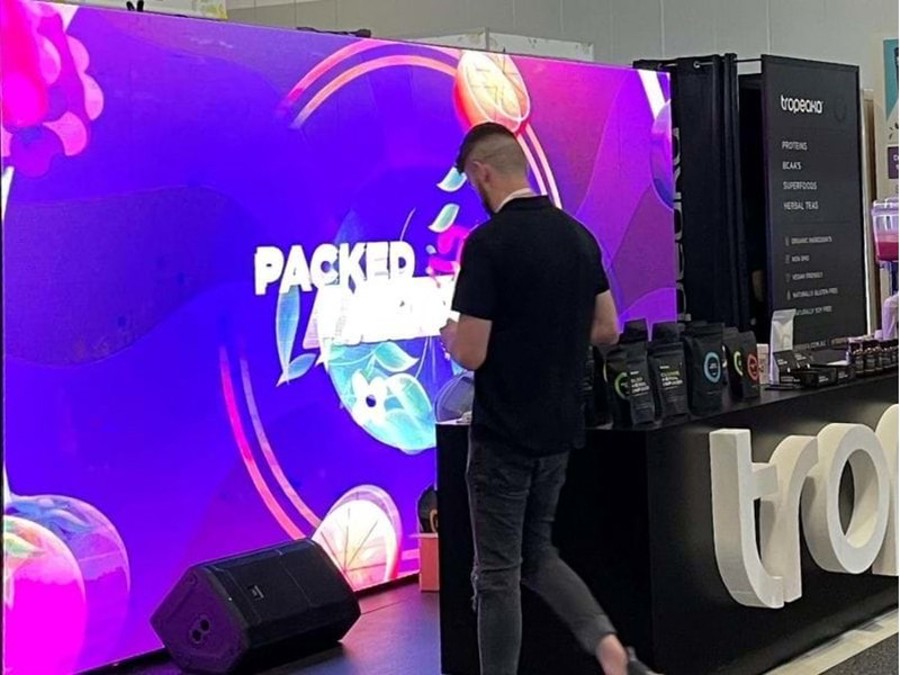
Brightness is measured in candelas per square metre (cd/m²), usually called nits. What counts is the light the screen competes with, so in a sunny atrium or a window, choose brightness before size. Current commercial spec sheets show:
| Where the screen sits | Brightness on current commercial spec sheets |
|---|---|
| Indoor, away from windows | 500 nits on a standard commercial signage panel |
| Bright mall concourse, atrium or exhibition hall | 700 nits or more ("high bright") |
| Inside a shop window, facing the street | 2,500 to 4,000 nits |
| Outdoors in direct sun | More than 3,000 nits, plus a dust and water rating |
Window screens also run hot. One window-display spec sheet lists an operating range of 0 to 30°C in direct sunlight, against 0 to 40°C out of it, so plan airflow in a sunny window bay. Look for an ambient light sensor, which adjusts brightness through the day.
Commercial vs domestic screens
A domestic TV is built for a few hours of viewing a night. Our guide to commercial vs domestic screens covers the detail.
- Operating hours. Commercial signage panels are commonly rated for 24/7 operation and use heavy-duty parts, often with burn-in protection and extra cooling. A home TV may be on for 2 to 4 hours a day.
- Warranty. Commercial signage often carries a multi-year warranty for commercial use; one window-display datasheet lists 3 years on parts, labour and backlight. Before you put a domestic TV on a shop floor, read its warranty terms for commercial or all-day use.
- Locked controls. Commercial panels can lock the buttons and remote, so the public can't change the settings.
Media players: looped files, built-in players or a CMS
| Option | How it works | Best for |
|---|---|---|
| Looped file | A video or slide file plays on repeat, with no one needed to restart it | One event, one message, such as an existing TV commercial or product reel |
| Built-in player, USB or PC | A player built into the panel, or a USB stick or PC connection, runs the content | A store screen with weekly changes |
| Content management system (CMS) | Content is uploaded online and pushed to screens on a schedule | Several screens or sites, offers that change by time of day, or remote updates |
Before a screen leaves us, we load your content (video, a slideshow of images or a live web page), set when each item plays, and test it. If you already have a brand film or TV commercial, we can run videos on a loop on the screens in our digital range. With a CMS, messages can switch by time of day, weekday or store location. Your own team can run it, or your agency, or our technical team.
For LED screens, resolution is set by pixel pitch: the gap between pixels in millimetres. The smaller the gap, the sharper the image up close. Our digital banners use P2.5 (2.5mm) as standard, and a finer P1.9 option is available.
Mounting: floor stands, counters, walls and overhead
Where the screen sits drives the format. These are the main options in our range, with figures from the current product pages:
| Format | Mounting | Key facts |
|---|---|---|
| TV 2 Go stand | Free-standing frame for your own TV | Takes up to 55" LED or 43" LCD TVs; whole system weighs 25kg and packs into a wheeled hard case; case can be wrapped as a sales counter |
| Digital banner stand | Free-standing, hung on cables or wall-mounted | 570mm wide × 1.9m high × 35mm thick; vertical or horizontal; several can be grouped into a wall |
| Digital flat panels | To suit the site, such as menu, welcome or information boards | Non-touch screens from 12" up to stadium sizes; rated for 24/7 use; can be certified for outdoor use (IP65) |
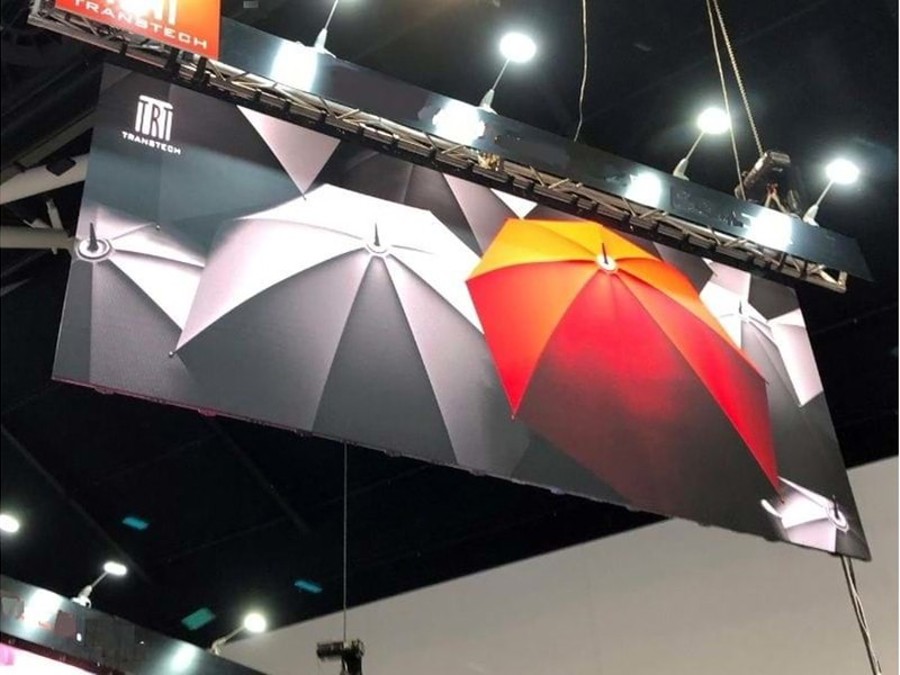
| Overhead digital screens | Hung above the stand | Circular, double-sided, 3m diameter; suits stands from 3m × 3m to 3m × 6m |
| LED walls | Built to size for the site | Built to size from 500mm × 500mm modules weighing 9 to 12kg each |
Position matters as much as size. A screen at the entrance stops passing traffic, one beside the product shows it in use, and one above the counter reaches people already queuing. We can print the surround or stand to match the campaign.
We can arrange installation of overhead and wall-mounted screens and larger LED walls. Portable free-standing screens are made for your own team to set up. Book hanging points, power and network through the venue, and check its exhibitor manual for rigging rules.
What drives digital signage cost
Cost depends on screen technology (LCD or LED, and pixel pitch), brightness, size and number of screens, content management, installation, and hire or buy. Prices shown on our product pages (excluding GST):
| Product | Price shown | Lead time shown |
|---|---|---|
| TV 2 Go (stand, TV bracket, fabric covers and wheeled case; TV not included) | From $1,286 | In stock |
| Digital banner, P2.5 | Most around $10,000 per unit, including processor | About 7 weeks |
| Overhead digital screen hire | From $9,560 for up to 5 days, including CMS access; content, hanging, power and Wi-Fi not included | 7 weeks |
| Digital flat panels | Quoted to your specification | About 7 weeks |
| LED walls | Quoted to your specification | About 3 weeks for most custom items |
Lead times run from order and agreed specification or artwork. Allow extra time for freight. A digital banner costs more to buy than a printed pull-up banner. If your team reprints banners for every campaign, the saving on print can cover that gap in about two years.
Digital signage in Australia: buy or hire
Hire suits a launch, trade show or short centre activation. Buy for a permanent store fit-out or a screen that tours many events. If you already own suitable TVs, a TV 2 Go stand lets you take them on the road instead of hiring screens at each venue. We deliver Australia-wide. All our screens can be hired, so ask us about availability for your dates.
Next step
Browse our digital signage displays for retail and events. Or send us the floor plan, the farthest viewing distance, the lighting (indoor, window or outdoor) and how often the content will change, and we'll spec the screen, player and mounting. Call 1300 240 250.