

YOUR CART IS CURRENTLY EMPTY
Retail display trends for 2027 in Australian stores
Published
Quick answer
Four retail display trends stand out for Australian stores heading into 2027: modular fixtures that can be reconfigured between campaigns, reusable and recycled display materials, screens placed where shoppers decide, and experiential zones that give people a reason to visit. Current Australian research shows most retail still happens in store but shoppers are watching their spending, so the smart move is to pilot one change in one store, measure it, then roll it out.
What the 2026 research says about Australian stores
Two current Australian reports set the scene for 2027 planning.
| Source | Finding |
|---|---|
| Deloitte Access Economics, Retail Forecasts (August 2026) | Online spending was around 24% of Australian retail sales in 2025, so most retail still happens in person. Growth in real retail turnover is forecast to slow from 2.8% in 2025-26 to 1.5% in 2026-27. |
| Australian Retail Outlook 2026 (Inside Retail with KPMG Australia), survey of 750 Australians | 80.2% shopped both online and in-store in the past three months. 47.1% rate an improved in-store experience as an important advancement for 2026, and 34.3% say a poor in-store experience stops them enjoying their ideal shopping experience. |
Put together: the store still carries most of the sales, shoppers expect it to work harder, and budgets are tight. That favours displays that can be reused, measured and moved.
Modular, reconfigurable fixtures
The Australian Retail Outlook notes that leading retailers are putting capital into high-productivity sites and experiential flagships, and that "each square metre now serves multiple purposes": online discovery, click and collect and brand engagement, as well as sales. A fixed fixture built for one campaign can't keep up with that.
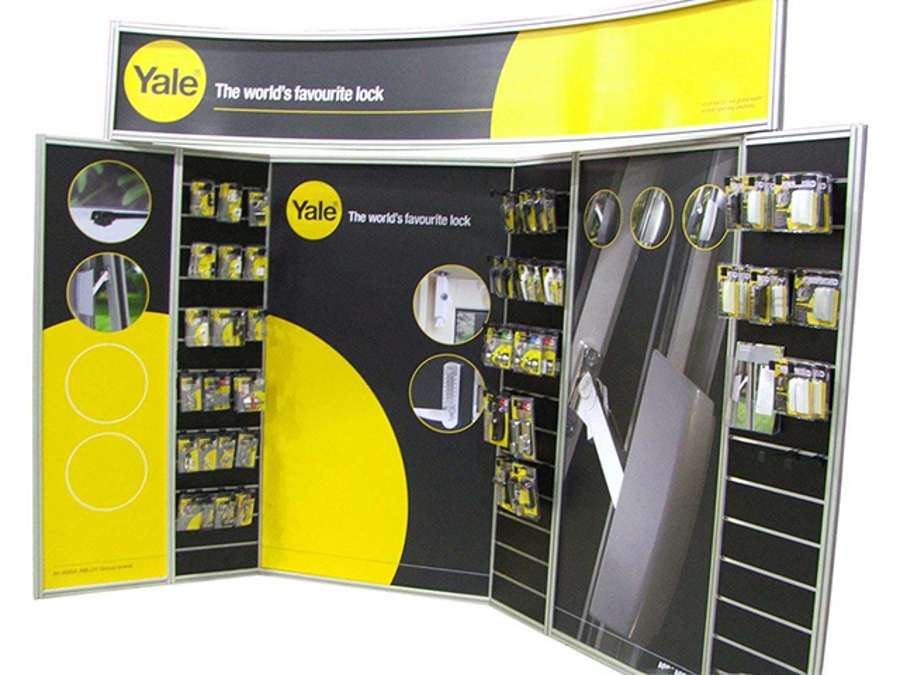
Modular systems can. A frame that takes interchangeable panels, shelves and hooks lets a store team change a bay from a seasonal launch to a promotion without a refit. When you brief a modular fixture, check three things:
- Reconfiguration. Can the same frame stand in a straight line, an L or a plus shape?
- Graphic changeover. Can the store team swap graphics without tools or a contractor?
- Transport. Does it break down small enough to move between stores or into storage?
Our portable slat wall is one example. It replaces heavy MDF slat board with an aluminium frame and slats, comes apart for transport, stands on its own in L or plus shapes, and takes graphics in built-in slots. The retail kits use sections 1,000mm wide by 1,500mm high. The compact retail kit without graphics starts from $653 excluding GST and freight, and production takes 1.5 weeks from order and print-ready artwork.
Recycled and reusable display materials
Sustainability is on most briefs, but the research gives a more measured picture. In the Australian Retail Outlook survey, 48% of respondents said they are likely or very likely to support retailers that pursue sustainability initiatives. Yet 39% said they will prioritise cost over sustainability as prices rise, and the report describes sustainability as a "niche" driver of which retailers people support.
For display buyers, that points to reuse that also saves money, rather than one-off "green" campaigns. Practical steps:
- Keep the hardware, change the print. Frames that take new graphics cost less per campaign and send less to landfill.
- Buy refurbished where it makes sense. Our recycled banner stands use returned hardware that our technicians check, refurbish and fit with a new printed banner. They start from $154 excluding GST and freight (850mm wide by 1.5m high, the shopping centre size, with print and carry bag), and the non-graphic parts carry a 12-month warranty.
- Plan the end of life. Ask how each fixture will be stored, reused or broken down into separate materials when the campaign ends.
Be careful with the claim itself. The ACCC says environmental claims must be "truthful and accurate", and it recommends businesses avoid broad terms such as "green", "eco friendly" and "sustainable". If a display is partly recycled, say which part.
Digital screens at the decision point
Shoppers are warming to in-store screens. In the Australian Retail Outlook survey, the share likely to try interactive digital screens in the next two years rose from 39% to 42.9%. Asked what would encourage them to use retail technology, 78.6% chose cost savings or discounts, well ahead of convenience at 48.3%.
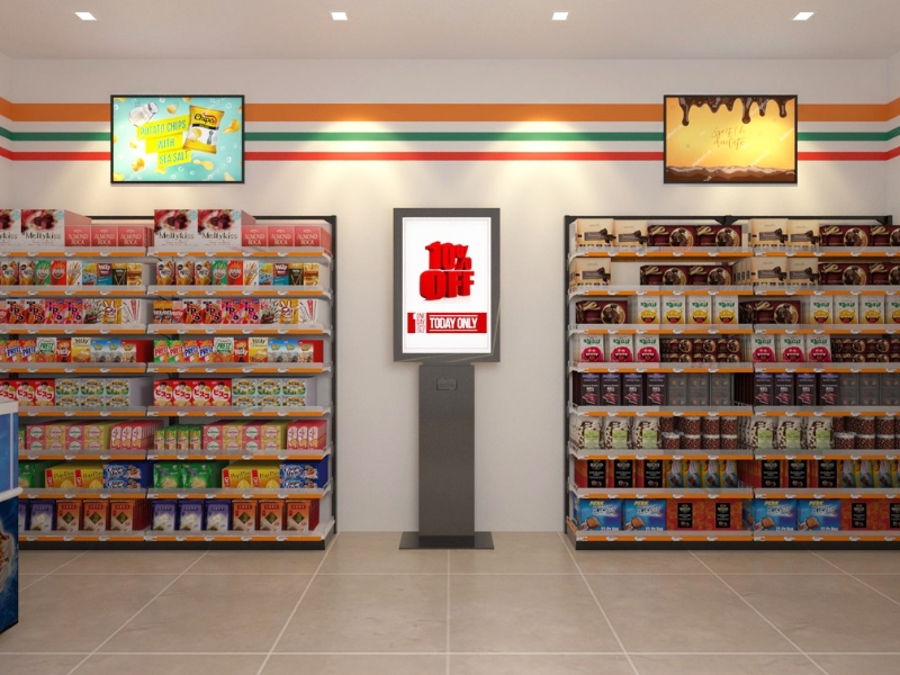
So the screen that works is one that helps people decide or shows them a deal, not one that plays a brand video to nobody. Our digital signage guidance singles out three placements:
| Placement | What the screen does |
|---|---|
| Store entrance | Motion catches shoppers passing the shopfront |
| Decision point, beside the product | Shows the product in use, or compares models and specifications |
| Above the counter | Reaches people already in the queue with offers and service information |
Touch panels suit product finders and catalogues. Overhead screens keep a message visible when the floor is busy. Content can be video, a slideshow of images or a live web page, run on a set schedule. Screens can be hired short term or bought for a permanent install, so a one-store trial doesn't need a capital purchase.
Experiential zones in store
Shoppers say the in-store experience matters, and they tell you where it falls down. In the Australian Retail Outlook survey, 24.4% named a lack of in-store assistance or expertise as a challenge, and 49.2% named a lack of product availability. Jeremy Taylor, chief marketing officer at fragrance brand Dusk, said in the report: "Retail stores, pop-up activations and immersive experiences will be key for brands in creating emotional connections and memorable moments."
An experiential zone doesn't need to be a theme park. It needs a reason to stop and something to do:
- A demonstration or trial point, where staff or a brand ambassador can show the product working.
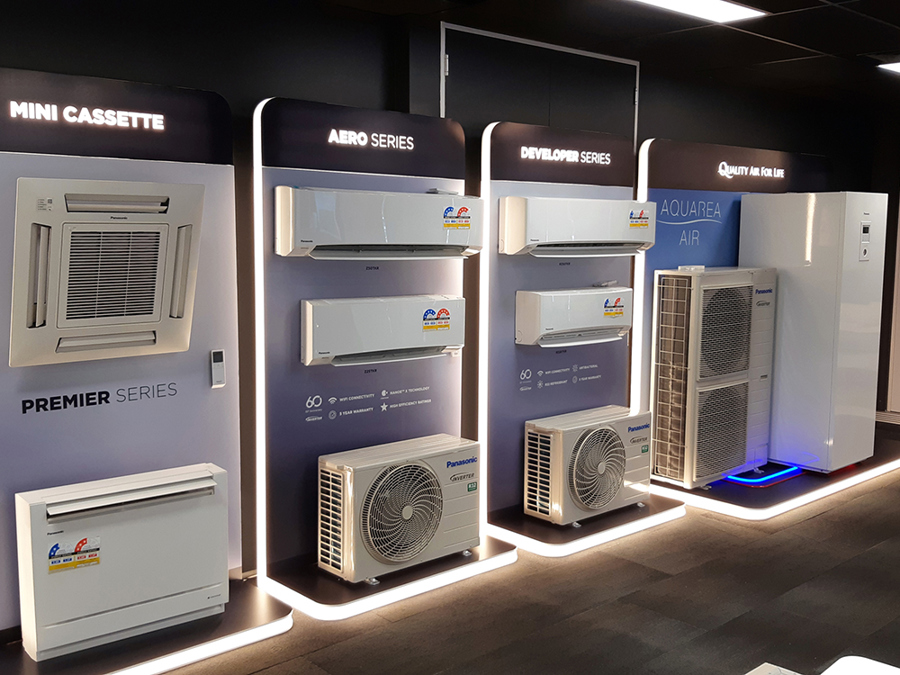
- A hero display that groups a range on lit bases or a feature wall, so it reads as a set.
- A short-term pop-up inside the store or in the centre, which brings the sense of "here for a limited time" that the original pop-up shops relied on.
Shopping centre pop-ups have their own rules. Shopping centre owners set their own display height limits. Our shopping centre pop-up displays are 1.4 to 1.5 metres high, depending on where they'll be used, double-sided to catch traffic from more than one direction, and 0.8 to 6 metres wide. Many Westfield centres no longer allow pull-up banners at all. Check the centre's own requirements before you book space.
What to pilot first
With turnover growth forecast to slow, it pays to prove a change in one store before you roll it out. A simple order:
| Pilot | Run it in | Measure |
|---|---|---|
| One screen at a decision point | One high-traffic store for one full campaign | Sales of the featured range against a similar store without the screen |
| One modular bay | A store with frequent campaign changes | Time and cost of each changeover |
| Reused hardware with new print | Your next seasonal campaign | Cost per campaign, and what goes to landfill |
| One experiential zone | A flagship or centre pop-up | Dwell time, trials or demonstrations, and sales during the activation |
Agree the measure before you start, and keep a comparison store. A trend is only worth rolling out if the numbers move.
For more on getting the basics right first, see our guide to enhancing retail displays.
Next step
Browse our retail displays, or read how we work on retail display solutions. Then ask us to prototype a trend in one store first: call 1300 240 250 or send a brief through the enquiry form.