

YOUR CART IS CURRENTLY EMPTY
Government and council stands for expos and consultations
Published
Quick answer
For most council and agency events, start with portable display boards that one person can carry, set up without tools and re-pin for each session. Add a tablet stand or interactive kiosk if you want feedback on the spot, and keep every panel readable and reachable for all visitors. If you only run a few sessions a year, hire the boards rather than buy them.
What works for government and council stands
Community engagement teams ask a lot of one kit. The same displays might go to a regional town hall on Tuesday, a shopping centre pop-up on Saturday and a state expo next month, carrying plans and maps that change between sessions.
That points to four needs:
- Portable: fits in a car boot and goes up without an installer.
- Changeable: new maps and notices go on in minutes, with no reprinting of the whole stand.
- Accessible: everyone in the community can read the material and reach the feedback point.
- Measurable: you leave with comments and survey responses you can report on.
Our government and council displays cover branded signage, portable displays, interactive kiosks and exhibition stands, backed by graphic and 3D design, printing and production, project management, logistics and storage.
Portable display boards: what they are and how they work
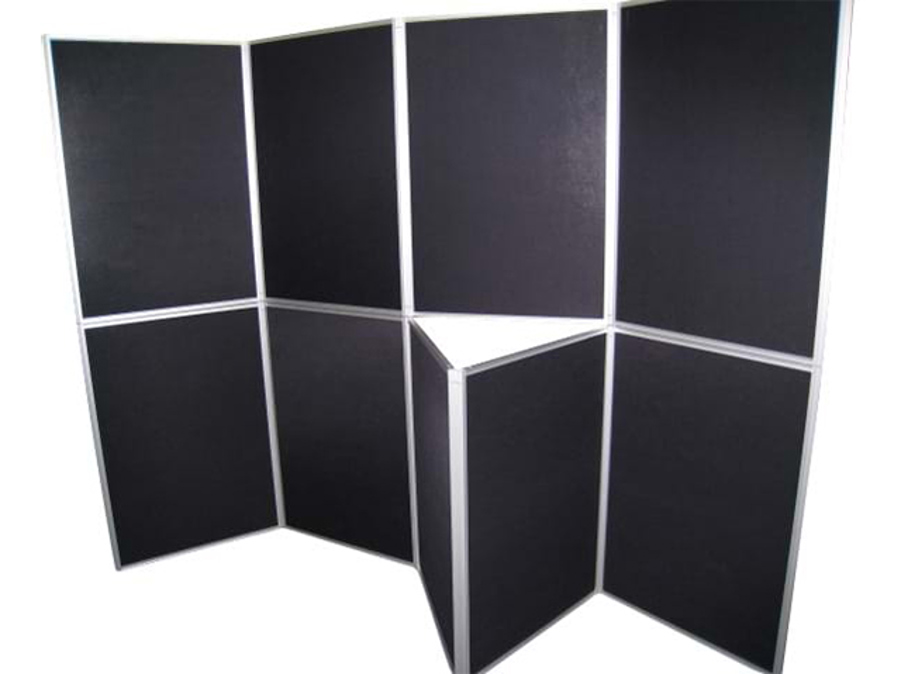
Our portable display panels (the Cario system) are double-sided, Velcro-compatible fabric boards on an aluminium frame. Each panel is supplied on its own and clips to its neighbours on poles, joining either vertically or horizontally, so one set can form a straight wall at a library and a zig-zag at an expo. Assembly takes minutes and needs no tools.
The fabric takes VELCRO® fasteners and pins, and the frame will hold picture hooks. Maps, posters, signs, brochure holders and product samples can go up and come down at every session, and the polyester covering is made to handle years of regular handling.
| Detail | Cario portable display panels |
|---|---|
| Standard panel | 750mm wide x 1100mm high, 2.7kg |
| Kits | 2, 4, 6 or 8 panels |
| 8-panel kit (straight wall) | 3m wide x 2.2m high |
| 6-panel kit | 2.25m wide x 2.2m high |
| 4-panel kit | 1.5m wide x 2.2m high |
| Carry bag | Holds up to 4 panels |
| Standard fabric | Black, with other colours and custom sizes on request |
| Production lead time | 1.5 weeks from order and print-ready artwork |
| Warranty | 2 years on non-graphic components |
| Price | From $637, excluding GST and freight |
A few practical points:
- Feet: angled runs such as a zig-zag are self-supporting. Straight walls and single "notice board" panels need the optional support feet.
- Weight: the eight panels in an 8-panel kit weigh about 21.6kg in total (8 x 2.7kg, before poles, feet and bags) and split across two carry bags, so one officer can move the kit.
- Lighting: an optional LED light kit (listed at $195 a pair, excluding GST) helps in dim halls and libraries.
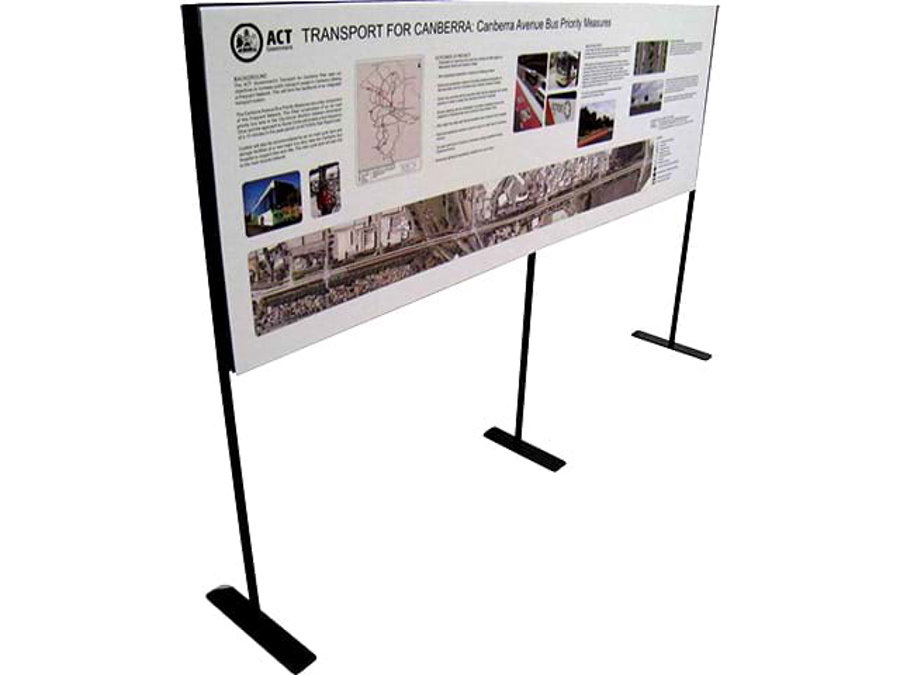
- Branding: panels can carry permanent laminated graphics on either face, or rigid printed boards that mount on the panels and may overhang them.
- Indoors: the panels are built for indoor use. They are light for their size, so take great care with them outdoors.
- Room dividers: a run of panels can also split a large hall into smaller spaces.
Display boards for schools, libraries and foyers
Between events, the same boards work indoors. Schools use them for student artwork, and councils use them for public submissions and notices in foyers, libraries and reception areas.
Expo stands for agencies and councils
At a careers expo, home show or field day, a council or agency stand competes with every commercial exhibitor in the hall, and a plain fabric wall with a few posters reads as a noticeboard. Options that lift it:
- Print the back wall. Graphic boards on the panels give you a branded backdrop while keeping the panels free for changeable material.
- Lead with one message. Put the program name and one clear question at eye height, such as "Have your say on the new library". Keep the detail on handouts and a QR code.
- Plan the layout. A U-shape or zig-zag of panels makes a semi-enclosed space where people stop to read. Leave room for prams and wheelchairs to enter and turn.
- Scale up for the big shows. At a major convention centre event, a custom exhibition stand may suit better, and the portable kit becomes your regional touring stand.
Running a consultation or community engagement session
Consultation displays have a different job from expo stands: people need time to read, compare options and leave a comment.
- One topic per panel. Lay out the panels in the order you want people to walk: the issue, the options, the map, then the feedback point.
- Print what's fixed, pin what changes. A printed project overview can last the whole program. Draft plans change between sessions, and pinned or VELCRO®-fixed prints are cheaper to replace than a full printed wall.
- Create a quiet corner. In a large hall, a run of panels or a Screenflex room divider can screen off a space for one-on-one conversations. Screenflex dividers have acoustic, pinnable panels, lock in place on castors and arrive fully assembled. They are sold outright, not hired for single events.
Accessible displays everyone can read and reach
Public information has to work for the whole community. The Australian Government Style Manual states that "Accessibility is a mandatory standard for government agencies", and that failing to provide equal access to government services and information "can be a failure of obligation under the Disability Discrimination Act 1992". Apply the same thinking to your printed panels.
- Plain language. The Style Manual says about 44% of Australian adults read at literacy level 1 to 2, and that writing to an Australian year 7 level "makes content usable for most people". Short headings and short sentences on panels help everyone.
- Contrast. WCAG, which the Style Manual sets as the baseline for Australian Government content, asks at level AA for a contrast ratio of at least 4.5:1 for normal text and 3:1 for large text. It is written for screens, but it is a sensible check for printed panels as well. Avoid text over busy photos.
- Text size and height. Keep the key message large and readable from standing or seated. Put detail lower down, where people stand close.
- Reach and circulation. Keep feedback cards, pens and screens within easy reach of someone seated, and leave clear floor space around the stand. Check reach ranges and circulation space with your access adviser or the venue before the event.
- Offer another way in. Give people a printed copy, a phone number or a staff member to talk to as well as a QR code or screen.
Digital feedback: tablets, kiosks and QR codes
Digital tools turn conversations into data you can report on.
| Option | Suits | Notes from our product pages |
|---|---|---|
| QR code on a panel | Every session | Links to your online survey. Offer a printed alternative too. |
| Tablet stands for feedback | Staffed stands and pop-ups | Built to your requirements, from $327 excluding GST and freight. The floor stand frame sits at 1200mm, the mount rotates to either orientation and the tablet locks in place. Table-top versions are also available. |
| Interactive digital kiosk | Libraries, civic centres, larger expos | 55 or 65 inch floor-standing touchscreen running Windows, with on-screen data capture. Available to buy or hire by the day. Quoted to your specification: our most popular style (55 inch, i5 processor, 8GB RAM) is in the vicinity of $9,500 ex GST, with a lead time of around 7 weeks. |
Names, email addresses and photos of people can all be personal information (the OAIC lists photographs among its examples), so plan how you will tell people what you are collecting and why. For Australian Government agencies, the OAIC's guidance on Australian Privacy Principle 5 says reasonable steps to notify people must be taken "at or before the time of collection, or as soon as practicable afterwards". The OAIC also notes that the Privacy Act "does not cover local, state or territory government agencies", that most states and territories have their own privacy laws for their public sector, and that some state authorities are still bound by the Privacy Act. Councils and state agencies should ask their privacy officer which law applies and what their notice must say. A short collection notice on the screen or beside the QR code is a sensible start.
Hire or buy for occasional use
If your team runs only a handful of sessions a year, display board hire avoids storing a kit between events. Hire kits run from 2 to 8 panels and come with poles, joiners, feet for straight runs and carry bags. Send us your poster or exhibitor numbers and the floor space, and we will plan the panel count and layout and quote the hire and printing as one job. Kits go out to many events, so book well ahead of the busy conference season.
Buy when the boards are out most months, several teams share them, or you want permanent branded graphics.
Storage and reuse between sessions
- Pack panels into their carry bags, four to a bag, and keep the poles, clips and feet in a labelled tub.
- Keep VELCRO® fasteners, pins and hooks with the kit.
- Store printed graphic boards flat and covered, separate from the fabric panels.
- Photograph each layout so the next team can repeat it in minutes.
Next step
Tell us about your next expo or consultation (dates, venue, number of sessions and what you need to show) through any product page or on 1300 240 250, and we will recommend a kit to hire or buy.