

YOUR CART IS CURRENTLY EMPTY
Gondola end sizes: measuring for supermarket POS displays
Published
Quick answer
There's no single standard gondola end size. Stores differ, so the only size you can safely design to is one you've measured yourself or one the retailer has given you in writing. What the grocers do publish is a set of limits for displays: Woolworths caps a front gondola end display at 2,000mm high, 1,500mm wide and 1,200mm deep, and Coles publishes the dimensions of its standard off-location unit. Measure the end, then design to the smaller of your measurement and the retailer's limit.
Where the published limits come from
The retailer limits in this article come from the display guidelines Woolworths and Coles give their suppliers. They give limits for displays, not the dimensions of the fixtures themselves. Check the current version with your buyer or category manager before you design. For the full approval process, see our guide to getting POS displays approved by Australian supermarkets.
The parts of a gondola end
A gondola is a run of shelving bays down an aisle, often shelved on both sides. The end is the short face at the end of the run, facing the main walkway, which is why it's prized space for promotions. When you measure one, these are the parts you'll be dealing with:
- Base deck. The lowest shelf, sitting just above the floor and can be deeper than the shelves above it.
- Shelves. Adjustable shelves fixed to the uprights. The gap between them is the shelf pitch.
- Shelf edge strip. The strip along the front of each shelf that holds the price tickets.
- Header. The panel or signage above the top shelf. At Woolworths, front gondola end displays sit under the store's own pre-planned messaging, so the space above your unit is not yours to fill.
- Fins and wobblers. Small signs that stick out from the shelf edge. At Woolworths, wobblers, fins and decals are handled by a separate Woolworths team, not through display approval.
Typical shelving sizes: a reference point, not a standard
Off-the-shelf gondola shelving sold in Australia gives a useful sense of scale. Two suppliers' published specifications list 900mm wide bays, heights of 1,500, 1,800 or 2,100mm, a 450mm base shelf plus 70mm for the upright post, and shelves that move in 50mm steps.
A supermarket's own fixtures may not match those figures, so use them to sanity-check your measurements, not as a size to design to.
What to measure in store
Take a tape measure, a notebook and a phone. Measure the actual end where the display will go, and if the campaign runs across many stores, measure at least one large and one small store.
- Width of the end. Measure across the face of the end from the outside of one upright to the outside of the other. Then measure the clear width between the uprights, which is what shelf-mounted items have to fit inside.
- Depth in front of the end. Measure from the face of the end to the edge of the walkway, and note anything that limits it: a column, a freezer, a checkout lane. A floor-standing display has to fit in this space and still leave room for trolleys to pass. Woolworths' maximum depth for a front gondola end display is 1,200mm.
- Base deck height and depth. Measure the height of the base deck off the floor and how far it projects. A display that sits in front of the end has to clear it or sit on it, and a unit placed on the base deck loses that height from the top.
- Shelf pitch and shelf depth. Count the shelves, measure the gap between each one and the depth of each shelf. Shelves adjust, so record the setting on the day and ask the store whether it changes for your promotion.
- Overall height and what's above. Measure from the floor to the top of the gondola, then look up. Note the retailer's signage above the end, lights, ceiling-hung signs and sprinkler heads. Your display has to fit under all of them as well as under the retailer's limit, which at Woolworths is 2,000mm for a front gondola end.
- Shelf edge strips and price tickets. Measure the depth of the shelf edge strip and note where the tickets sit. Anything you fix to a shelf must not cover them. For Coles, every shelf of an off-location unit needs a strip for the shelf label, at least 105mm long and 39mm high on the left-hand side, or across the whole shelf if it holds more than one product. Woolworths does not allow suppliers to put price points on display units.
- The floor. Note the floor finish and whether it's level. Stores are mopped every day, so Coles wants off-location units to stand on a plastic base or carry a clear water-resistant coating.
- Photograph everything. Take a straight-on photo of the end, a side view and close-ups of the base and shelf edge, with the tape measure in shot. Record the store, the aisle and the date. Photos answer the questions you didn't think to measure.
Published size limits for supermarket displays
| Display | Retailer | Maximum or standard size (H x W x D) |
|---|---|---|
| Front gondola end display | Woolworths | Up to 2,000 x 1,500 x 1,200mm |
| HBB low-profile gondola end | Woolworths | Up to 350 x 1,090 x 460mm |
| Shelf-ready tray | Woolworths | Up to 350 x 450 x 300mm |
| Easy Erect 4 Shelf off-location unit (standard unit, not a gondola end limit) | Coles | 1,650 x 445 x 430mm (1,350mm body plus 300mm header) |
How the published rules shape the design
Woolworths front gondola ends must use a "waterfall" design, with shelves stepping up towards the back. Woolworths doesn't allow box bins here, since a solid box stops shoppers seeing across the store. The unit should be fully supplier-branded unless it's tied to a Woolworths event, and it stays within 2,000mm high, 1,500mm wide and 1,200mm deep.
Woolworths HBB low-profile gondola ends are much smaller: a maximum of 350mm high, 1,090mm wide and 460mm deep, checked against the planogram space. Shelf-ready trays are capped at 350mm high, 450mm wide and 300mm deep, and Woolworths' commercial team checks that trays fit the planogram space too.
Coles has standardised its off-location displays, so suppliers choose from approved units. Its Easy Erect 4 Shelf is 1,650mm high overall (a 1,350mm body plus a 300mm header), 445mm wide and 430mm deep. If your product won't fit those dimensions, Coles' operations merchandise support team has to approve the larger unit.
Two other limits from these guides are worth designing in from the start. At Woolworths, any value or savings message on a display must apply to every line in it. At Coles, an Easy Erect 4 Shelf is rated to 16kg a shelf and takes one product line per shelf.
From measurements to a display
Your measurements set the box the display has to fit inside. The grocer's rules set the shape. With both in hand, the design can start:
- Take the smaller of your measured space and the retailer's published limit for each dimension.
- Allow for the base deck, shelf edge strips and anything overhead.
- Draw the unit to fit inside that envelope, then render it for approval.
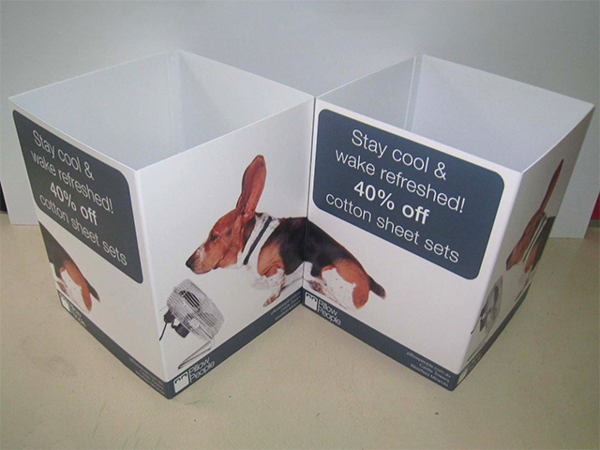
We can turn your measurements into renders and CAD drawings for you to submit for the grocer's approval. Once the structure is fixed, the artwork goes onto its flat template; our guide to reading a POS display dieline explains how. For a simple floor unit, our cardboard dump bins come in a standard 450mm square by 700mm high, and we can make custom sizes and shapes.
Next step
Have a look at our supermarket display work. When your measurements and photos are ready, tell us the grocer and the store count on our contact page or call 1300 240 250, and we'll design a unit that fits.