

YOUR CART IS CURRENTLY EMPTY
LED wall vs projection vs LCD video wall: which suits your event?
Published
Quick answer
Choose an LED video wall when the room is bright, the image has to be big and seamless, or the stage will be filmed. Choose projection when you can dim the lights, want a very large image, or need to project onto an unusual surface. Choose an LCD video wall, or one large flat screen, when people stand close and fine detail matters, and thin seams between panels are acceptable. Whichever you pick, check weight, power and rigging with the venue early.
How each option works
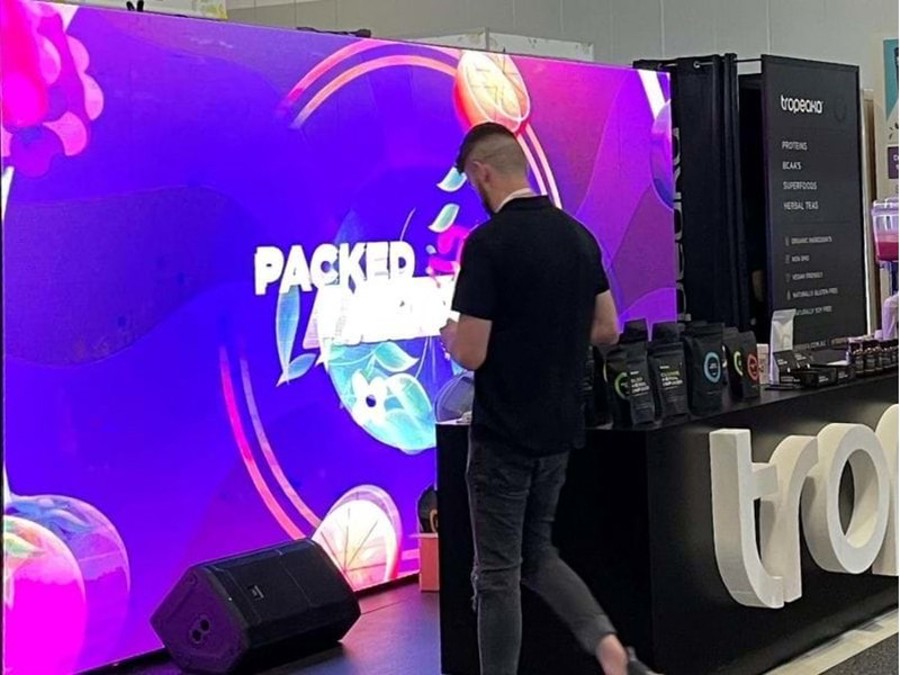
LED wall. An LED wall is built from modules tiled together. Ours are typically 500mm x 500mm modules, wired and programmed so the whole wall behaves as one seamless screen, built to the size the stand or stage needs. Every pixel is a tiny light source, so the wall makes its own light.
Projection. A projector throws an image onto a screen or surface. Front projection sits on the audience side of the screen, on a stand or on rigging. Rear projection sits behind the screen and needs clear space there. Either way the image is reflected light, so the room's own lighting competes with it.
LCD video wall. An LCD video wall tiles flat panels in a grid and drives them as one picture. Each panel has a frame around its edge, called the bezel, so the joins show as thin lines across the image. A single large flat screen has no seams, but its size is fixed.
Brightness and ambient light
Light in the room usually decides the format before anything else does. Exhibition halls and shopping centres are brightly lit, and many function rooms have windows.
- LED walls emit their own light, which is why they suit large stands and stages in lit halls. The image stays punchy without dimming the room.
- Projection needs a darkened room or a very bright projector. In a lit hall, blacks turn grey and colours wash out. It is at its best in a ballroom, theatre or plenary room where the house lights can come down.
- Flat panels depend on the panel. A standard indoor screen is fine where the lighting is low or controlled. Rooms with big windows or skylights call for a high-brightness screen. Our guide to how bright digital signage should be explains how to match brightness to the spot.
When comparing quotes, check whether a brightness figure is peak (the maximum a panel reaches briefly) or typical (what it holds in normal use). Setting one supplier's peak figure against another's typical figure gives a false comparison.
Size, seams and viewing distance
LED walls scale in modules. With 500mm modules, a 3m x 2m wall is 6 x 4 = 24 modules, and a bigger wall simply adds more. Sharpness depends on pixel pitch, the spacing between pixels. A tighter pitch gives a sharper image and lets people stand closer. A fine pitch costs more per square metre, so match it to the closest realistic viewing distance rather than buying the finest available. Our resolution and pixel pitch guide walks through it.
LCD video walls are sharp up close. Flat panels give fine detail at short range, which suits product detail, menus and small text. The trade-off is the bezel lines. Plan content around the grid so faces, logos and headlines don't sit across a join.
Projection can go very large, but gets dimmer as it grows. The same light spread over a bigger area is a dimmer image. Image size is also limited by the throw distance the room allows.
Set-up, rigging and space behind the screen
- LED wall. The modules need a structure: ground-stacked on a frame or flown from rigging. They are then wired, programmed and tested. We deliver and set up LED walls, load and test content before bump-in, and can manage content remotely afterwards.
- Projection. The path between projector and screen has to stay clear. Presenters and visitors who walk through a front-projected beam cast shadows, and rear projection needs depth behind the screen that a tight stand may not have. Alignment is done on site.
- LCD panels and single screens. Panels go on a mount, a stand or into a wall. A screen can be built into a display wall so the screen and the graphics around it look like one piece. For a single portable screen, our TV 2 Go stand takes up to a 55" LED TV or 43" LCD TV, weighs 25kg as a system and packs into a wheeled case. It is in stock, from $1,286 excluding GST and freight. That price covers the stand, mounting bracket, frame covers and case; you hire the TV from us or bring your own.
Venue limits: power, weight and rigging
Big screens are heavy, draw power and often hang from the roof, so the venue gets a say.
- Weight. A single LED module typically weighs 9 to 12kg. That 3m x 2m wall of 24 modules is 24 x 9 = 216kg to 24 x 12 = 288kg of modules alone, before the frame or rigging.
- Rigging. ICC Sydney's event safety guidelines say "all primary rigging for events is coordinated and installed by ICC Sydney" and "Detailed rigging plans are to be submitted to the ICC Sydney Event Manager no later than 21 days prior to move-in." The venue may ask for the "Weight, dimension, make, model and/or data sheet of items to be rigged." Perth Convention and Exhibition Centre's exhibitor manual says its in-house exclusive rigger "must be used to carry out all primary rigging to venue infrastructure".
- Power and cabling. Perth Convention and Exhibition Centre's manual says "All electrical and lighting requirements can be ordered through the official display contractor." ICC Sydney's guidelines say electrical contractors must ensure "all cabling is installed to prevent trips and falls and is tested and tagged as per relevant standards."
Every venue sets its own power and rigging rules. Send us the venue and show dates early and we'll check the requirements with the organiser.
What drives the cost
LED walls are built to the job, so we quote each one individually. These are the drivers to brief on:
- Size and pixel pitch for an LED wall: more modules and a finer pitch both add cost.
- Structure and rigging: ground-stacked frames, flown rigs and venue rigging charges.
- Days on site, including bump-in, rehearsal and bump-out.
- Content: footage made for the screen's shape and resolution, or adapted from existing artwork.
- Hire or buy. Most exhibitors hire screens for a show, and all our screens can be hired. Buying makes sense if the screen will be used again, and we can keep it in storage for you between shows.
For an LED wall, timing is confirmed once the requirements are set, and most custom items take around three weeks to produce. Our digital flat panels are rated for 24/7 use, which matters if a screen will run all day, every day.
Comparison table and quick decision guide
| Factor | LED wall | Projection | LCD video wall |
|---|---|---|---|
| Bright hall or daylight | Strong, makes its own light | Weak unless the room is dark | Depends on panel brightness |
| Seams | None, modules act as one screen | None | Thin bezel lines between panels |
| Size | Built to size from modules | Very large, but dimmer as it grows | Set by the panel grid |
| Close viewing | Needs a fine pixel pitch | Shadows if people cross the beam | Sharp at close range |
| Weight and rigging | Heavy: 9 to 12kg per module | Projector on a stand or rigging; space for the throw | Panels on mounts or a wall |
| On camera | Bright, seamless backdrop | Depends on room lighting | Seams visible in wide shots |
- Stage, launch or keynote in a lit room: LED wall.
- Plenary or gala with controlled lighting and a huge image: projection.
- Product detail viewed at arm's length: LCD panels or a single large screen.
- One screen on a shell scheme stand: one 55 inch screen, mounted on a stand and looping a product video. In our experience it's the most common exhibition setup, and the simplest to run.
Our event range covers LED walls and flat screens. If projection suits the room better, ask the venue or organiser about its AV services.
Can I hire an LED wall in Sydney?
Yes. We hire LED walls and screens, and we deliver and install them at the venue with your content loaded and tested before bump-in. We're based in Sydney and install Australia-wide, with venues such as ICC Sydney, MCEC and BCEC, then return to bump out after the show.
Next step
Compare our LED walls and digital signage for events pages. Then tell us the room, how far the audience will be from the screen, the lighting and the content, through the enquiry form or on 1300 240 250, and we'll recommend the screen.