

YOUR CART IS CURRENTLY EMPTY
Red carpet arrival moments for premieres, festivals and awards
Published
Quick answer
A red carpet arrival needs four things: a media wall wide enough for the biggest group you'll photograph, a carpet that leads guests to it, light on people's faces, and a clear spot for photographers that doesn't block the way in. Size the wall at about 600 to 700mm per person plus a margin each side, repeat the logos so every crop shows one whole, tape the carpet edges down, and plan the route so guests arrive, pose and move on without doubling back.
What makes an arrival moment work
The arrival is the one moment at a premiere or an awards night that is designed to be photographed. Every picture taken there, by press, by guests on their phones and by your own photographer, carries the event name and the sponsors behind it. That only works if the backdrop fills the frame, the people in front of it are lit, and guests know where to stand.
A good arrival has a simple order: guests step out, walk the carpet, stop at a marked spot in front of the wall, pose for the photographers opposite, and carry on into the venue. Most problems come from breaking that order: a wall that's too narrow, a carpet that ends in the wrong place, or a press line standing in the entrance.
Media wall size and logo repeat
Width. Work from the largest group you expect, not the usual pair. Our guide to media wall size for group photos suggests about 600 to 700mm of width for each adult standing shoulder to shoulder, plus a margin at each end so the branding still fills the frame.
For a cast of six, that's 6 x 0.7m = 4.2m of people. On a 6m wall, (6 - 4.2) / 2 = 0.9m is left on each side, which keeps the backdrop continuous even when the group shifts.
Height. Leave headroom above the tallest guest so the top of the branding isn't cropped. At their standard heights, our SuperWall, Big Mural and Brandframe walls are 2.25m to 2.35m tall.
Logo repeat. A step-and-repeat works when the pattern repeats often enough that any crop, from a tight head-and-shoulders shot to a wide group shot, shows at least one complete logo. The logos that matter most belong around head height: guests' legs hide the bottom of the wall and tight crops lose the ends.
Which wall. For a one-off premiere, our exhibition wall hire supplies printed SuperWalls from 2.4m up to 9m wide in one piece, and lists media walls and photo backdrops for launches and awards nights among its common uses. For a wall you'll bring back every year, a floor-standing Brandframe can be made in any size, is most often ordered 3m or 6m wide at 2,350mm high, and takes new silicone-edge graphics when the sponsors change. Sizes, frames and prices for each system are compared in our guide to choosing a media wall backdrop.
Carpet and flooring
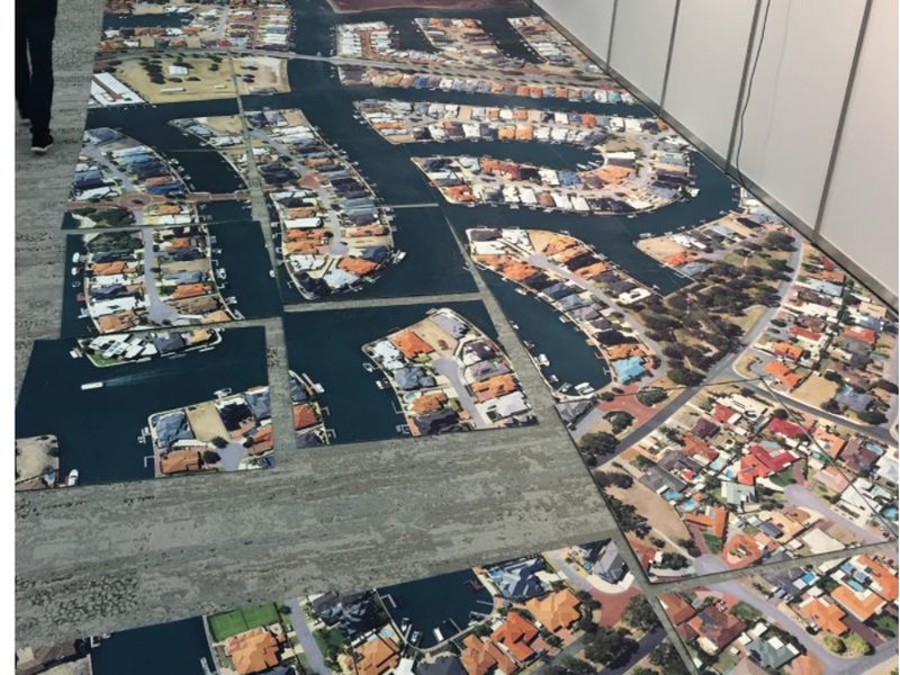
The carpet tells guests where to walk and frames the bottom of every full-length photo. It doesn't have to be plain red: printed carpet can be printed in a colour matched to your brand, or carry the event name where the carpet meets the wall.
What to know before you order:
- Size. Our printed carpet comes in rolls up to 1.55m wide and 4m long, 4mm thick. A longer run is made from more than one length: an 8m approach needs 8 / 4 = 2 lengths, so plan where the join falls and keep it away from the posing spot.
- Artwork. The textured surface prints at a lower resolution than smooth materials, so keep text at least 25mm high and avoid fine detail.
- Grip and fixing. A textured rubber backing stops it slipping, and it's made to be laid by your own team: unroll it, position it and fix it with the removable carpet tape we supply, which comes up without leaving residue.
- Wear. It's made for short runs. Our product page puts it at around 15 days of busy exhibition traffic before wear starts to show, which is plenty for a premiere.
- Price and time. From $340 per square metre (ex GST and freight). Production takes 1.5 weeks once you've ordered and supplied print-ready artwork, plus delivery.
Venues care about the edges, because a lifted edge is a trip hazard. ICC Sydney's Exhibition Manual (release date 15 December 2023) says "edges of thin decorative flooring such as carpet, vinyl, matting, wood or the like, are to be taped down or firmly secured." Ask your venue for its current rules.
Lighting for media and phones
The press aren't the only ones taking pictures. Guests photograph the arrival on their phones too, and a phone flash won't light a group in a dim foyer. Plan the light around the faces, not just the wall.
- Light the people from the front. Light falling on the posing spot from the camera side helps every camera, including phones.
- Avoid gloss. A glossy backdrop under flash bounces light straight back into the lens. Our SuperWall, Big Mural and Brandframe graphics are dye-sublimated: the ink goes into the polyester fabric, so there's no shiny coating to catch the flash.
- Lift the wall in a dark room. A Big Mural wall takes an optional LED light kit, $215 (ex GST) for the pair. A Brandframe Glow lights the graphic from inside the frame. If you light the wall from behind, still light the faces in front, or photos show a bright backdrop and dark people.
- Book power. Lit walls and photographers' lights need an outlet near the wall, so add it to the venue order.
Flow: arrival, photo, entry
Draw the route on the venue plan before anything is ordered.
- Arrival. Start the carpet where guests step out of the car or come through the door, so the walk itself is part of the moment.
- The posing spot. Mark it in front of the centre of the wall, with room behind the guests so they aren't pressed against the backdrop.
- The press line. Put photographers opposite the wall, far enough back to fit the group in frame, and behind a barrier so they stay put. Our café barriers come 1m or 2m wide, on steel frames with wide feet, printed on both sides, so the press side and the public side can each carry a message.
- Entry. The carpet should carry on past the wall to the door, so guests move on without walking back through the next arrival.
Keep the wall and the press line clear of emergency exits and fire equipment, and keep wall feet and cables away from where guests stand.
Festival and premiere examples from our work
A kids' TV festival arrival. For a children's television network's live festival, the arrivals media wall carried the festival logo in a tight repeat. It stood behind a red carpet, with space in front for camera crews and lighting. Because the logo repeats across the whole wall, the event name shows in every shot, whichever way guests turn.
A TV talent show in a shopping centre atrium. For a live show staged in an atrium, a giant stage backdrop carried lettering big enough for shoppers on every balcony level to read. Banners on stands and signs along the balcony rails carried the branding around the space. It's a reminder that at a public premiere, the crowd around the carpet is part of the picture, so brand what they'll see from every level.
Awards nights. In a ballroom, check the ceiling height, chandeliers and fire rules before choosing a tall wall. Venues can ask for proof that a backdrop is fire retardant: ICC Sydney's Exhibition Manual (release date 15 December 2023) cites the AS/NZS 1530.3:1999 test methods for backdrops, signs and banners and says the venue may ask for documents to confirm it. We work with you to supply fire-test certificates for our SuperWall, Big Mural and Brandframe fabrics: ask for them when you order.
Arrival moment checklist
- Largest group size and the wall width it needs (about 600 to 700mm per person plus a margin each side)
- Wall height with headroom above the tallest guest
- Logo repeat tested at close and wide crops
- Carpet length, joins away from the posing spot, edges taped
- Text on the carpet at least 25mm high
- Light on the posing spot, not just the wall
- Power booked for lit walls and photographers
- Press line behind barriers, opposite the wall
- Route from car or door, to wall, to entry, with no doubling back
- Venue's current rules on fire rating, flooring and exits
Next step
Send us your event date, venue, the largest group you'll photograph and the length of the arrival route through the enquiry form, or call 1300 240 250, and we'll put together a wall and carpet that suit the moment. If you'd rather we set up the hire wall at the venue, ask when you book.