

YOUR CART IS CURRENTLY EMPTY
How to choose branded barriers for queues and crowds
A queue at a launch or activation is a good problem to have, but it still needs a line around it. Branded barriers do two jobs at once: they show people where to stand and where not to walk, and they carry your message to everyone waiting and everyone walking past.
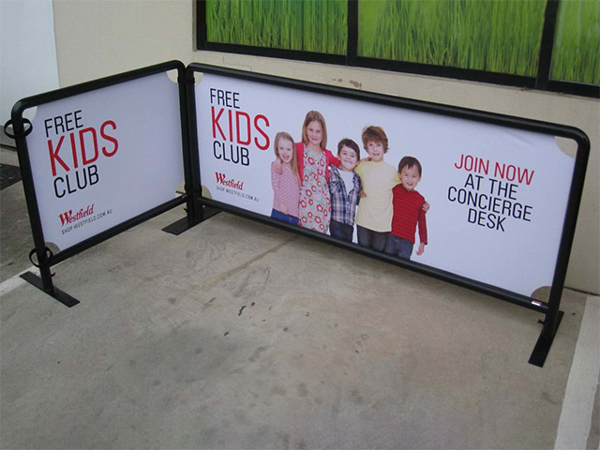
Our café and event barriers are steel frames with wide feet and a printed panel on both sides, in 1m and 2m widths. This page covers how they compare with the other common queue barriers, what venues expect from you, how many to order, and how to plan the artwork, the weather and the lead time.
The three common types of queue barrier
Printed steel panel barriers. A rigid frame with a printed banner across it. This is the type we supply. Because the whole panel is printed, it's the most visible branding of the three, and each barrier stands on its own feet. It suits perimeters, outdoor queues, alfresco areas, sponsor zones and anywhere the barrier itself should be part of the brand.
Retractable belt posts. Posts with a belt that pulls out and clips to the next post. They are the usual choice for an indoor queue that zigzags, because the lanes can be changed quickly. Branding is limited to the belt. We don't list belt posts in our range, so check what the venue already has before you plan around them.
Rope and post. Posts joined by a hanging rope. It reads as formal (think red carpet) and works for a VIP entry or a gallery rope line, but a hanging rope only guides people, and it carries no message.
You can also mix them: printed barriers on the outside edge, where the passing crowd sees them, and belt posts to shape the lanes inside.
Planning the barriers
#1 - Check the venue's rules first
Venues treat queues as part of the floor plan, not an afterthought, so ask for the rules before you design anything.
- Convention centres. The Perth Convention and Exhibition Centre's Event Manual says provision for queue and crowd management "must be addressed in the draft stages of floor plan design", with adequate space and infrastructure for queuing in public areas and feature areas.
- Aisles stay clear. ICC Sydney's Exhibition Manual sets exhibition aisles at a minimum of three metres and says encroachment into public aisles from a stand is not permitted. Crowds drawn by activities on a stand "must not block the aisles at any time". In practice, the queue has to fit inside your space.
- Barriers built into a stand. ICC Sydney's Event Safety Guidelines say barriers incorporated into a custom-built stand must be designed to "yield to pressure without toppling".
- Shopping centres. Vicinity Centres' Fitout Guidelines say that if bollards are needed for queue management at a pop-up kiosk, they "must be organised by the retailer", and that retailers must stay within their site and not impede shopper traffic. Ask the centre for its own rules before you book.
You'll find ICC Sydney's manuals on its organiser toolkit page and Perth's on its manuals and inductions page.
#2 - Plan for people, not just barriers
A barrier marks a line. It doesn't manage a crowd on its own. Our café barriers are free-standing and movable, with no crowd-load rating, so don't use them to hold back a crowd that could push: ask the venue what it requires. ICC Sydney's Event Safety Guidelines say events that attract a large volume of guests, or where alcohol is served, need crowd control staff, with numbers set by the venue and the client based on a risk assessment. Build that into the plan early, alongside the barriers.
#3 - Work out how many you need
Measure every run of barrier on the floor plan, add them up, then divide by the barrier width. Mix widths to fit.
- A queue lane 6m long, with barriers on both sides, needs 6m + 6m = 12m of barrier: six 2m barriers.
- A run of 5m is two 2m barriers plus one 1m barrier (2m + 2m + 1m = 5m).
- Use 1m barriers for corners, returns and the entry and exit ends, where a 2m panel would overshoot.
Leave the entry and exit open and obvious. ICC Sydney's manual also says displays must not hinder access to emergency exits, fire hoses or fire extinguisher cabinets, so keep the queue clear of them.
#4 - Design the artwork for both sides
Our barriers are printed on both sides, so you have two audiences.
- The outside faces people walking past. Keep it to the brand and one line about what's happening.
- The inside faces people waiting, who have time to read. Use it for what's coming next: the offer, the prize, how to enter or what to have ready.
Templates are 1m x 0.75m and 2m x 0.75m: the printed panel is 0.75m high, set within the 0.9m high frame. Keep logos and key words towards the top of the panel, where people standing in the queue won't block them. Our artwork specifications cover file set-up, bleed and resolution.
#5 - Plan for outdoors and wind
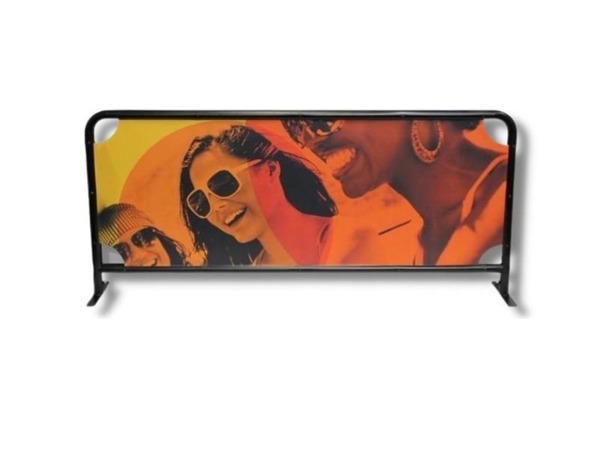
The panels are printed on outdoor banner vinyl with UV stable inks, made for Australian sun, rain and wind. The steel frame and wide feet make the barrier movable, but it has no published wind rating.
A solid printed panel catches the wind like a small sail, though, so on an exposed site:
- ask the venue how the barriers should be secured, and keep any weights clear of walkways
- check the venue's fixing rules for bitumen, pavers and concourses; ballast alone does not establish a safe wind limit
- agree beforehand when the barriers come in and who makes the call.
Our guide to exhibiting at an outdoor event covers wind, rain and sun in more detail, and the rest of our outdoor displays range covers the flags, marquees and umbrellas that often go with barriers.
#6 - Allow for the lead time, and plan to reuse them
Standard production for our barriers is 2.5 weeks from your order and print-ready artwork, plus freight time to your postcode. The frames are built to last for years, and the graphics can be changed over when the message changes, so one set of frames can carry a launch this month and a different campaign next season. Each barrier carries a two-year warranty for the original owner, which doesn't cover mistreatment or normal wear and tear.
Prices start from $450 excluding GST and freight. You can choose a black or silver frame, in 1m or 2m widths, all 0.9m high, on our café and event barriers page.
Where branded barriers work well
- Product launches and store openings, around the queue and the photo moment.
- Brand activations at concerts, sporting events and other outdoor events, as a branded perimeter around a sampling or sponsor zone. See our work on brand activations.
- Shopping centre activations, within the site the centre allocates. Our guide to what you need for a shopping centre pop-up kiosk covers the rest of the kit.
- Hospitality and alfresco areas, where barriers mark the edge of a bar or dining area.
Tell us the venue, the length of the queue you expect and your event date, and we'll work out how many barriers you need and send the templates. Call 1300 240 250 or send us an enquiry.