

YOUR CART IS CURRENTLY EMPTY
How to choose a counter for your exhibition stand
A stand counter does three jobs at once. It gives your team a surface to work at, it hides what shouldn't be on show, and its front carries your brand to the aisle. So choose it by what goes on the top, what has to fit underneath, how the kit travels and who will set it up, not by the shape alone.
Our portable range gives you four ways to do it: the pop-up counter, the Presenter tables, the inflatable illuminated counter and, if you're bringing an Executive pop-up stand, its wheeled case dressed as a counter. Here's how they compare, followed by our six tips for choosing. For a format-by-format checklist of pop-up counters in general, see our pop-up counter buying guide. If the job is to present a product rather than to serve from, a plinth or showcase is usually the better tool, and tip #6 covers that.
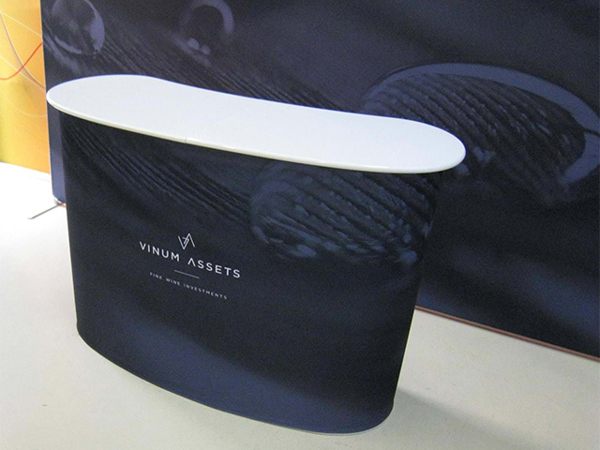
Our portable counters at a glance
| Counter | Top | Height | Weight | Price from |
|---|---|---|---|---|
| Pop-up counter | 1,300 x 480mm curved, gloss painted | 900mm (custom heights available) | 12kg | $792, with graphic wrap |
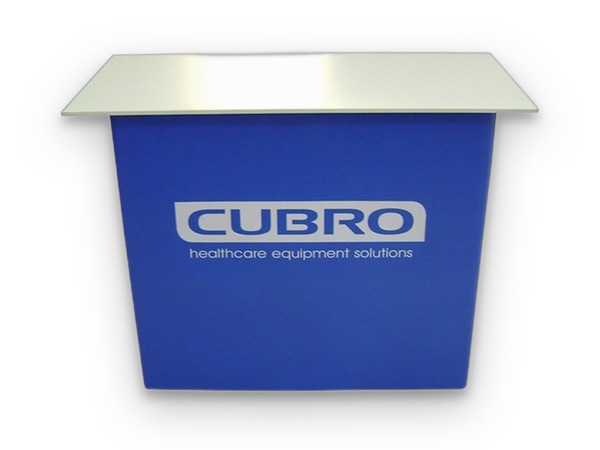
| Presenter 1000 | 1,000 x 600mm melamine-coated | 900mm (custom heights available) | 7kg | $324, unbranded |
| Inflatable counter | 600mm round, 600 x 600mm square or 1,000 x 600mm | 1,000mm | 12 to 28kg in its bag | $698, with lit graphics |
All prices on this page exclude GST and freight. All three have a standard production time of 1.5 weeks, counted from your order and print-ready artwork. Allow extra time for delivery, which varies by postcode.
#1 - Start with what goes on the top
The top decides the counter more than anything else.
- Light kit: pop-up counter. The pop-up display counter takes up to 15kg on its top, enough for a laptop, brochures and a few samples. The glossy, bull-nosed top comes in white, black or wood grain.
- Demonstrations and heavier products: Presenter. As supplied, a Presenter table holds 70kg on the top, and a reinforcing pack adds capacity for heavier items. The melamine-coated top is food-safe and wipes clean with a damp cloth. The Presenter 1000 suits exhibitions and shopping centres, but it is typically considered too large for Coles and Woolworths, where a smaller model in the Presenter range fits better. Tables can also be joined side by side, or set in an L, to make a longer work area.
- Visibility first: inflatable counter. The top is thermo-formed ABS plastic over an MDF inner top and base. The product page doesn't list a load for the top, so tell us what will sit on it before you order.
#2 - Plan what has to fit underneath
Behind the counter is where the stock, cables, bags and spare brochures live.
- Pop-up counter: a shelf fits inside the base, and an extra shelf ($66) and a cable entry cap ($34) are available, so a laptop or screen on top can be powered without cables on show.
- Presenter: a rear shelf and storage space come standard, with an extra shelf ($58) and the same cable entry cap ($34) as options.
- Inflatable counter: its product page lists no shelf or storage space, so plan somewhere else for stock.
The product pages for these counters don't mention locks, so treat what's inside as out of sight rather than secure, and take valuables with you at the end of each day. For a product that has to be locked away on show, see tip #6.
#3 - Decide whether the counter should light up
A counter that glows draws the eye across a dim hall. Our inflatable counters have LED lighting inside that shines out through a backlit polyester fabric graphic. The lighting runs on mains power or on a 16AH lithium-ion rechargeable battery, so it can work where there is no power point. Inflation is by a mains pump (included), a rechargeable battery pump or a hand pump.
Artwork for a lit counter needs designing for backlighting, so brief your designer, or our in-house design studio, early.
#4 - Brand it once, then change the message
- Graphic wraps. The pop-up counter and Presenter tables are usually branded with a printed wrap that covers the front and both sides of the base. It is printed on durable banner vinyl and attaches with industrial-strength VELCRO®, so you can swap it between campaigns. Permanent graphics, logo stickers and fabric wraps are also available.
- Header boards. A printed header board above the table puts the brand above people's heads. On a Presenter, a header on two poles with its graphic is $206.
- Fabric skins. The inflatable counter's graphics are dye-sublimated fabric, colour-fast and washable, and spare skins fold down small for storage.
#5 - Match the counter to how the kit travels
- Pop-up counter: five component pieces fold into a flat pack of 12kg, and one person should have it fully assembled, wrap on, in less than three minutes. The optional carry bag ($98) measures 800 x 900 x 110mm.
- Presenter 1000: 7kg, folds flat and takes around 60 seconds to assemble. It ships in a cardboard carton; the carry bag ($118) is 600 x 1,000 x 135mm.
- Inflatable counter: packs into a zip-up carry case with shoulder straps, with the graphic left on. The round counter weighs 12.5kg in its bag and the square 12kg, but the rectangular one is 28kg, so plan for two people or a trolley.
- Executive pop-up case: if you are freighting an Executive pop-up stand anyway, its hard-shell wheeled case is suitable for air freight, and an optional graphic wrap turns the case into a sales counter on site. The stand weighs about 28 to 38kg including the case, depending on size, and starts from $3,276 excluding GST and freight.
#6 - Use a plinth or showcase when the product is the point
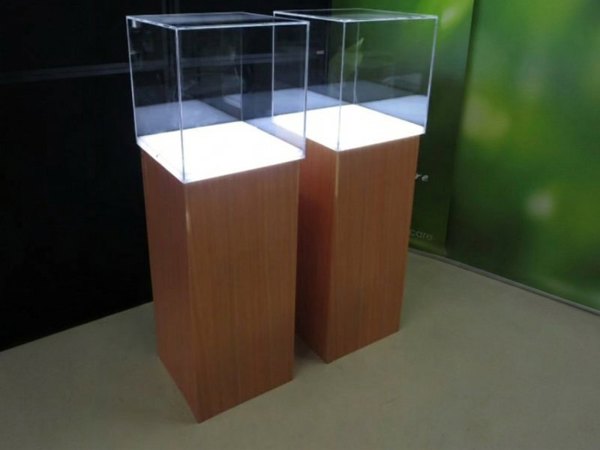
A counter is a place to work. When the stand's job is to show one product, put it on a plinth at eye level, and if it is valuable, a prototype or easily handled, put it under a clear case.
Our showcase plinths pair a clear acrylic case with a solid acrylic or timber base. Security can be matched to the setting:
- a lockable door, sized to suit
- the case screwed to the plinth with security screws
- or, where the risk is low, a case that simply slides over the base.
Choose a case just a little taller than the tallest item it will hold. On a typical 400mm square, 900mm high plinth, that usually means a case about 300 or 400mm high. Showcase plinths are quoted to your requirements, with a standard production time of 2.5 weeks, a week longer than the counters, so allow for that in your timeline. For finishes, lighting and lead times on plinths, see our guide to plinths for product launches.
Tell us what the counter has to hold, what goes underneath and how it will travel, and we'll recommend the one that fits. Call 1300 240 250 or send us an enquiry.