

YOUR CART IS CURRENTLY EMPTY
What are the latest trends in stand design and exhibition displays?
The stand design trends worth planning for in 2027 are reusable stands with swappable fabric graphics, lighting built into the walls, screens built into the structure, open layouts with somewhere to meet, and colour that does one clear job. Each one is backed by more than fashion: the events industry's Net Zero roadmap, published Best Stand judging criteria, or kit already in our own range.
Last updated: October 2026, for stands planned for 2027. The questions below take each trend in turn.
How did you choose these trends?
Most trend lists are opinion. We kept only trends we could point to in a published source or a product you can order today:
- A Net Zero Roadmap for the Events Industry (Net Zero Carbon Events initiative, November 2022), which includes a plan for cutting event waste and materials.
- IBC Best Stand Design Awards 2026 judging criteria (IBC, the media technology show in Amsterdam), which spell out what judges look for in a stand.
- The Displays 2 Go range, where these ideas are already built into products.
We've left out statistics. Survey figures date quickly, and none of them will design your stand for you.
Are reusable stands replacing single-use builds?
Yes, and this is the trend with the most behind it. The Net Zero roadmap says the events industry needs a "circular" approach: reusable items, sustainable materials, and designing out waste. It names building materials from exhibition stands among the waste events produce, and gives renting a stand, instead of building and tearing one down for each event, as an example of the shift. Its waste milestones give "foam core is no longer used" as an example of the action each event should take.
Judges are asking the same question. The IBC criteria ask whether a stand reuses materials from previous years or uses environmentally friendly materials.
How do I brief for a reusable stand?
- Brief for reuse from day one. Ask for a structure that can be reconfigured for a different space, with graphics that change between shows. Our custom exhibition stands are built to be used again, and we can keep yours in storage between shows and change the graphics for the next event.
- Hire if you only exhibit at one or two shows a year. A hire kit gives you the walls, counters and flooring, can carry your printed graphics, and comes back to us when the show ends. Check what each kit includes, such as lighting, when you ask for the quote.
- Choose recycled fabric. SuperWall skins use fabric that is 85% recycled polyester, made from old PET bottles, and we print them by dye sublimation with water-based inks.
Why are fabric graphics on lightweight frames so popular?
Printed fabric over a lightweight aluminium frame is a practical choice for stand walls. When the message changes, you reprint the fabric skin and keep the frame.
A SuperWall skin slides over the frame like a pillowcase and zips closed, so one person should be able to put the wall up in under 10 minutes, without tools. The 270gsm polyester fabric can be machine washed cold, so the skin can be cleaned between shows. The most popular height is 2.25m, there is a 1.5m shopping-centre height, and custom sizes are available.
Is built-in lighting worth it?
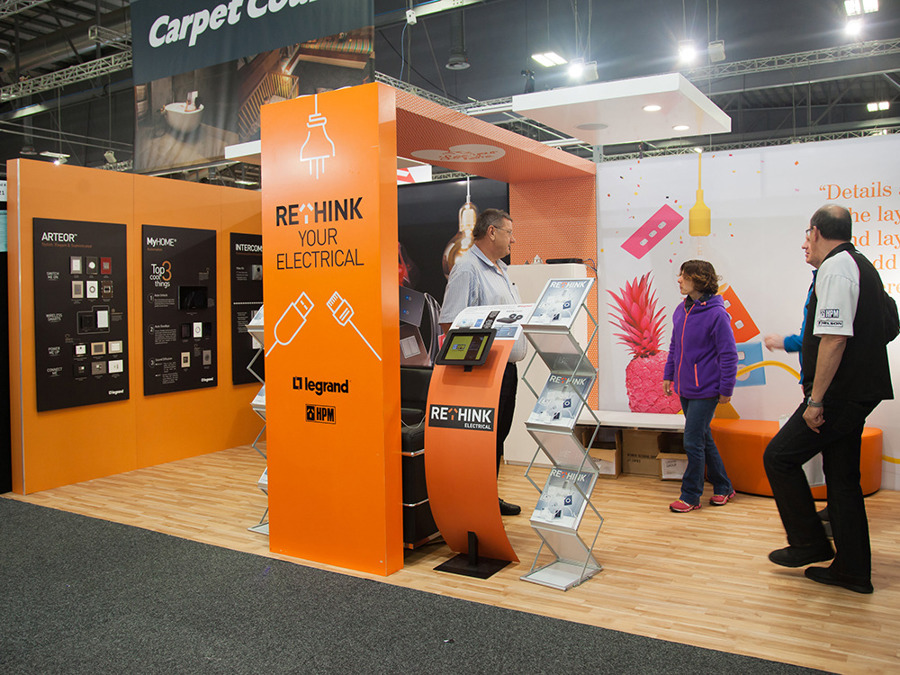
The IBC judges are asked whether the designer has used lighting to create a memorable experience for the visitor. Building the lighting into the wall is one way to answer that, because the graphic itself becomes the light source.
The Illuminated SuperWall hangs a curtain of LEDs inside the frame behind a fabric skin made for backlighting, so the whole wall glows evenly like a lightbox. Standard sizes are 2.4m and 3m wide, both 2.45m high, with other sizes on request.
What should I watch for with a backlit wall?
Backlighting needs its own artwork. Don't reuse files prepared only for a front-lit wall. Once the lights are on, check colour and density and look for dark joins or shadows. Remember that a backlit wall adds less in a hall that is already very bright. Our guide to backlit vs non-lit fabric covers the trade-offs.
How are screens being used on stands?
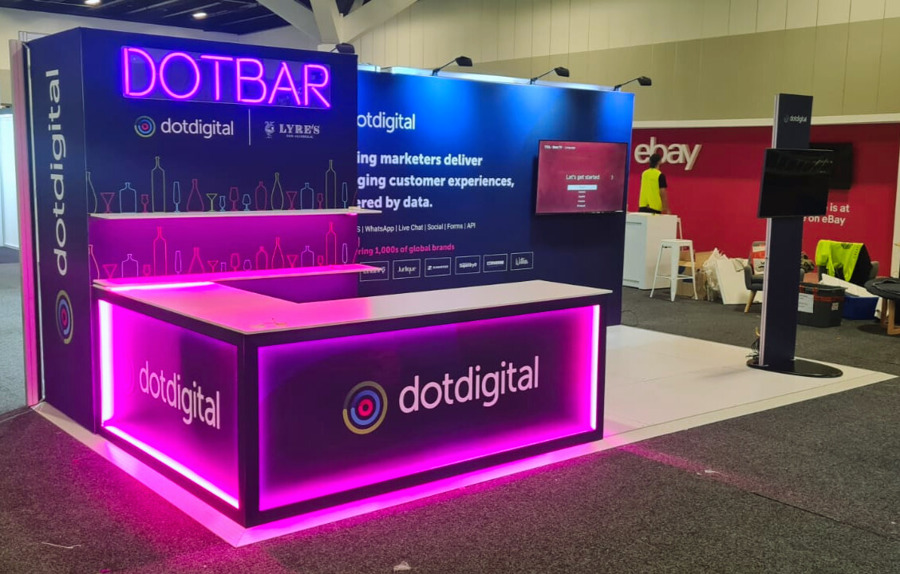
Screens work best when they are planned into the stand, not wheeled in front of a wall at bump-in. On our custom builds, we can design LED walls, digital screens, lighting, and games or interactive features into the structure itself.
A few patterns come up again and again:
- A screen at eye level for the product story, usually a single screen playing a video loop.
- Overhead screens to carry the brand to the aisle on a busy floor.
- An LED wall as the backdrop for launches and presentations. LED walls are typically tiled from 500mm square modules, so they can be sized to the stand.
Put the screen positions, power and content on the brief early. Our digital and multimedia page explains the options.
Why are open layouts with meeting space a trend?
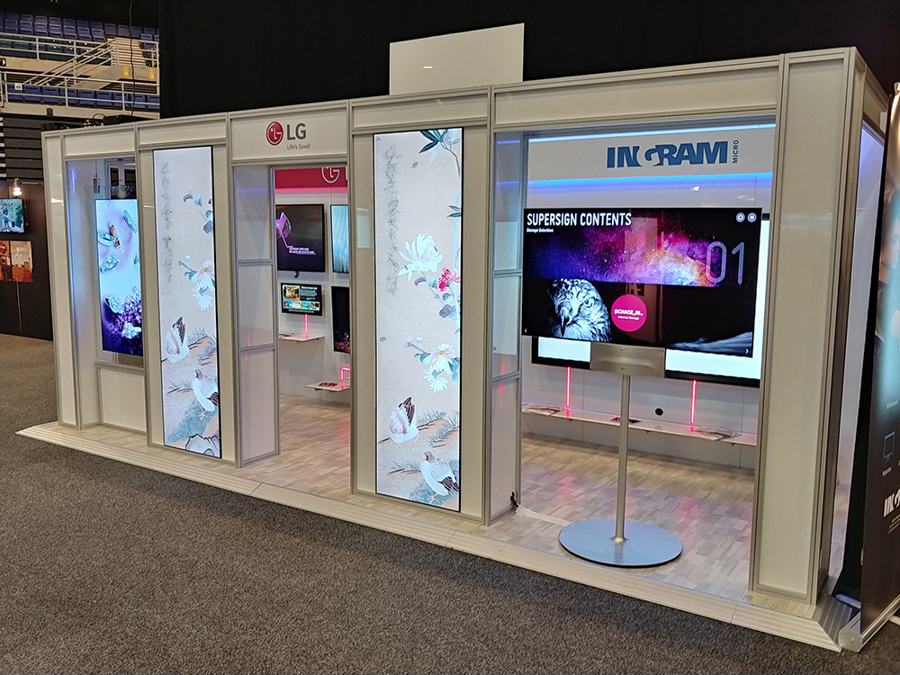
The IBC criteria ask whether visitors can move freely and logically through the stand, and whether the design makes room for meeting areas, product demonstrations and refreshments. They also ask whether the stand is accessible, giving "avoiding a step up" as an example.
In our design work, that comes down to a few basics:
- Clear sightlines from the aisle and an obvious way in.
- A place to sit or stand and talk that is not in the walkway.
- Storage for bags, boxes and stock, out of sight.
- Main graphics big enough to read from about ten metres.
If you're using a raised floor, ask early how people in wheelchairs or with prams will get onto it.
How should I use colour and branding?
Colour does a lot of work from the aisle, but the judging criteria favour restraint. The IBC criteria ask whether colour has been used "in a focused, refined and strategic manner", whether the branding is clearly visible from every approach, and whether it is immediately clear what the exhibitor sells.
So pick one or two brand colours and use them at scale. Put the logo high enough to be seen over people's heads, and make the main message something a visitor can read while walking. Texture, such as wood-look flooring or timber joinery, can add warmth without competing with the message.
Which trends are worth following?
| Trend | What backs it | Worth it when |
|---|---|---|
| Reusable stand, swappable graphics | Net Zero roadmap; IBC sustainability question | You exhibit more than once with a similar space |
| Fabric on aluminium frames | Our SuperWall range | Almost always; messages change, frames don't |
| Built-in backlighting | IBC lighting question | The hall is not already flooded with light |
| Screens built into the structure | Offered on our custom builds | You have content worth watching and power booked |
| Open layout, meeting space | IBC use-of-space and accessibility questions | You need conversations, not just brochure handouts |
| Restrained colour, clear branding | IBC visual appeal and branding questions | Every stand |
Which trends have you dropped?
Some ideas from the earlier version of this page have been dropped. Hybrid and remote-engagement features (live streams and virtual tours) are about people who aren't there. A physical stand's job is the people walking past it. Technology for its own sake, such as a headset experience with a queue, also struggles against the IBC tests of being "fit for purpose" and making it clear what you sell. Use it only when it shows the product better than anything else could.
How do I plan a 2027 stand around these trends?
- Decide whether you'll reuse the stand, and brief for that from the start.
- Choose fabric walls in sizes you can reconfigure for different spaces.
- Decide where lighting and screens go before the design is signed off, and book power with the organiser.
- Mark out the meeting space, storage and a step-free way in on the floor plan.
- Pick one main message and one or two colours, and test them from the aisle.
With 3D stand design, you see the stand on screen before anything is built, so you can check sightlines and the way in while changes are still cheap.
Send us the show, the space you've booked and what the stand has to do, and we'll show you how these trends apply to your custom exhibition stand. Or call 1300 240 250.