

YOUR CART IS CURRENTLY EMPTY
What will a shopping centre or supermarket ask before a prize promotion?
A prize wheel or entry draw in a shopping centre or supermarket needs two things sorted. The site owner has to say yes to the space, and the promotion has to meet trade promotion law, which may or may not mean a permit. Centre management and retailers will want to see both before your team sets up.
Here's what they typically ask for, so the paperwork is ready when you book. We've used two centres' published casual leasing packs (ask your centre for its current one), the major supermarkets' supplier pages and each regulator's website. Every centre and retailer has its own conditions, so treat this as a checklist and confirm the details with the site.
Booking the space
#1 - A booking request with your display described
Centres book promotional space through their casual mall leasing team. Expect a form asking for your business details, ABN, proposed use, preferred dates and site, and whether you need power. Victoria Point Shopping Centre in Queensland asks for "photos of your proposed set up for consideration". Our shopping centre managers directory lists centre managers, the people to talk to about booking casual leasing space.
Describe the game properly. "Prize wheel promotion, spin after registering, prizes on display" tells the centre far more than "brand activation".
#2 - Proof of public liability insurance
Both centre packs we checked ask for $20 million cover:
- Unley Shopping Centre wants "a copy of your Certificate of Currency for Public Liability cover of no less than $20 million".
- Victoria Point asks for $20 million public liability, with certificates of currency "no less than two weeks prior to occupation".
If an agency runs the promotion for a brand, check whose name the centre wants on the policy. Unley's form asks you to confirm the policyholder name matches the applicant's.
#3 - A display that fits the site
Centres set limits to protect walkways and shopfronts:
- Height. Unley says all sites have "a height restriction of 1.5m". Victoria Point says display height "should not exceed 1.5 metres". Our floor-standing prize wheels are 1.5m high, right at that limit, so confirm with the centre before you book.
- Sightlines. The Casual Mall Licensing Code, a voluntary code agreed to by members of the Shopping Centre Council of Australia, says a centre must ensure a casual mall business "does not substantially interfere with the sightlines to a lessee's shopfront". The code doesn't apply in South Australia, which regulates casual mall licensing separately.
- Clear walkways. Victoria Point's terms ban obstructing walkways, entrances, shopfronts or fire exits. Plan where the queue will stand.
- Tagged leads. Both centres require electrical cords to be tested and tagged.
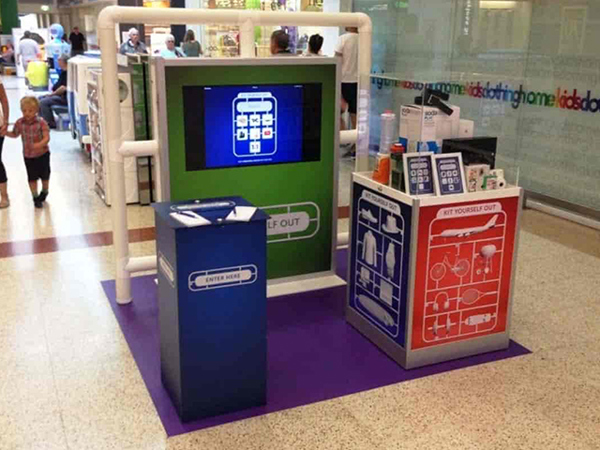
Our Mall Registration Kit, which you can hire or buy, has a 1.5m-high backdrop and is sized for the height guidelines of the major centres. It works in a space 2.5 to 3 metres wide.
#4 - How the noise and the queue will work
A prize wheel's clicker is part of its appeal, but centres control sound. Unley's terms say no audio equipment without centre management's consent. Victoria Point needs written consent for any machine that causes noise or vibration. Both centres limit approaching shoppers: at Victoria Point, customers may only be approached when they come to the display themselves. Tell the centre how the game draws people in and keep your hosts inside the site.
Trading in a supermarket
#5 - Registration through the supermarket's own system
Supermarkets have their own processes for in-store activity, separate from the centre's. Woolworths asks agencies and suppliers to read and sign its In-store Sampling Manual and to book through its In-store Events Booking System, and says to allow up to two weeks for applications. Coles asks demonstration companies to read its Demonstration Company Procedures, and needs booking requests "a minimum of 4 weeks in advance". Both pages are about sampling and demonstrations. If you want to run a game in store, raise it when you book.
#6 - Food safety evidence for Coles demonstrations
Coles requires "documented evidence that your company has a Food Safety Program in place for all demonstrations", audited and certified by an independent third-party auditor, and a copy of the certificate before a booking can be made. Coles asks for it for all demonstrations, so check with Coles whether it covers your activity before you book.
Running the promotion legally
#7 - Permits, and the permit number on display
A free prize draw or spin run to promote a business is a trade promotion. The rules vary by state, and each state where entrants live may apply. What the regulators said:
- NSW: an authority is required if the total prize value exceeds $10,000. Below that, the NSW trade promotion rules still apply.
- ACT: no permit is needed where the total prize value doesn't exceed $3,000, but conditions apply.
- NT: no permit is needed for a minor trade lottery with prizes worth $5,000 or less.
- VIC, WA and TAS: no permit is required, but conditions apply.
- QLD: free-entry draws need no licence, but conditions still apply, such as making the terms easy to find.
- SA: check with Consumer and Business Services (CBS).
If a permit applies, the number goes on your signage too. NSW requires the authority number on all advertising material, and the Northern Territory requires the permit number on entry forms and promotional material.
#8 - Written consent from the brand being promoted
Agencies need this one. NSW says "if you are conducting a trade promotion on behalf of a business, make sure that you have written consent from the benefitting business". Victoria requires written consent from the business being promoted.
#9 - Terms on show and purchase conditions made clear
Put the terms, or where to find them, on the stand. NSW requires the rules to be clearly advertised. If buying a product is the way to enter, NSW says that condition must be "clearly and prominently displayed on the outside of the product", and NSW allows entry by purchase only at the product's "normal retail value". South Australia adds that you "cannot charge more for the goods and services being promoted while the lottery is being run". Tell the retailer about any purchase-to-enter mechanic before you launch.
#10 - Prizes that suit a public, family audience
Shopping centres and supermarkets have children walking past all day.
- Alcohol: as a trade promotion prize, NSW prohibits more than 20 litres of liquor at 20% alcohol or less, or more than 5 litres above 20%. In the Northern Territory, liquor must not be the principal prize. In Queensland, a minor can't enter if the prize includes alcohol.
- Age-restricted prizes: in South Australia, a ticket is void if the holder is under the legal age to receive the prize.
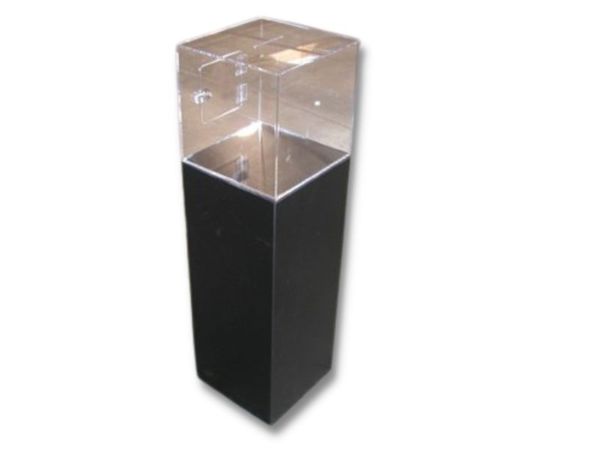
Store prizes securely and keep only display samples on the stand. A locking shopping mall entry box keeps draw entries safe all day. It stands 1 metre high on a 350mm square footprint, with the entry slot in a clear acrylic cube that locks.
#11 - A clear statement of what happens to entrants' details
An entry form collects personal information. The Office of the Australian Information Commissioner's guidance says organisations covered by the Privacy Act must take reasonable steps to tell people things such as who is collecting their details and why. Victoria also requires the conditions of entry to say if entrants' information will be used "for a purpose other than the lottery". Be ready to tell the centre or retailer how entries are stored and who can see them.
For a broader checklist of what a centre kiosk needs, see our guide to what you need for a shopping centre pop-up kiosk. When you're ready to choose the wheel or entry box, browse our prize wheels or call us on 1300 240 250.