

YOUR CART IS CURRENTLY EMPTY
How to make your exhibition stand more sustainable
Published
Quick answer
Start with reuse: build on an aluminium modular frame you can reconfigure for each show, and change only the printed fabric graphics. Light the stand with LEDs, cut single-use print and giveaways, and decide where every part goes after the show before you order. Back any environmental claim on your stand with specific evidence.
What makes an exhibition stand sustainable?
The decisions that matter most are made at the brief. What the stand is made of, how many shows it will do and what happens to it afterwards matter more than any single tip on the day.
A stand built for one show and thrown in a skip at bump-out carries all of its materials and freight for one event. A stand used across a programme of events spreads the same materials over many. So start the brief with your show calendar for the next two or three years, the smallest and largest site you expect to book, and where the stand will live between events.
Choose a reusable modular frame
Modular systems are no longer boxy. An aluminium frame with tensioned fabric graphics gives a clean, seamless finish and can be rearranged for each site.
- Exhibition Brandframe is built to whatever size you need. Because it is fully modular, you can add or take away sections as your site changes from show to show. Curved sections, a roof or a wall with a lockable door are all possible. The frame carries a two-year warranty on non-graphic components for the original owner. If you already own a framing structure, we can fit Brandframe extrusion to it rather than starting again.
- SuperWall walls use a lightweight aluminium frame with a printed fabric skin that closes with a zip. Packed in its bag, a 3m wide wall weighs 12kg, and one person can assemble the frame in no more than five minutes without tools. Use a single wall as a backdrop, or combine three to enclose a 3 x 3m site.
When you brief a modular stand, ask for component sizes that suit your storage and transport. Smaller pieces pack more easily but take longer to assemble.
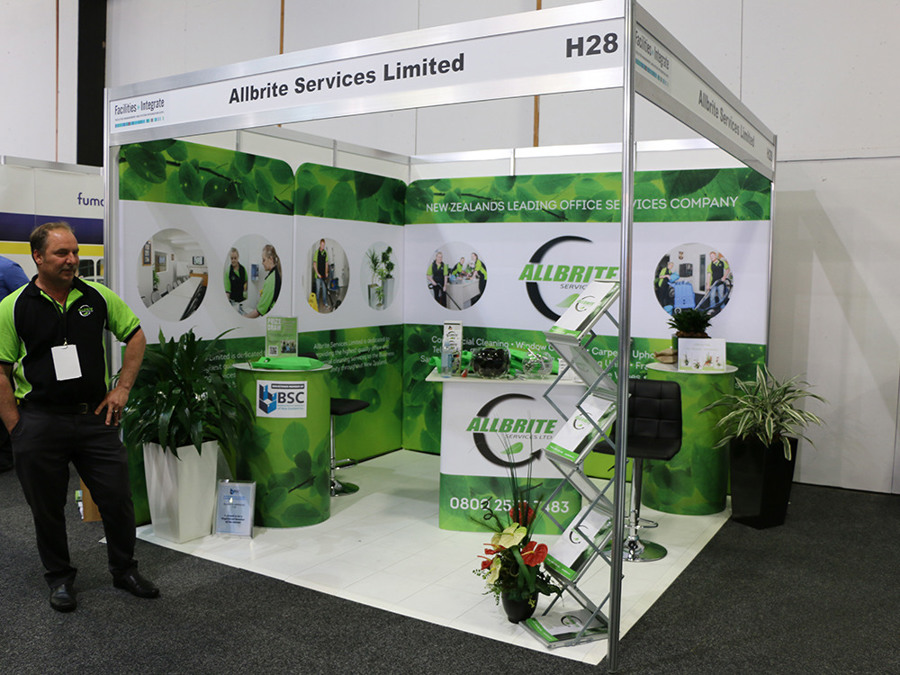
Fabric graphics and dye sublimation
We print our fabric graphics by dye sublimation. Heat and pressure turn solid dye straight into a gas, which moves into the fabric while it is warm and is locked in as it cools. Because the colour sits within the fabric rather than on the surface, it holds up against fading and washing over repeated use.
Our dye-sub printing page explains why we chose the process:
- its dyes are water-based, not solvent-based, so it avoids the volatile organic compounds (VOCs) released by some print methods
- the printing itself uses no water, so there is no print wastewater to run off into waterways
- prints come off the printer dry, with no separate drying stage.
The fabric on Brandframe and SuperWall graphics is a polyester that can be machine washed cold, so a marked graphic can be cleaned rather than reprinted.
Recycled fabric and refurbished hardware
Two parts of our range cut the amount of new material in a stand.
Recycled polyester graphics. In our recycled polyester display range, graphics are printed on recycled polyester instead of standard print fabric. The range covers the SuperWall curved exhibition wall, SuperWall Edge and a three-wall SuperWall expo set. For the expo set, the graphic fabric is knitted from 85% recycled polyester sourced from recycled PET bottles. That figure applies to the fabric, not the frame.
Refurbished banner stand hardware. Our recycled banners give pull-up banner hardware a second life. Clients send back stands they no longer need. We inspect and repair each one, swap out any damaged parts, then supply it to a new client with a newly printed banner. You get a 12-month warranty on non-graphic components. Prices start from $154 excluding GST and freight, and standard production takes one week from your order and print-ready artwork.
When you compare quotes, ask what each component is made of and whether the parts can be separated at the end. A frame and fabric that come apart are far easier to reuse or recycle than materials that are bonded together.
Reskin the stand instead of rebuilding it
Often the lowest-impact stand is the one you already own. Choose hardware that takes replacement graphics, so a rebrand or a new campaign means a new print, not a new stand.
- Brandframe uses silicone edge graphics (SEG). A silicone strip on the fabric edge pushes into a groove in the frame, so graphics can be swapped by hand, without tools, when the design changes.
- A SuperWall skin slides off the frame and the new one slides on.
- If you already own a pull-up banner stand, we can fit a new banner to it.
- SuperWall skins can be printed on one side or both. If a wall stands at the back of your site, a skin with a different design on each face gives you two looks from one print. Turn the wall around for the next show.
- Keep the evergreen brand message on the large walls. Put show-specific offers and dates on small panels or screens, so only the small items need reprinting.
LED lighting and power
Specify LED lighting for any lights you need. The Australian Government's energy.gov.au lighting guide for business says LEDs "use up to 75% less energy and emit 90% less CO2 than the old halogens" and "last up to 25 times as long". The same page notes that LEDs generate less heat than halogens.
If you want an illuminated wall, the LED options in our range include the Brandframe Glow, which lights the frame from inside so the whole wall reads as a lightbox, programmable LED lighting inside a Brandframe wall, and an LED light kit add-on for the SuperWall expo set. Any lit wall still adds to your power load.
Before you order power from the organiser, add up the wattage of everything on the stand: lights, screens, fridges and coffee machines. A lower total load may let you order a smaller supply.
Less single-use print and fewer giveaways
Bulk brochures are heavy to ship and soon out of date. Some practical swaps:
- Capture leads digitally. Use a tablet or a QR code that leads to your brochure or a registration page, and follow up after the show with the material each prospect asked for.
- Print short. If you need print, run a small quantity of a single flyer on recycled stock.
- Choose giveaways people keep. One useful, well-made item beats a bag of plastic novelties.
- Serve with less waste. If you are serving food or drinks, use reusable serveware where the venue allows it. Ask the organiser which waste and recycling streams the venue provides, and brief your team on them.
- Make uniforms last. Choose durable shirts with your brand rather than the show name, so they can be worn at every event.
Freight, travel and storage
Lightweight fabric systems are easier to move. A complete SuperWall unit, with frame, graphic and carry bag, weighs between 7 and 14kg depending on size, so a small stand can often travel with your team rather than needing its own truck. For larger stands, consolidate everything into one delivery rather than several part-loads.
Packaging is a waste stream too. SuperWall packs into its own carry bags, and Brandframe can be ordered with custom road or carry cases. Reusable cases protect the stand and cut the bubble wrap and cardboard that end up in the skip at bump-out.
For staff travel, limit parking passes and encourage car-pooling to the venue.
Storage decides whether a stand gets a second show. A stand left in a garage or a corridor gets damaged and replaced. Our logistics and storage service holds event assets in our warehouses between events. We log each item as it arrives, look it over for wear, carry out any maintenance and cleaning, and send it out ready for the next booking.
If you only exhibit once or twice a year, consider exhibition wall hire for the show period instead of owning hardware that sits idle.
Plan the end of life before you order
Decide where every part of the stand goes before you sign off the design:
| Part | First choice | If it can't be reused as is |
|---|---|---|
| Aluminium frame | Reuse at the next show or reconfigure for a new site | Separate it from fabric and plastic parts and recycle the aluminium as scrap metal |
| Fabric graphics | Reuse, or turn a double-sided wall around to show the other face | Reprint only the panels that have changed |
| Pull-up banner stands | Keep using the hardware across your events | Return the hardware to us for refurbishment and reuse |
| Counters, plinths and furniture | Store and reuse across your show calendar | For one-off events, hire rather than buy |
Keep your environmental claims honest
If your stand graphics say "sustainable" or "eco-friendly", make sure you can back the claim up. The Australian Government's business.gov.au guidance on sustainability claims advises avoiding broad, unqualified claims such as "eco-friendly", qualifying what you say, and having evidence to back it up. Specific statements, such as "this frame has been used at six shows", are easier to prove than general ones. Check the ACCC's guidance on environmental claims before anything goes to print.
Next step
Send us your show calendar and the floor sizes you usually book through the enquiry form on any product page, or call 1300 240 250. We will spec a stand that can be reused across the whole programme.