

YOUR CART IS CURRENTLY EMPTY
Poster sizes in Australia: A0 to A8 in mm, cm and inches
Published
Quick answer
Most Australian poster sizes follow the ISO 216 A series. The everyday poster sizes are A3 (297 × 420mm), A2 (420 × 594mm), A1 (594 × 841mm) and A0 (841 × 1189mm). Each size is half the area of the one above it, so two A3 sheets side by side make an A2. Above A0 come 2A0 (1189 × 1682mm) and 4A0 (1682 × 2378mm).
Standard poster size chart (A8 to 4A0)
The A series became a national standard in Australia in 1974 and the international standard, ISO 216, in 1975. Every size has the same proportions (a 1 : 1.414 ratio), so artwork scales up or down between sizes without cropping or distortion.
Sizes are width × height, portrait. For landscape, swap the two values. Millimetres are the official values; centimetres and inches are converted from them (inches rounded to one decimal place).
| Size | Millimetres | Centimetres | Inches | Common uses |
|---|---|---|---|---|
| 4A0 | 1682 × 2378 | 168.2 × 237.8 | 66.2 × 93.6 | Rarely used oversize |
| 2A0 | 1189 × 1682 | 118.9 × 168.2 | 46.8 × 66.2 | Rarely used oversize |
| A0 | 841 × 1189 | 84.1 × 118.9 | 33.1 × 46.8 | Posters, technical drawings |
| A1 | 594 × 841 | 59.4 × 84.1 | 23.4 × 33.1 | Posters, flip charts |
| A2 | 420 × 594 | 42 × 59.4 | 16.5 × 23.4 | Posters, flip charts, drawings |
| A3 | 297 × 420 | 29.7 × 42 | 11.7 × 16.5 | Posters, drawings, diagrams |
| A4 | 210 × 297 | 21 × 29.7 | 8.3 × 11.7 | Letters, forms, catalogues, office printing |
| A5 | 148 × 210 | 14.8 × 21 | 5.8 × 8.3 | Note pads, books |
| A6 | 105 × 148 | 10.5 × 14.8 | 4.1 × 5.8 | Postcards, books |
| A7 | 74 × 105 | 7.4 × 10.5 | 2.9 × 4.1 | Rarely used for posters |
| A8 | 52 × 74 | 5.2 × 7.4 | 2.0 × 2.9 | Playing cards |
A0 has an area of one square metre. 2A0 is twice A0 and 4A0 is four times A0.
Is A2 bigger than A3?
Yes. The lower the number, the bigger the sheet. A2 (420 × 594mm) is twice the size of A3 (297 × 420mm), and A3 is twice the size of A4. An easy check is that the long side of one size is the short side of the next size up: A3 is 420mm tall and A2 is 420mm wide.
The same rule tells you how many sheets fit into a bigger one. Two A1s make an A0, four A2s make an A0, and sixteen A4s make an A0.
B-series sizes: B0, B1 and B2
ISO 216 also defines a B series for jobs where the A sizes don't fit. Each B size sits between two A sizes. B1, for example, falls between A1 and A0.
| Size | Millimetres | Inches |
|---|---|---|
| B0 | 1000 × 1414 | 39.4 × 55.7 |
| B1 | 707 × 1000 | 27.8 × 39.4 |
| B2 | 500 × 707 | 19.7 × 27.8 |
If a poster is going into an existing frame or holder, measure the frame before you choose a B size.
Which poster size for which job
Choose the size by viewing distance and by what the poster has to hold, not by habit.
| Setting | Size to start with | Why |
|---|---|---|
| Shop window | A1 or A0, portrait | Has to work from the footpath. A3 and A4 get lost behind glass. |
| Point of sale and counters | A4 or A3 | Read at arm's length. Pairs well with a counter-top holder. |
| Conference wayfinding | A1 or A0 on a stand for directions; A3 or A4 for room-door schedules | Directional signs are read on the move from a distance. Session lists are read up close. |
| Exhibition stand | A1 or A0 for product or speaker posters; a fabric wall for the backdrop | A run of small posters looks cluttered on a stand wall. One large fabric graphic reads better. |
| Shopping centre | A0, 2A0 or a custom-size double-sided frame | Shoppers pass on both sides and at walking pace, so bigger and two-sided works harder. Check the centre's casual leasing rules before you print (centre managers directory). |
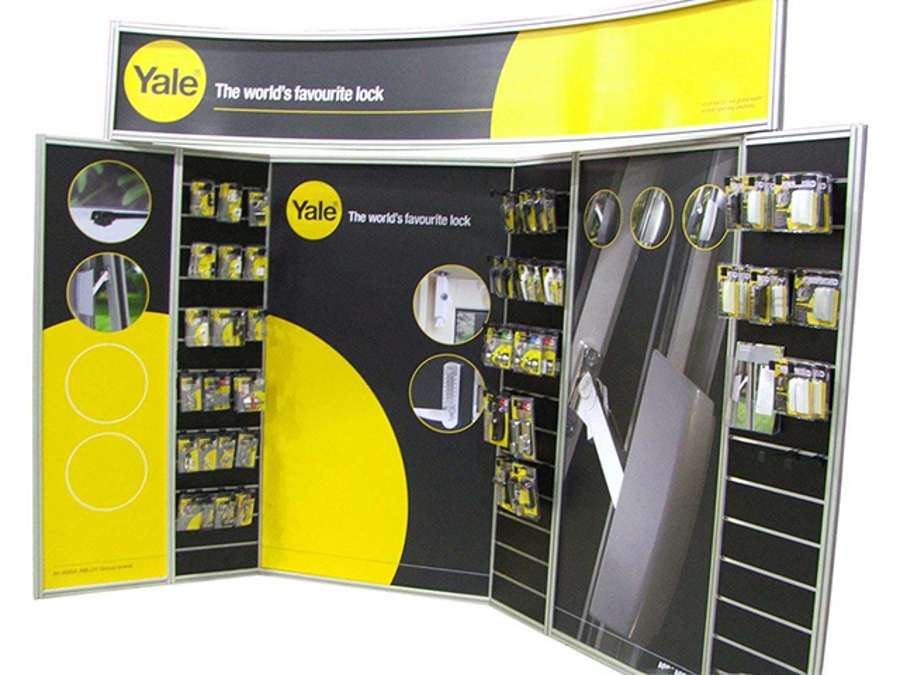
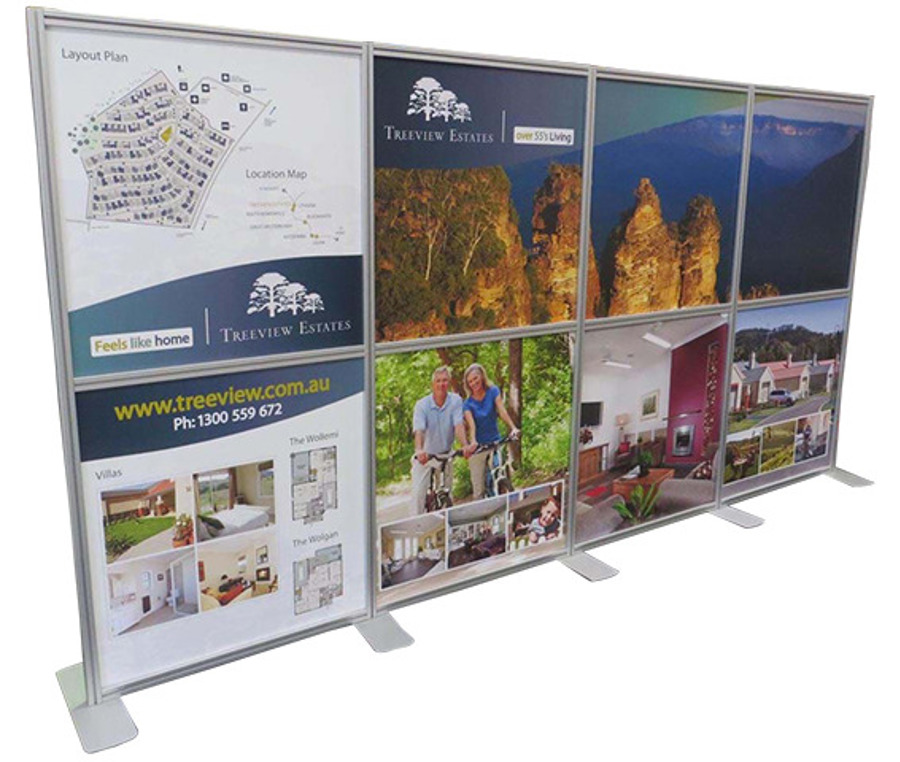
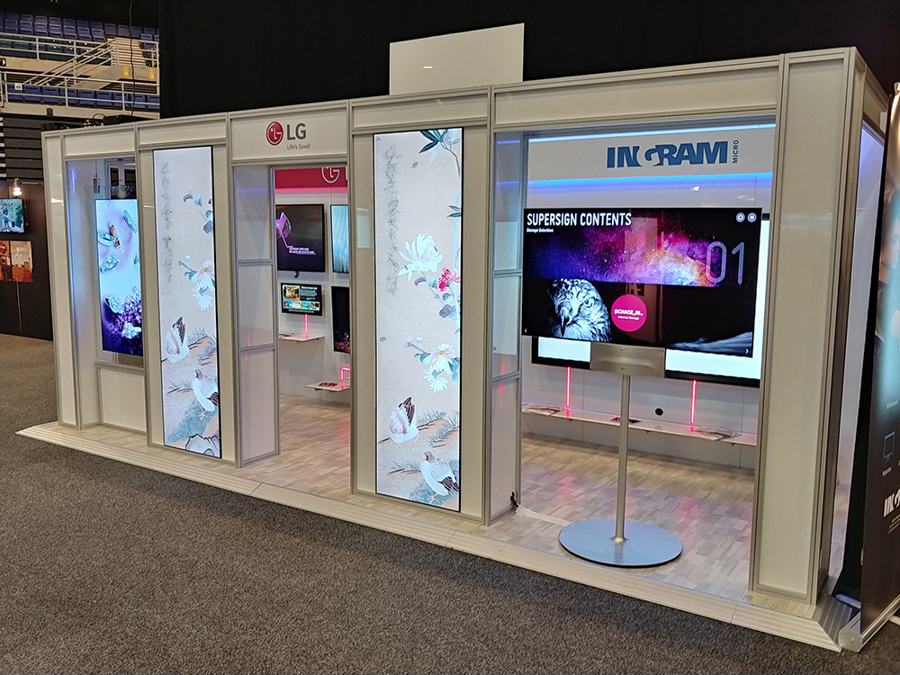
For anything you'll reuse, consider a frame with a fabric graphic instead of a paper poster. Brandframe uses a printed fabric with a silicone edge that locks into an aluminium frame, so the face sits flat and taut. When the message changes, you replace the fabric skin, not the frame.
The Floor-Standing Brandframe stands on its own in a foyer, on a stand or in a mall. It can be built at almost any size, and we've made shopping-centre-height, double-sided versions for Westfield. The standard 3000mm wall is 3000mm wide × 2350mm high, and the Brandframe Glow option lights the graphic from inside like a lightbox.
Large poster sizes: bigger than A0
2A0 and 4A0 are the largest A-series sizes and are rarely used. 4A0 is the top of the scale, so anything bigger is printed to the size of the wall, frame or space.
Our in-house wide-format printers can print custom graphics up to 3.2 metres wide in one continuous piece, depending on the material. That covers 4A0 with room to spare. See printing and production for print media, fabric printing and hand finishing.
Setting up poster artwork for print
Our full artwork specifications cover this in detail. The main points are:
- Size: set the PDF up at 100% of finished size, or in proportion, with bleed included.
- Bleed: allow 10mm on every edge unless a product template says otherwise. An A1 poster file with bleed is 614 × 861mm.
- Resolution: at least 150 ppi at 100% of finished size for best results. 75 ppi is the lowest we accept.
- Colour: supply CMYK, and convert spot colours to CMYK. For a dense black, use C 50, M 50, Y 50, K 100.
- Fonts: outline or embed all text.
Resolution and viewing distance go together. A poster read at arm's length shows every soft edge, so aim for 150 ppi or better. A large graphic seen from across a hall is more forgiving. At 150 ppi, that works out to:
| Size | Pixels at 150 ppi (trim size, no bleed) |
|---|---|
| A3 | 1754 × 2480 |
| A2 | 2480 × 3508 |
| A1 | 3508 × 4967 |
| A0 | 4967 × 7022 |
If you're not sure your file will hold up at full size, ask for a proof before printing. Digital proofs are available on request, and printed A3 proofs are $45 ex-GST each.
US poster sizes and artwork from overseas
If artwork comes from a US head office, check its size before you print. US sizes don't share the A-series ratio, so they won't scale to an A size without cropping or white space.
| US size | Millimetres | Nearest A size |
|---|---|---|
| Letter (8.5 × 11 in) | 216 × 279 | A4 |
| Tabloid (11 × 17 in) | 279 × 432 | A3 |
| 24 × 36 in | 610 × 914 | A1 |
Ask for the file at the A size you need, or tell us the original size and we'll advise.
If the poster is for an event or a foyer and needs to stand on its own, a pull-up banner is often the simpler choice. Sizes vary by model, from the 500mm wide Premier at 1.8m tall to extra-wide stands, and each product page lists exact sizes.
---
Next step: If a paper poster won't be big enough or tough enough for the job, look at the Floor-Standing Brandframe, or call 1300 240 250 and tell us the size and where it's going.