

YOUR CART IS CURRENTLY EMPTY
Branded cart roadshows: one cart, several locations in a day
Published
Quick answer
A cart roadshow puts one branded cart, bike or trolley in front of several audiences in a day: a station concourse at breakfast, a CBD forecourt at lunch, a shopping centre in the afternoon. Plan it stop by stop. Each site needs its own approval, from council for public space or from the owner for centres and station concourses, and some councils book fixed sites only, so the cart moves between permits rather than roaming. Build the cart around the product and the route, keep chilled food that is potentially hazardous at 5°C or colder, and count the same figures at every stop.
Why run a cart roadshow?
A fixed stand waits for people to come to it. A cart goes to where they already are, and a roadshow repeats that several times in one day. The same cart, the same team and the same stock reach commuters, office workers and shoppers in turn, so you can follow your audience through the day instead of choosing one crowd.
It also gives you a built-in test. Because every stop uses the same kit and the same offer, the differences between stops tell you which locations work for your product.
The trade-offs are time and paperwork. Every move costs set-up and travel time, and every site has its own rules. The rest of this guide is about managing both.
Choosing the cart, bike or tray
The right unit depends on the product, the ground and how far it has to travel between stops.
| Unit | Best for | Power, cooling and storage | Production time |
|---|---|---|---|
| Vendor bike | Shopping centres, pedestrian malls, beaches, parks, sports events and festivals | Battery or mains power, eskies, ice wells, cook tops, sinks, drawers and cupboards | Built to order, typically around 2 to 3 weeks |
| Outdoor sampling trolley | Grass, sand, kerbs and pedestrian malls | 70-litre food-grade bin, optional clear lid and drainage tap | 1.5 weeks |
| Wheeled sampling bins | Smooth floors: shopping centres, supermarkets, pedestrian malls | Insulated or uninsulated bin, optional lid | 1.5 weeks |
| Custom sampling cart | Train stations, supermarkets, shopping malls, festivals, exhibitions and beaches | Refrigerated, frozen or room-temperature product; collapsible designs | Made to order to your requirements |
A few points from our product range to help you choose:
- Match the wheels to the ground. Our wheeled sampling bins have small industrial-grade castors made for moderately smooth surfaces. For rougher ground, the outdoor trolley has two gel-filled, puncture-proof tyres, so a flat tyre won't end the session.
- Bikes take a wide range of add-ons. A vendor bike can be fitted with battery or mains power, eskies, ice wells, an umbrella or canopy, shelving and a branded skirt that adds work space once it's parked.
- Check the size against the van. The outdoor trolley is 425mm in diameter and 900mm high, or 1,000mm with the lid handle. Measure custom carts and bikes against the van doors and any lifts on the route.
- Add a tray for the last few metres. A vendor tray (520 x 400mm) lets a second person take samples into a crowd while the cart holds stock.
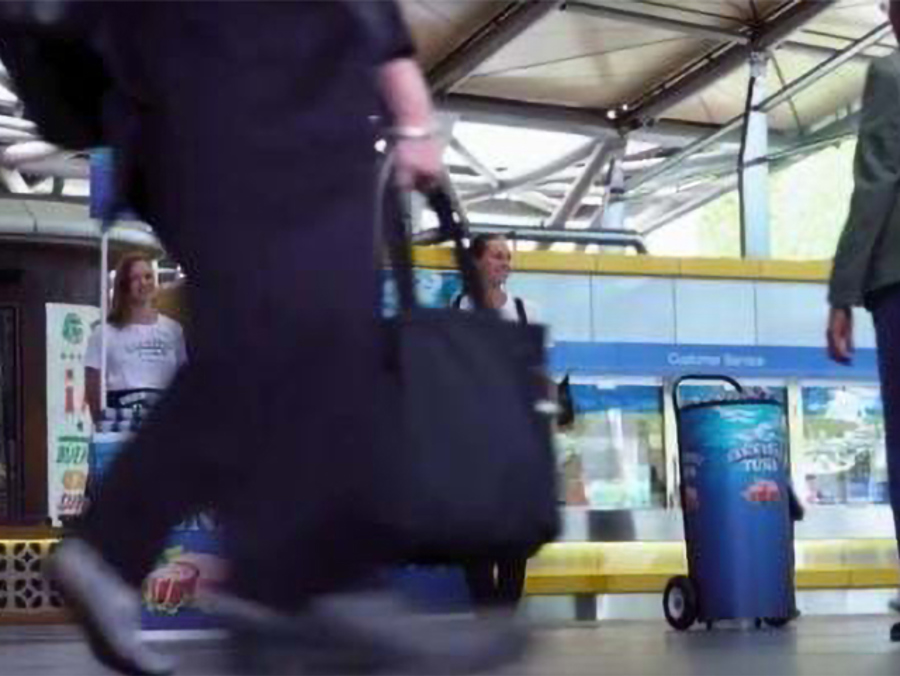
We build carts and bikes to order; we don't hire them. Production times run from your order and print-ready artwork, with freight on top. If the cart is one part of a bigger custom brand activation, allow about 5 weeks for the build, so brief us well before the first stop.
Route planning and timing
Plan the day as a timetable, not a list of places.
- Choose stops by audience and time. Put each stop where your audience is at that hour: commuters at a station in the morning, office workers at a CBD forecourt at lunch, shoppers at a centre in the afternoon.
- Book a window at each stop. The councils below charge by the hour or the session, so the timetable is set by the permits you can get.
- Allow for the move. Each change of site means packing down, travelling, unloading and setting up again. Build that into every gap.
- Plan a restock point. A van parked nearby, or a base between stops, means the cart never runs out mid-session.
- Have a wet-weather plan. Some councils ask for a back-up date when you apply.
Permits for public spaces and private sites
Plan on every stop needing its own approval, because the rules differ more than most brands expect. Two councils show the range.
City of Melbourne requires a permit to hold a promotion or sampling activation in public open space it manages, and its rules say "Roaming is not permitted": activations stay within a booked promotion site. Sites include Bourke Street Mall, Queensbridge Square and, for sampling only, outside Flinders Street, Melbourne Central and Parliament stations. Promotions can run for no more than 7 consecutive days per site, tobacco, gambling and alcohol promotions are not allowed, and food or drink giveaways need a temporary and mobile food premises registration. Apply 10 full business days ahead for a low-impact, sampling-only activation, or 3 to 4 weeks ahead if you need vehicle access.
Fees add up across a roadshow. From 1 July 2026, each application costs $70, plus $1,409.10 per site per day for up to 2 hours (GST free). A day with three 2-hour stops at three Melbourne sites is 3 x $1,409.10 = $4,227.30 in site fees, before application fees.
North Sydney Council issues a permit for publicity and promotional events, including handing out free samples. It asks for at least two working days' notice, a certificate of currency for public liability of at least $20 million, and food products that are hermetically sealed and list all ingredients and a use-by date. Its 2026-27 fees start with a $347.40 lodgement fee per location per day, plus $341.20 per hour (minimum 1 hour), with no GST.
Other councils have their own forms, fees and lead times, so check each one on your route.
Private sites need the owner's approval. Shopping centres, station concourses, office forecourts and campuses are managed by their owners, not council. In Westfield centres, for example, Scentre Group's BrandSpace team offers roaming as a format, to "Directly sample your product to customers". Get every approval in writing, with the exact spot, times and footprint.
Stock, refills and cold chain
If the cart hands out food, plan the cold chain before you plan the graphics.
Food Standards Australia New Zealand (FSANZ) counts bicycles among the premises a mobile food business can use. Its guidance says potentially hazardous food needs to be kept cold (5°C or colder) or hot (60°C or hotter) "during receipt, storage, display and transport", that you need to notify the council where your business vehicle is garaged, and that you may also need to notify other councils you intend to work in. Its premises checklist includes a basin used only for hand washing, with warm running water, soap and single-use towels. Check with each council on the route whether a sampling cart counts as a mobile food business in its area.
In practice:
- Build cooling into the cart. Our carts can be made for refrigerated, frozen or room-temperature product, with internal eskies, insulated bins or ice wells. Eskies and ice slow warming but don't refrigerate, so check temperatures with a food thermometer through the day, as FSANZ advises.
- Keep the lid on. A clear polycarbonate lid on the outdoor trolley keeps cold items colder for longer and covers stock in crowded locations.
- Hand samples out, don't leave them out. The City of Sydney's event guidelines, for events in its parks, open spaces and streets, say food given away as samples must be handed out by a staff member "off a tray or plate" and not left for self-service.
- Sample size only. Melbourne's rules require sample-size portions for grab-and-go giveaways and ban products in glass.
Staffing and transport between sites
A cart roadshow usually needs a driver as well as the people on the cart. Plan:
- A second person on the cart at busy stops: one sampling, one restocking or collecting data.
- A driver and van for anything that can't be ridden or wheeled between stops.
- A packing list taped inside the cart, so the same kit leaves every stop.
- Breaks between stops, not during them.
We don't supply promotional staff. If we supplied your kit, though, we can give on-site or after-hours help on the day.
Measuring each stop
The roadshow format only pays off if you compare stops fairly. Record the same figures at every location:
- samples handed out, and over how many minutes
- conversations, sign-ups or scans
- sales nearby, where a retailer can share them
- weather and anything unusual, such as a delayed set-up.
Divide samples by the minutes at each stop to compare locations on the same basis. After the first week, drop the weakest stop and give its time to the strongest. Our product sampling guide covers objectives and measures in more depth.
Next step
Browse our mobile sampling range, then tell us the product, the route and how the kit travels between stops, and we'll suggest the cart, bike or trolley that suits it. Send us an enquiry or call 1300 240 250.