

YOUR CART IS CURRENTLY EMPTY
Food safety training for sampling teams: what your staff need
Published
Quick answer
Staff who serve unpackaged food at a tasting are handling food, and the business behind them may need a certified food safety supervisor as well. Under the national Standard 3.2.2A, enforceable since December 2023, food service, catering and retail businesses that handle unpackaged, potentially hazardous, ready-to-eat food must train their food handlers and appoint a supervisor. The supermarkets add their own staff rules on top.
What this guide covers
This article is about the people: who needs which training, who supervises, what records to keep and what the retailers expect of the team. For the food itself (temperatures, the 2-hour/4-hour rule, notifying the council), see our guide to in-store food sampling.
Everything below comes from Food Standards Australia New Zealand (FSANZ), the state food regulators and the retailers' own documents. It is a guide, not legal advice, so confirm with the local council or state food authority before your campaign starts.
Does standard 3.2.2A apply to your sampling?
FSANZ's guidance on the standard says it applies to food service, catering and retail businesses that "handle unpackaged, potentially hazardous food that is ready to eat". Potentially hazardous food is, as WA Health puts it, generally food that needs to be kept in the fridge to stay safe: meat, dairy, seafood, cut fruit and vegetables, cooked rice, and fresh or cooked pasta.
What the team does with the food decides the category:
- Category one (all three tools): a caterer or food service business that turns unpackaged potentially hazardous food into ready-to-eat food that is still potentially hazardous, for example by chopping, cooking, heating or thawing it.
- Category two (supervisor and trained handlers): a retailer that handles that food unpackaged but doesn't make or process it, other than slicing, weighing, repacking, reheating or hot-holding.
FSANZ's Safe Food Australia guide says the category applies "regardless of the business size, location or business model (e.g. permanent, temporary, fixed, mobile)". Sampling wrapped biscuits from the packet is a different matter to cutting cooked chicken at the table, so ask the council which, if either, applies to your demo.
Food handler training before the first session
For category one and two businesses, each food handler must, before they start, have completed a food safety training course or have adequate skills and knowledge in food safety and hygiene. FSANZ says a course must cover four things:
- safe handling of food
- food contamination
- cleaning and sanitising of food premises and equipment
- personal hygiene.
There is no set refresher period, but FSANZ calls regular refresher training best practice. Safe Food Australia notes that free online programs such as I'm Alert and DoFoodSafely are recognised by regulators, and the NSW Food Authority runs its own free Food Handler Basics course. Keep a record of who has trained. It isn't compulsory, but it is the easiest way to show a food inspector.
A food safety supervisor who is reasonably available
Category one and two businesses must appoint a certified food safety supervisor (FSS) before handling high-risk food. The certificate must come from a registered training organisation or one recognised by the regulator, and must be less than 5 years old.
The supervisor has to be "reasonably available" to advise and supervise each food handler. FSANZ says that means working on site or being easy to contact, for example by phone, and that it isn't reasonable to appoint someone who doesn't regularly handle food or is never on site. For a sampling program spread across many stores, decide which supervisor covers which shifts, and make sure every demonstrator has their number.
Records for category one businesses
Only category one businesses need the third tool: records that show key risks are under control. FSANZ lists receiving, storing, processing, displaying and transporting potentially hazardous food, plus cleaning and sanitising. Records must be kept for at least 3 months. On a sampling run, a shift log of food temperatures and cleaning times is a good start, and FSANZ accepts other ways of showing a food inspector the risks are managed.
How each state applies the standard
The standard is national, but each state's regulator applies it and the councils enforce it:
- NSW. The NSW Food Authority says the requirements don't apply to "providing food free to the community". Don't assume that covers brand sampling: ask the council or the NSW Food Authority before you rely on it.
- Victoria. Safe Food Victoria says your local council sets the class of your food business, and that "Class 1, most class 2, and class 3A food premises must have a food safety supervisor".
- Western Australia. WA Health lists some supermarkets and delis in either category: it depends on whether the business makes and serves the food or only handles it unpackaged. Ask the local council which rules apply to your sampling program.
- Other states and territories. FSANZ links to each regulator's own guidance on the standard. Ask the council where you are sampling.
Hygiene rules every demonstrator should know
FSANZ's advice for food handlers comes down to a few habits:
- Wash hands properly. Use the basin provided for hand washing only, with warm running water and soap. Scrub for at least 15 seconds and dry with a single-use towel or hand dryer. Wash before handling food, after the toilet, and after coughing, sneezing, eating or touching hair or face.
- Don't touch ready-to-eat food with bare hands. Use tongs or gloves.
- Tie hair back, remove loose jewellery and cover open sores.
- Stay away if sick. With diarrhoea or a fever, tell your supervisor, stop handling food and return only when a doctor says you are well, usually 48 hours after symptoms stop.
What Coles and Woolworths ask of the team
Both supermarkets check the company before the people. Coles requires demonstration companies to have their own HACCP-based food safety program, and Woolworths asks for a copy of a current HACCP at registration. Coles' demonstration standards then set these rules for demonstrators:
- food safety training and Coles Demonstrator Accreditation, before working in its stores
- hair protection that confines all hair, protective clothing or an apron, and nails short, clean and unpolished
- food-grade disposable gloves that aren't latex, because latex can cause reactions
- jewellery limited to one plain ring and medical alert items
- open wounds covered with a blue adhesive dressing
- samples offered to children only with a parent's or guardian's permission.
Woolworths' sampling rules ask every demonstrator to complete an online safety induction, and their planning checklist puts that 4 weeks before the event. Where staff don't wear a corporate uniform, their dress standards allow no jewellery apart from wedding bands, and no fake nails. Demonstrators must be trained to answer questions about allergens and ingredients, and samples go to an accompanying adult, not straight to a child.
For how the booking and paperwork work, read our guide to in-store sampling in supermarkets.
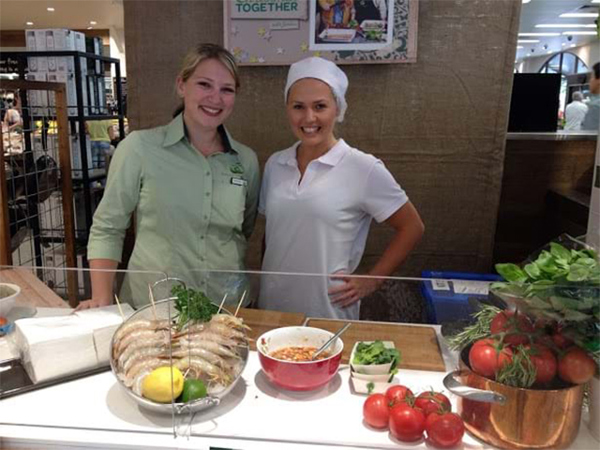
Kit that makes the rules easier to follow
Training only works if the station lets staff follow it. Plan for:
- A wipe-clean, food-safe work surface. Our demonstration tables have food-safe tops that wipe down, and some take sneeze guards.
- Somewhere to wash hands. Coles says stores must give demonstrators reasonable access to hand wash basins. For events away from a store, we can build a basin into a custom demonstration counter. Ask the council what hand washing it needs at a temporary site.
- Sanitiser at the station. Woolworths says sanitiser must be available whenever sampling is undertaken. Our touch-free sanitiser station runs on batteries, so no power lead crosses the floor.
- A tray staff can serve from. Our vendor trays are 520 x 400mm with a surface suitable for direct food contact. We sell them; we don't hire them.
Next step
If you're planning a national sampling program and need matching kit for every team, send us the details through the enquiry form or call us on 1300 240 250.