

YOUR CART IS CURRENTLY EMPTY
All you need to know about flag bases
A teardrop or feather flag is only as good as the base holding it up. The flag, pole and carry bag are the same wherever you go, but the base has to suit the ground: a stake for grass, a cross base or steel plate for hard floors, and a mount for walls and vehicles. Get it wrong and the flag leans, spins or ends up on the ground.
Every one of our teardrop flags and Blade 2 Go flags comes with an in-ground stake. Everything else is an add-on, so it pays to know the surface before you order. This page runs through each base, the surface it suits, and the checks to make before a flag goes up. If you're still choosing the flag itself, see our guides to flag sizes and flag shapes.
Match the base to the surface
Grass and soft ground: the in-ground stake
The stake comes with every flag and packs in the same bag, so it adds nothing to the carry. On a sports ground, a lawn or a showground, it's often all you need.
Before you push a stake in, check what's under the grass (see the checks below).
Sand and beach sites
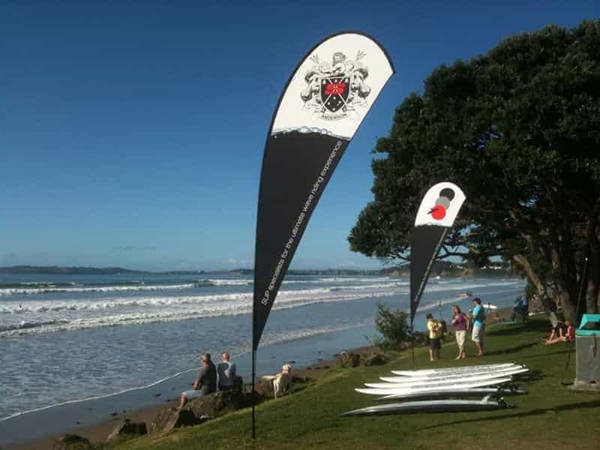
We list the stake for grass, sand and other soft ground, but check how firm the sand is before you rely on it. Where you can, set your flags on firmer ground at the edge of the sand, such as a grassed foreshore or a path, and ask us about the right base for the site before you order. Expect a harder day for the flag too: our flag FAQs rate beaches among the most challenging places for flags, because of the stiff breezes, and salt can dull the colours over time.
Concrete, paving and bitumen: cross base or steel base plate
A stake can't go into a hard surface, so you need a base that sits on top of it.
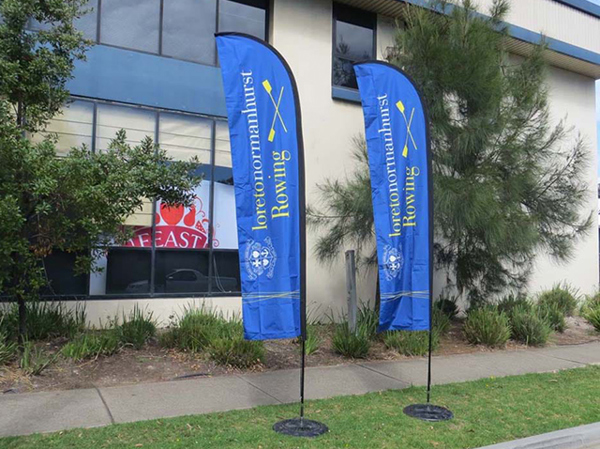
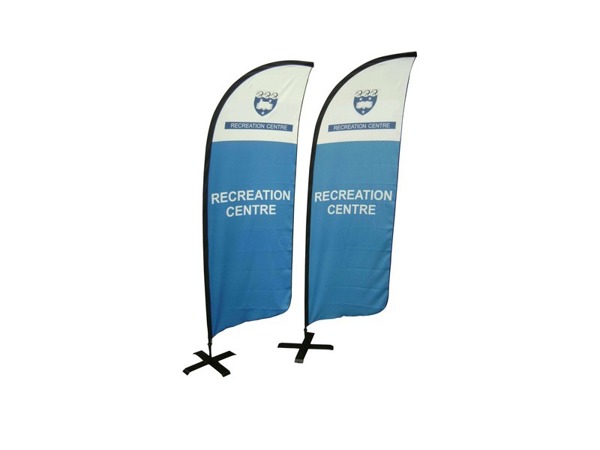
- Cross base. Four flat feet in a cross, made for hard surfaces. It's $78.00, excluding GST and freight.
- Steel base plate. A flat steel plate for concrete, paving and other hard surfaces. It's $105.80, excluding GST and freight.
- Heavy cast iron base. For hard ground where you want more weight at the foot of the flag. Ask us for a price.
Indoor floors
Our flags are made for indoor and outdoor use, so the same flag can work a foyer, a conference or an exhibition hall. Indoors, use a cross base or steel base plate, never the stake. Keep the base clear of walkways, because the feet of a cross base stick out past the flag and are easy to trip on in a busy aisle.
Car yards and vehicle activations
For dealer events, test-drive days and vehicle activations, the flag can go on the car rather than the ground. A car tow-ball mount puts the flag on the car's tow ball, and car tyre brackets are made for car dealers. Both let you set a flag up right at the vehicle you're promoting.
Walls and shopfronts
Wall-mounted brackets, angled at 60 degrees or 90 degrees, hold a flag out from a building at a shopfront or entrance. Allow enough clearance for the flag to move without hitting the wall.
What about water bases and sand bags?
We also supply a water base for our teardrop and Blade 2 Go flags. It isn't listed on the product pages yet, so ask us for a price. For the most weight on hard ground, choose the heavy cast iron base, or ask us what suits your site.
Before you put a flag in the ground
#1 - Check for underground services
A stake goes straight into the ground, and so can anything else pushed in to hold a display. SafeWork NSW's guide to managing work health and safety at events says that where pegs and anchor stakes are likely to be used, possible underground electrical and gas services should be considered, and suggests weights instead where possible. Some sites set their own rules:
- Henty Machinery Field Days asks exhibitors to "check with HMFD management before digging or driving posts into the ground" (2026 Exhibitor Handbook).
- Clarence City Council (Tasmania) says "the use of metal pegs is not permitted in parks due to the possibility of hitting irrigation lines" (event requirements page).
If in doubt, ask the organiser or venue, and use a base that sits on the surface instead.
#2 - Keep clear of roofs, walls and branches
Flags are often damaged by beating against something while they fly. Our flag FAQs list hitting a roof or wall among the things that can wear a flag out in under three months. Choose a spot clear of awnings, signs and trees, and allow for the flag to swing on its pole.
#3 - Keep the base out of the walkway
A flag base sits low and is easy to miss. SafeWork NSW's events guide expects marquee anchors to be protected against trips, impalement and traffic, and the same thinking applies to a flag base on a busy path. Set flags at the edge of the space, not in the middle of it.
#4 - Check before you use public land
Footpaths and other public land are the council's call, so ask them first. At a shopping centre, venue or showground, the centre or venue management decides.
Wind: when to take flags down
Our flags have no published wind rating, so we can't give you a wind speed that is safe for them: you need to decide when they come down. The base holds the pole; it doesn't make the flag safe in any weather.
- It's windier up the pole. As our flag FAQs point out, the wind at the top of a tall flag is much stronger than what you feel at ground level. Our teardrop flags and the Blade 2 Go both come in 2.5m, 3.5m and 4.5m, so the top of a tall flag can be well above where you feel the wind.
- Rain adds weight. A soaked flag is heavier, and in strong wind that extra weight wears it faster.
- Agree a trigger. Before bump-in, agree with the organiser when flags and signage come down and who makes the call. SafeWork NSW lists pulling signage down due to high winds among the proactive steps an organiser can take. Follow the organiser's or venue's call; there is no wind speed we can give you as a safe limit for these flags.
For a beach, headland, open paddock or any other exposed site, ask us which height and base to order. For a fuller plan, see our guide to weatherproofing outdoor activations, and our flag FAQs for washing and care.
Not sure which base you need? Tell us the surface and the site, or call 1300 240 250, and we'll match the base to your flags.