

YOUR CART IS CURRENTLY EMPTY
How to write a sponsorship activation brief
A sponsorship activation brief gives everyone working on your presence at an event the same facts: what your contract lets you do, where you'll be on site, when you can build, who has to approve what, and what it all has to achieve. Write it once, and the rights holder, your agency and the people building your space can all work from it.
Many sponsorship briefs stop at the idea. The ones that run smoothly also give the build team the practical detail: footprint, ground, power, access and bump-in times. Here are the eight things we'd put in yours, then a checklist you can copy.
What is a sponsorship activation brief?
When you sponsor an event, a team or a venue, you buy rights: to use the event's name and marks, to have a presence on site, to reach its audience. The activation is how you use those rights on the day, and the brief is the document that sets it up.
Unlike most briefs, it has three readers. The rights holder needs to see that the activation stays inside the contract and its event rules. Your agency needs the objectives and the audience to come up with the idea. And the fabricator needs hard numbers to design, price and build something that works on that site. If one of them is missing a fact, it tends to show up late, as a redesign or a rushed bump-in.
What to include in your brief
#1 - Set the objectives and say whose audience you're borrowing
Say why you bought the sponsorship and what the activation has to deliver: awareness among the event's crowd, product trial, leads, sales on the day, or hosting key clients. Give each objective a number.
Then describe the audience. At a sponsored event the crowd belongs to the rights holder, not to you. They came for the game, the concert or the festival, so the brief should say what will make them stop, what you want them to do, and how long they'll realistically give you between the gates, the bar and their seats.
#2 - Spell out what your contract allows
List the rights that shape the activation, taken from your sponsorship agreement:
- Which event names, logos and marks you may use, and how they can be combined with your brand
- Where you're allowed to be: the zone, site or space you've been allocated, and its size
- What you may do there: sample, sell, run a competition, collect data, play music
- How many event days are covered, and whether hospitality or branding inside the venue is included
- Any category exclusivity, and rules about other sponsors' products in or near your space
Attach the relevant schedule of the agreement, or a summary signed off by your sponsorship manager. A designer who doesn't know what the contract allows can easily design something the rights holder will reject.
#3 - Put the rights holder's approvals into the timeline
Ask the rights holder's partnership team, early, what they need to approve and how long each step takes. It can be more than the artwork. Sign-offs often include:
- The concept, before money is spent on design development
- Any use of the event's marks, against their brand guidelines
- The site plan and structure drawings, for the operations and safety team
- The final artwork, before it goes to print
Ask for the event or venue manual too, and the list of documents they'll want from you before bump-in. Then work those dates back from the event, alongside your own internal approvals. A custom brand activation build typically takes us about 5 weeks, so the approvals have to fit around that, not after it.
#4 - Give the build team the site details
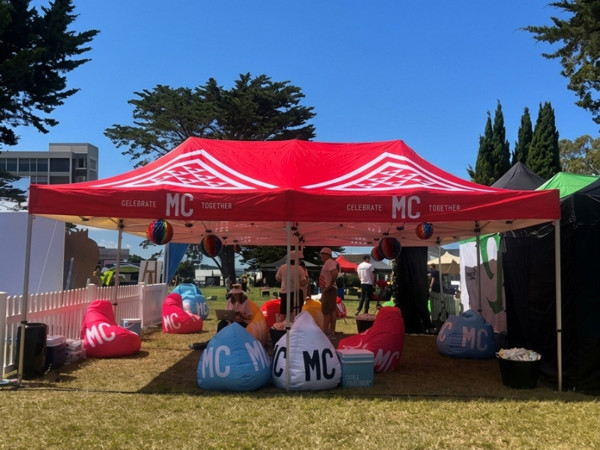
This is the part many briefs leave out, and it shapes much of the design. For each site, give:
- Location: where your space sits in the venue, and what's next to it
- Footprint: length and width in metres, and any height limit
- Ground: grass, concrete, asphalt, carpet or a stadium concourse, and whether you can peg into it or must use weights
- Exposure: how open the site is to wind, sun and rain
- Access: the route in, gate and door sizes, and whether a vehicle can get close
- Power and water: what's supplied, where the outlet is, and who provides it
Outdoors, wind is usually the deciding factor: a structure on an open oval needs a different base from one in a walled courtyard, and both have to be weighted or tied down. If you don't know a detail, ask the rights holder before the build team designs around a guess.
#5 - List bump-in, event and curfew times
Give the exact times you can build and pack down, the event hours, and any curfew on noise, vehicles or work after a set hour. Note any accreditation or induction your build crew needs before they can get on site. A tight bump-in window favours kit that goes up quickly without tools. A multi-day event needs a plan for securing the space overnight.
#6 - Supply brand assets and artwork details
Attach your brand guidelines and the rights holder's approved lock-ups of the event marks, then say who is producing the artwork and when it's due. If the creative work is still to be done, our guide on how to write a creative brief covers what designers need.
#7 - Plan the reporting both sides need
Your agreement may list deliverables the rights holder has to report on, and you'll have your own measures for the activation. Put both in the brief so the space is designed to capture them: a counted sampling flow, a data-capture point with a privacy notice, a photo point for content, or a hosting area with a guest list. Agree who collects each figure, and when the wrap-up report is due.
#8 - Set the budget, contacts and sign-off
Give the activation budget as a figure or a range, separate from the rights fee, and say what it covers: design, build, graphics, freight, installation, staffing, power and storage. Say whether the kit will be reused at other events in the season, because that changes how it's built and packed.
Finish with a contact list and one decision maker. Typical names are your sponsorship manager, the rights holder's partnership manager, the venue or site operations contact, your agency and your fabricator.
Sponsorship activation brief checklist
Copy these headings into your brief. Where an answer isn't known yet, write down who you've asked.
- Contacts: sponsorship manager, rights holder partnership manager, site operations, agency, fabricator, final decision maker
- Objectives: each one with a number, and the audience you're reaching
- Rights: marks you may use, allocated space, permitted activities, event days, exclusivity
- Approvals: each rights holder sign-off, who gives it, and the turnaround
- Site: location, footprint, height limit, ground, exposure, access, power and water
- Times: bump-in, event hours, curfew, bump-out, crew accreditation
- Brand: your guidelines, event mark lock-ups, artwork owner and deadline
- Reporting: rights holder deliverables, your own measures, who collects them
- Budget: a figure or range, what it covers, reuse plans
- Attachments: contract schedule or summary, event or venue manual, site map
If you're also exhibiting at trade shows, our guide to writing an exhibition stand brief covers stand sizes, shell schemes and exhibitor manuals.
What happens after you send it
We design and build brand activations for indoor and outdoor events across Australia and New Zealand. Your project manager is your single point of contact, helps refine the brief, and looks after production, freight, installation and dismantling.
For a lot of outdoor sponsorships, a branded marquee is the starting point. Our Gazebo 2 Go event marquees go up in under 2 minutes without tools, and their canopies are printed on a water-resistant, fire-retardant 600 denier polyester. Outdoors, every marquee needs weights or anchoring, and accessories include weighted steel base plates and sand bags. On event days, we can also give on-site or after-hours support for the equipment we've supplied.
Send us your completed brief, or call 1300 240 250, and we'll be in touch within one business day.