

YOUR CART IS CURRENTLY EMPTY
Gamification at trade shows: how to do it without gimmicks
Published
Quick answer
Gamification at a trade show means adding game elements, such as points, a spin, a timer or a leaderboard, to your stand so visitors have a reason to stop and take part. It stops being a gimmick when the game is tied to your product and every play ends in a qualified lead or a useful conversation. Pick the format to suit your audience and stand size, then plan the prize, the data capture and the promotion rules before you design the game.
What gamification at a trade show actually means
Gamification is game play in a setting that isn't a game. On an exhibition stand, that covers anything from a prize wheel to a skill challenge with a live leaderboard. The usual mechanics are a goal, a score, a reward and a reason to come back.
Done well, a stand game does three jobs:
- It earns attention. People stop where something is happening, and a crowd watching a game draws more people in.
- It teaches. A quiz or challenge built around your product gets key points across faster than a brochure.
- It produces data. Every play is a chance to capture details and, with consent, qualify the visitor.
The gimmick version does the first job only: it draws prize hunters, the queue blocks your sales team, and the lead list fills with people who will never buy.
Start with the lead, not the game
First, answer three questions:
- Who do you want to stop? A B2B stand wants buyers and specifiers, not everyone walking the aisle.
- What should they learn or do? A product feature, a demo booking, a sample request.
- What will you capture? Name, company and role, plus one or two qualifying questions.
Then design the game so the play itself does the qualifying. A trivia quiz about the problem your product solves works as a short survey in disguise: the answers tell your team who has that problem. A skill challenge that uses your product puts it in the visitor's hands. Capture details before the play, not after, so every game is a lead.
Prize wheels and chance games
A prize wheel is the quickest way to add a game to a stand. The sound of the clicker carries, the outcome is instant and people in the queue can watch every spin. It suits busy shows where volume matters and conversations are short.
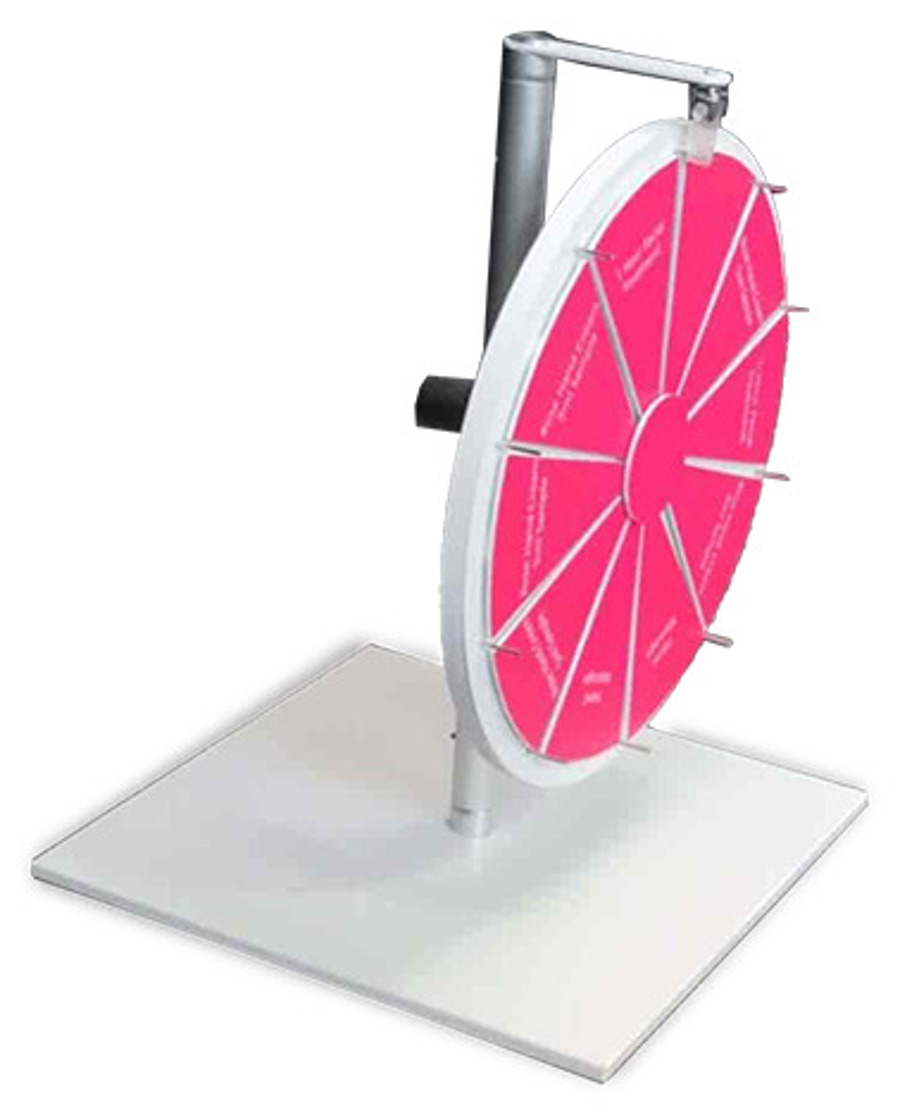
To keep a wheel from becoming a gimmick:
- Make the spin the reward for an action, such as completing a short registration, watching a demo or answering a product question.
- Brand the segments around your product, not generic prizes.
- Put a host on the wheel and a second person on data and prizes, so the line keeps moving and your sales team stays free.
Our prize wheels come in floor-standing and counter-top formats, plus an off-the-shelf wheel with write-on segments when time is short. Choosing a format, writing the specification and planning the queue are covered in our spin to win prize wheels guide.
A simple business card or entry-form draw is the low-key version of a chance game. It suits audiences who would rather not perform in front of a crowd. A branded entry box from our competitions and prize promotions range gives the draw a fixed spot on the stand.
Leaderboards and skill challenges
Skill games run longer than a spin and create a show of their own: visitors compete for a leaderboard place, others stop to watch, and the top scores bring people back later in the show.
Formats that work on a stand:
- Physical challenges such as a timed rowing or cycling challenge, or a steady-hand game.
- Product challenges, where the visitor races to assemble, operate or find something using your product.
- Knowledge challenges, such as a timed product quiz with the score on a screen.
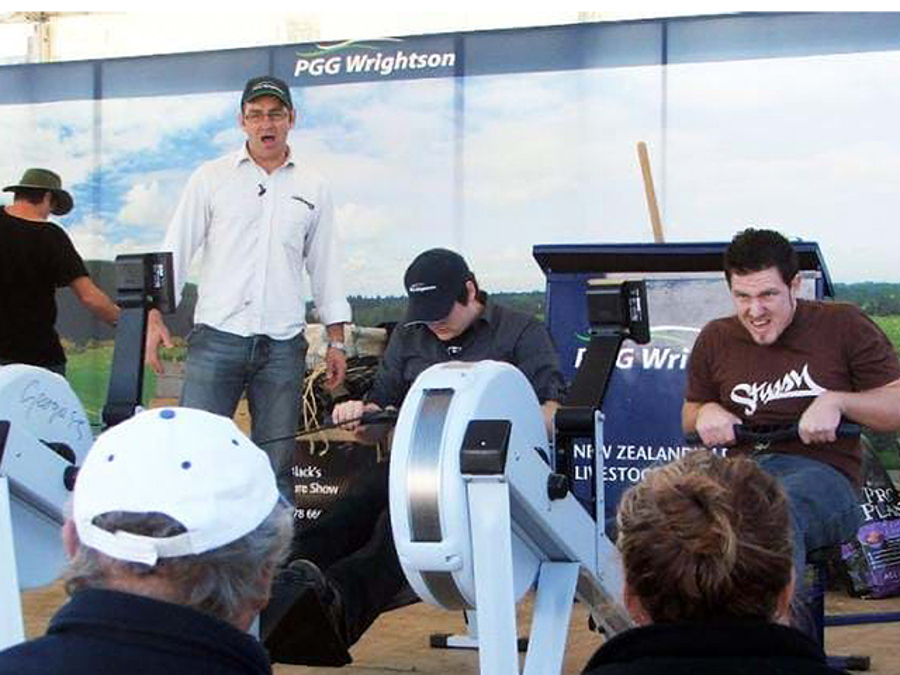
The rowing and bike games on our interactive games page are one example: visitors raced Olympic athletes on a rowing machine or bike. Games like this are built from your brief, so the challenge, branding and scoring can tie back to your product.
Keep the leaderboard fair and visible. Publish how scores are counted, reset it at a set time each day, and announce the winner when you said you would.
Reaction and touchscreen games
Touchscreen and reaction games suit smaller stands and visitors who prefer to play one at a time. A tall touchscreen kiosk or wall-mounted screen can run a quiz, a product selector or a reaction game, and capture details as part of the play.
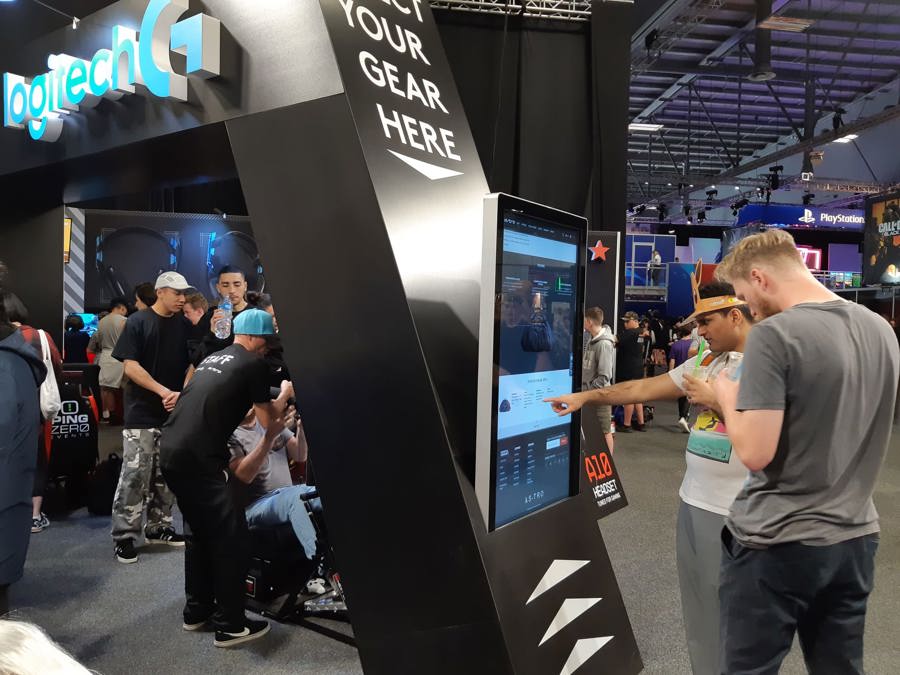
Keep screen games short. A visitor should finish in about the time it takes to have a first conversation, and the last screen should hand them to a staff member, not to a "thanks for playing" message.
A branded photo kiosk is a lighter option, and it tends to work best with a younger crowd. Visitors take a picture against your branding and share it, which carries the stand beyond the hall. We can build a custom photo kiosk to suit the activation: one that prints a copy to take away or lets each visitor record a message of support for someone else.
Passport trails and show-wide hunts
Some shows run a passport, stamp trail or QR code hunt across the hall. Visitors scan codes at participating stands, answer a question at each one and climb a show-wide leaderboard, with prizes at the end.
These are usually organised by the show, so ask the organiser early whether one is planned and how to take part. If you join:
- Make your question about your product, so the answer gives your team an opening line.
- Put the code where a staff member can see who scans it, so the scan starts a conversation.
- Have a reason for the visitor to stay once they have scanned, such as a demo or a sample.
You can run a smaller version on your own stand, with several codes or stations around the space that each teach one point.
Prizes, permits and trade promotion rules
Choose prizes your buyers want and other visitors don't: a product trial, an upgrade, a consultation or a year's supply. High-value generic prizes attract the wrong crowd. NSW also bans some prizes, including tobacco and vaping products.
A game where chance decides the winner is generally treated as a trade promotion lottery, and adding a skill element may not change that. The rules vary by state, so check with your state regulator before the show, and with each state where entrants live. What the official sites say:
| Jurisdiction | What the regulator says |
|---|---|
| NSW (NSW Fair Trading) | An authority is required if the total prize value for a single trade promotion exceeds $10,000. If you need one, give NSW Fair Trading the rules at least 10 working days before you start and show the authority number on all advertising. At any prize value, entry must be free of fees, the rules must be clearly advertised, and advertising must not suggest that winning is a definite outcome. |
| ACT (Gambling and Racing Commission) | Covers promotions where winners are decided by any means that includes "an element of chance or a mixture of chance and skill". Generally it must be approved before it is advertised or run. No permit is needed where the total prize value doesn't exceed $3,000, but conditions must still be met. |
| VIC (VGCCC) | Prizes determined by chance are covered "even if the event includes skill-based activities". Entry fees can't be charged. No permit is required, but the conditions in the Gambling Regulation Act 2003 and its regulations apply. |
| Other states and territories | Check with your state or territory regulator. |
Your promotions or legal team should own the terms and conditions. Write in what happens when a prize runs out, how many plays each person gets, and how winners are notified.
Game formats compared
| Format | Best for | Time per play | Staff needed | Lead quality | Rules to check |
|---|---|---|---|---|---|
| Prize wheel | High-traffic shows, quick capture | Short | Host plus data and prizes | Depends on the action that earns the spin | Chance game: check with your state regulator |
| Entry draw | Audiences who won't perform in public | Short | Minimal | Moderate | Chance game: check with your state regulator |
| Skill challenge and leaderboard | Product demos, repeat visits | Medium | Host and scorer | High if the challenge uses your product | Check with your state regulator, especially if prizes involve chance |
| Touchscreen or reaction game | Smaller stands, one-to-one | Short to medium | One staff member to follow up | High if the questions qualify | Depends on how winners are chosen |
| Photo kiosk | Social reach, consumer audiences | Short | Minimal | Lower unless details are captured | Consent for images and data |
| Show-wide hunt | Organiser-run trails | Short per stand | Staff to start the conversation | Moderate | Run by the organiser |
Measuring whether the game worked
Most stand games give you something to count: plays, registrations, demo bookings and leaderboard entries. Compare those with how many became qualified leads and, later, sales. That ratio tells you whether the game earned its place or just drew a crowd. For other engagement ideas, from demonstrations to QR codes, see our FAQ on drawing visitors onto your stand.
Next step
Browse our prize wheels and interactive games, or call 1300 240 250 with your show date, stand size and audience, and we'll help you choose a stand game that fits.