

YOUR CART IS CURRENTLY EMPTY
Trade show mistakes corporate exhibitors still make
Published
Quick answer
The trade show mistakes that cost corporate exhibitors most are planning too late, exhibiting without a measurable goal, crowding the stand graphics, sending staff who haven't been briefed, giving visitors nothing to do, capturing leads with no plan for them, and leaving follow-up until next week. Follow-up is often the costliest, because by the time it fails every other cost has been paid. All seven are avoidable with a written plan agreed before the stand is designed.
Mistake 1: planning too late
Late planning rarely looks like a disaster. It looks like a run of compromises: a poor position on the floor plan, rushed artwork, express freight, and a roster made up of whoever is free that week.
Our trade show planning timeline works back from the show date:
| When | What to lock in |
|---|---|
| 12-18 months out | Objectives, budget and which shows to attend |
| 9-12 months out | Stand space, stand design, travel and accommodation |
| 6-9 months out | Graphics and printed material, pre-show marketing, staffing |
| 3-6 months out | Technology and screens tested, freight and logistics planned |
| 1-3 months out | Final confirmations, promotion and staff training |
A repeat show with a stand you already own can move faster. Two kinds of date rarely move, though: the organiser's deadlines in the exhibitor manual, and your own artwork sign-off. Enter both in the calendar the day you book the space, and give one person ownership of the timeline.
Mistake 2: no clear goal or measure
"Raise our profile" is not a goal you can report on. Without a target agreed before the show, nobody can say afterwards whether it paid off, and the next budget discussion starts from opinion.
Choose one main objective, give it a number, and agree it with sales before the stand is designed, because the objective decides the layout.
| Main objective | What to measure | What it means for the stand |
|---|---|---|
| New business | Qualified leads against agreed criteria, meetings booked | Room to talk, a fast way to log leads |
| Product launch | Demonstrations given, launch leads | A defined demo area with sight lines from the aisle |
| Key accounts | Meetings held with named customers | Seating or a semi-private meeting space |
| Brand awareness | Visitor numbers, dwell time, social mentions | A strong single message and something to do |
After the show, work out cost per lead: the total spend on space, stand, travel and staff time divided by the number of leads. Then track how many leads became sales in the following months. Our guide to measuring exhibition success covers the other measures worth recording.
Mistake 3: a stand that says too much
Visitors decide whether to stop as they walk past. A back wall carrying the logo, a full product list, five bullet points, a QR code and a slogan reads as noise from the aisle, so people keep walking.
- One message, high on the back wall. Say what you do and who it is for, in words a visitor understands in a few seconds.
- Logo above head height, where it can still be seen when the stand is busy.
- Detail where the conversation happens: at the product, on a screen or in a brochure, not across the wall.
- Check the proof at viewing distance, from the angles people actually approach from, with people and furniture in front of it, not as a flat file on a monitor.
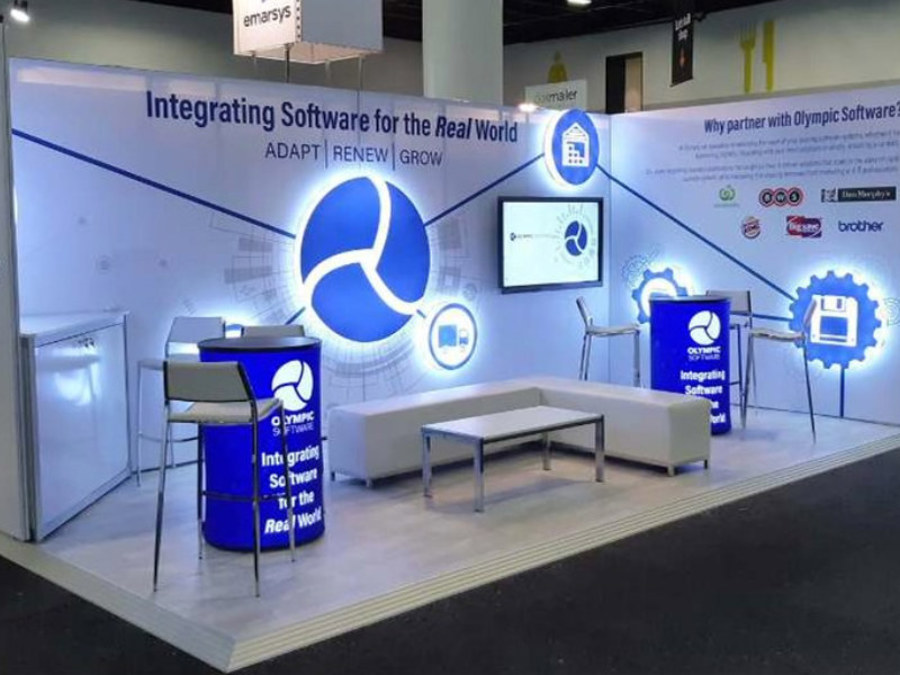
The same applies to layout. A counter set across the front of the stand reads as a barrier. Keep the front open, with clear paths in and around the space.
Mistake 4: untrained, unbriefed staff
The people on the stand shape the result as much as the graphics do. The familiar problems are staff on their phones, clustered in conversation, sitting down or eating on the stand, and product experts who can't tell a buyer from a browser.
Run a briefing before the doors open. Cover:
- the objective and the target for the day
- the one message, and the two or three proof points behind it
- opening questions that start a conversation (better than "can I help you?")
- how to qualify a lead and how to log it
- who runs each demonstration
- the roster, with breaks taken off the stand
Rotating shifts keeps energy up across a long show, and name badges that show each person's role help visitors find the right person. More on this in our notes on stand staffing best practice.
Mistake 5: nothing to do on the stand
Visitors need a reason to step off the aisle. A product they can handle, a live demonstration, or a screen showing the product at work gives them one, and gives staff an easy way to start talking.
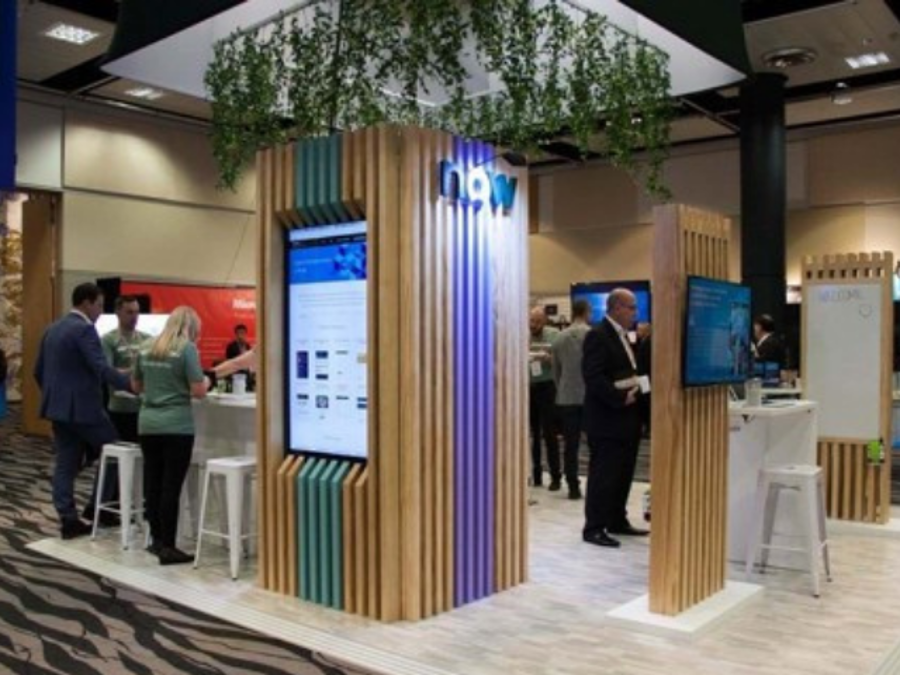
- Give each demonstration a defined space, so a crowd doesn't block the entrance.
- Make screens earn their place. A looping logo is decoration. A short product demo or customer example gives people something to watch.
- Hide the clutter. Cases, cables, spare stock, food and bags need a cupboard or a storage counter.
Mistake 6: no lead capture plan
A bowl of business cards tells you who visited, not who wants to buy. Decide before the show what you will capture for each lead:
- name, company, role and contact details
- what they are interested in, and their timeframe
- a rating (hot, warm or cold) against criteria sales has agreed
- the next step promised on the stand
Use a form, app or scanner your staff have practised with, and test it on the venue's connection during bump-in.
If you plan to send marketing emails afterwards, the Spam Act applies. The ACMA says you must have consent before you send. Express consent can be given by filling in a form or face to face, and you should keep a record of who gave it, when and how. A consent tick-box on the capture form, worded by your legal or privacy team, is the simplest way to get and record that consent on the stand.
Mistake 7: no follow-up after the show
This is the mistake that wastes everything else. A visitor who stopped, talked and left their details is a warm lead. A week of silence while the team catches up on email cools that lead quickly.
As we wrote when we covered how to follow up on leads, the fix is a plan written before the show:
- Make it someone's job. Name the person who owns follow-up and give them the tools to do it.
- Write the emails before you leave the office. Load leads as soon as the show closes and send the first contact while your stand is still fresh in their minds.
- Match the message to the lead. Use the interest captured on the stand, offer more than one next step (a demo, a download, a meeting), and repeat any offer you made at the show.
- Follow the rules. Every marketing email must identify you as the sender, include your contact details and offer a simple way to unsubscribe. The ACMA says unsubscribe requests must be honoured within 5 working days.
- Track conversion. Count how many leads became sales, and their value. That data shapes next year's budget and gives you evidence when you negotiate with the organiser.
A pre-show sense check
Run through this list a fortnight before the show:
- The objective and target are written down and agreed with sales
- Exhibitor manual deadlines are in the calendar, with an owner for each
- The main message can be read and understood from the aisle
- Every visitor and staff route has been walked on the floor plan
- Each demonstration has its own space, and there is storage for cases and stock
- Staff are briefed, rostered and given breaks
- The lead form is tested and the consent wording approved
- Follow-up emails are written, with a named owner and a first-contact date
- The method for calculating cost per lead is agreed
Getting the stand itself right
If you exhibit several times a year, a reusable stand takes a lot of the late-planning pressure away, because only the graphics need to change. Our SuperWall backdrop is a printed fabric skin that slides over a click-together aluminium frame and zips closed. One person should have it standing in under 10 minutes. Standard production is 1.5 weeks, counted from the order and print-ready artwork. Prices start from $1,467 excluding GST and freight for a 2.4m wide, 1.5m high wall, or $1,731 at the full 2.25m height.
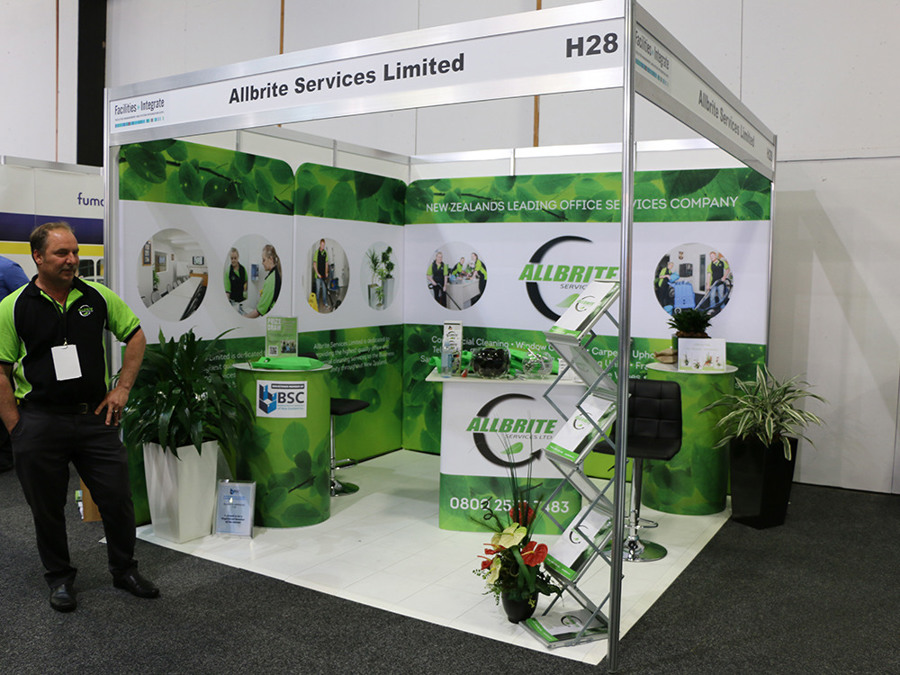
For one flagship show a year, a custom build sized to your booked space is often the better choice. Our exhibition stands range covers both portable systems and custom builds.
Next step
Planning your next show? Start with the planning timeline in Mistake 1, then call us on 1300 240 250 to talk about the stand.