

YOUR CART IS CURRENTLY EMPTY
Setting trade show objectives beyond 'raise awareness'
Published
Quick answer
ROI (return on investment) measures a trade show in money: what it brought in against what it cost. ROO (return on objective) measures it against the specific objectives you set before the show, such as meetings held, qualified leads or product demonstrations. Use both. Set three or four objectives, each with a number, a deadline and an owner, design the stand and the roster around them, and report against them once the sales cycle has had time to run.
What is ROO (return on objective)?
ROO stands for return on objective. Instead of asking only "did this show make money?", it asks "did we achieve what we set out to achieve?". You write a short list of objectives before the show, each with its own number, and judge the show against that list afterwards.
The objectives don't have to be sales. A show can be the right place to meet key accounts face to face, launch a product, recruit distributors or look after existing customers. Some of that turns into revenue months later, and some of it shows up as loyalty: a customer who keeps buying is worth more than one who buys once. ROO gives that work a score instead of leaving it out of the report.
ROI vs ROO: which should you measure?
ROI is the financial measure. The ROI Institute, which publishes the ROI Methodology, calculates it as net benefits divided by costs:
ROI (%) = (monetary benefits - total costs) ÷ total costs × 100
For example, if a show costs $60,000 all-in (space, stand, freight, travel and staff time) and the deals traced to it bring in $90,000 in gross profit, the net benefit is $30,000 and the ROI is 50%.
| ROI | ROO | |
|---|---|---|
| Question it answers | Did the show pay for itself? | Did the show do the job we set? |
| Measured in | Dollars and a percentage | The units of each objective: leads, meetings, demos, sign-ups |
| When you can report | After deals close, often months later | Mostly at close of show, then tracked through the pipeline |
| Best for | Budget decisions and comparing shows | Running the show and improving the next one |
Use them together. ROO tells you during the show and in the first week whether you are on track. ROI tells you at 6 or 12 months whether the show earned its place in next year's budget. The ROI Institute notes that intangible benefits, the ones not converted to money, are in many cases "more important to an organization than a positive ROI", so report those too.
Why 'raise awareness' isn't enough
"Raise awareness" is the most common trade show objective and the least useful. You can't count it, so nobody can tell whether it happened. The stand designer can't design for it, and the team on the stand don't know what a good day looks like.
Rewrite every objective until it answers five questions:
- Who? The audience, as narrowly as you can: "facilities managers at NSW hospitals", not "visitors".
- What, in a number? "120 qualified leads", not "lots of leads".
- By when? Close of show, or 90 days after it.
- How will we count it? Lead scans, the meeting calendar, the demo log, the CRM.
- Who owns it? One named person, not "the team".
So "raise awareness of our new range" becomes "show the new range to 200 visitors from our target sectors and capture 80 of them as rated leads by close of show, counted from lead scans, owned by the product manager". That is the old idea of SMART objectives without the acronym.
Trade show objectives you can count
Pick three or four. More than that and the team on the stand can't keep them in their heads.
| Objective | Metric | How the stand supports it |
|---|---|---|
| Qualified leads | Leads captured and rated against criteria agreed with sales | An open front, a counter near the aisle with a scanner or tablet, and a quieter spot to qualify |
| Meetings with key accounts | Meetings booked before the show and meetings held | An enclosed meeting space or lounge, plus a shared booking calendar |
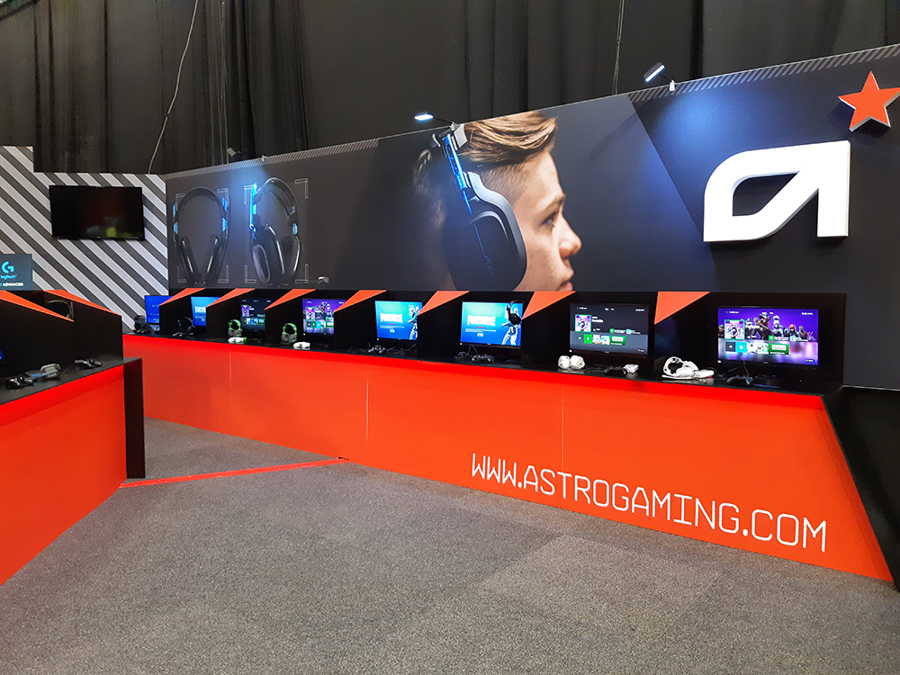
| Product demonstrations | Demos completed, and the share that become leads | Demo stations with screens at standing height, visible from the aisle |
| Product launch | Visitors who saw the launch, media and analyst briefings held | A hero display or plinth with its own lighting, and a published reveal time |
| Database growth | New contacts who agree to hear from you | A registration point with a clear reason to sign up |
| Customer retention | Existing customers hosted, and their feedback scores | Seating, hospitality and storage for catering out of sight |
Turning objectives into stand design and staffing
The objectives should shape the stand before any artwork is drawn. A stand built for 40 private meetings needs walls, seating and somewhere to put coffee cups. A stand built for 400 badge scans needs an open front and as little standing between the aisle and your staff as possible. One stand rarely does both well in a small space, which is another reason to choose a short list.
Put the objectives at the top of your exhibition stand brief. When we design custom exhibition stands, we begin with what you want the show to achieve, the floor space you have and what you can spend. You then see the stand in 3D before anything is built, so you can check that each objective has a place on it.
Then roster to the objectives:
- Give each objective an owner on the stand. One person runs meetings, one runs demos, one watches lead quality.
- Roster for the busy times. Put your most experienced people on during the sessions where your audience is most likely to be in the hall.
- Brief everyone on the targets. Tell the team the daily number, the lead rating rules and what a good conversation looks like.
Our guide to stand staffing covers training, messaging and how to qualify visitors without being pushy.
Setting targets that hold up
Build targets from your own numbers, not from a published average. Your sector, your price point and the show itself make more difference than any industry figure. Work backwards from what the show costs:
| Step | Example |
|---|---|
| Total cost of the show | $60,000 |
| Average gross profit per deal | $15,000 |
| Deals needed to cover the cost | 4 |
| Your usual qualified-lead-to-deal rate | 1 in 10 |
| Qualified leads needed | 40 |
| Show days | 3 |
| Qualified leads needed per day | About 14 |
If you have no history yet, set the first year's targets as a baseline, record everything, and tighten them the following year. A target nobody believes is worse than a modest one the team can beat.
Measuring during and after the show
During the show, check the numbers at the end of each day against the daily target. If demos are busy but few become leads, change how the team closes a demo. If meetings are being missed, look at the calendar. Small changes on day one pay off on days two and three.
Capture leads the same way every time. Every lead needs the same fields: the contact, a rating, the next step and who owns it. If you plan to market to these people, remember that Australian Privacy Principle 5 sets out when an organisation covered by the principles must tell people certain things as it collects their personal information, and APP 7 says an organisation may only use or disclose personal information for direct marketing "if certain conditions are met". You also need consent before you send them marketing emails or messages (Spam Act 2003), and the ACMA says a ticked box on your form is best practice. Check your capture form with your privacy team before the show.
After the show, follow up while the conversation is still fresh, and tag every lead in your CRM with the show name so sales can be traced back to it. Then review at intervals that match your sales cycle, such as 30 days, 6 months and 12 months. A true evaluation of a show takes time after it is over. Our page on measuring exhibition success lists more metrics worth tracking.
Reporting to leadership
Keep the report to one page:
- Objectives, targets and actual results, side by side
- Cost per result: for example, $60,000 divided by 52 qualified leads is about $1,154 per lead
- Pipeline and ROI to date, with the date of the next review
- Intangibles: key accounts met, competitor intelligence, media coverage
- What we'll change next time, in three bullet points
Report the ROO numbers straight after the show and the ROI as deals close. That way leadership sees progress early and the financial return when it is real. For more on why shows are worth the investment, read the power of trade shows.
Next step
When we read a brief, the first thing we look for is the objectives, and they aren't always about sales. Send us your three or four objectives, the show and your space size, and we'll design the stand around them. Call 1300 240 250 or use the enquiry form on our custom exhibition stands page.