

YOUR CART IS CURRENTLY EMPTY
All you need to know about pull-up banner materials
Most pull-up banner problems come back to the material, not the stand. A print that curls at the edges, lets the stand's pole show through as a shadow, or flares white under stage lights was printed on the wrong material for where it ended up.
This page explains the materials you'll see on quotes, what causes curl, show-through and glare, and how to check "PVC-free" and "recycled" claims before you sign off. For stand types, sizes and prices, see our pull-up banner buyer's guide.
What we print our pull-up banners on
Our standard pull-up banners are printed digitally on a PVC-free banner vinyl, made to stay flat and keep glare low. It is the standard print on the economy Promo, Premier, Quickscreen, shopping centre, extra-wide and recycled stands in our banner stands range.
On the Quickscreen and the double-sided shopping centre stands you can also ask for a blockout dye-sublimation fabric upgrade, our recommendation when you want the best result. Our standard print is already PVC-free. If your brief also asks for recycled content, or you need the data sheet for the material you're quoted, ask us before you order.
Whichever material you choose, the print can be changed later. Send the stand back to us and we'll fit a new graphic to the same base.
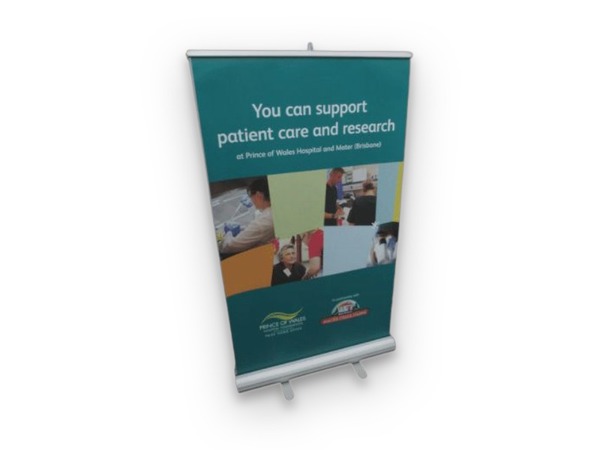
The materials you'll see on a quote
Polyester (PET) film
The usual material for roll-up banners. Manufacturers sell it as "anti-curl" and dimensionally stable, so it hangs flat when pulled out of the base. Typical roll-up films have a grey back to block light and a satin print surface; one manufacturer says its satin finish gives "a no-glare appearance".
Polyester film with a PVC coating
Some "polyester" banner materials are laminates. One grey-back roll-up banner on the market is a polyester film with PVC coating: 420gsm in total, made up of 290gsm of PVC and 130gsm of PET. If your brief says PVC-free, a material described only as "polyester" isn't enough. Ask for the data sheet.
Blockout fabric
A fabric with an opaque layer built in, so light and artwork don't pass through it. Blockout fabrics made for dye sublimation are polyester, because the process sets the colour inside the polyester fibres rather than on the surface. Our blockout upgrade on the Quickscreen and shopping centre stands is a dye-sublimation fabric. If your brief names a material, ask us to confirm the exact spec before you order.
PVC (vinyl) banner
The classic flexible banner material. We supply PVC banners as well as fabric. If PVC is offered for a pull-up stand, ask whether it is a grade made for roll-up use, and if your brief says PVC-free, this is the material it rules out.
Why do pull-up banners curl at the edges?
A pull-up banner is rolled tightly into the base after every event. A material that isn't built for that holds the curve, and the edges roll inwards once it's pulled out. Roll-up films are made to resist this: suppliers describe them as "anti-curl", "stay-flat" and designed to "retain their original shape with no curling at the edges".
To keep a banner flat:
- Choose a roll-up grade. Ask whether the material is made for retractable stands, not just for banners in general.
- Retract it slowly. Guide the top rail down by hand so the print rolls evenly.
- Store it rolled in its base and bag between events.
Light showing through: when to choose blockout
"Blockout" means no light and no artwork bleeds through from the other side. A grey back does two jobs on a pull-up banner: it stops light passing through, and it stops the support pole and hardware behind the banner showing as a shadow through light areas of the artwork.
You need blockout when:
- the banner stands in front of a window or a bright foyer wall
- it is lit from behind, for example near a stage wash or a lightbox
- it is double-sided and the two prints mustn't show through each other.
Blockout and double-sided are different things. Blockout is about opacity; double-sided means printed faces on both sides. Ask for both if you need both.
Glare under stage lights and camera flash
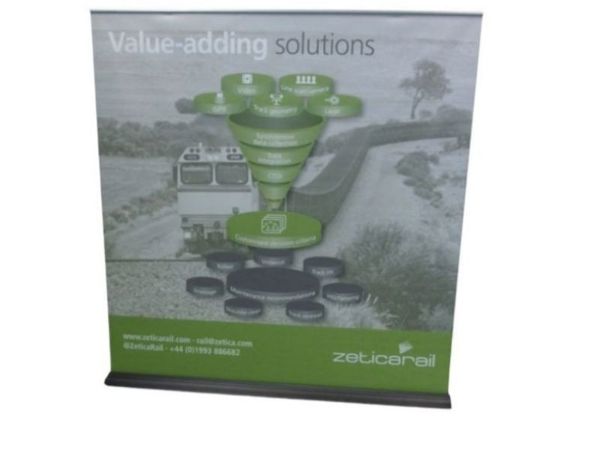
A shiny print surface reflects light back at the viewer, so part of the banner can flare white under spotlights or a camera flash and become hard to read. That is why roll-up films are sold with satin, low-glare print surfaces, and why our standard pull-up print is a low-glare material. A reflective banner behind a speaker is a particular risk in photos and video.
For staged, lit or photographed settings:
- Specify a low-glare finish, not gloss.
- Specify blockout if lights or windows sit behind the banner.
- Tell us how it will be lit and filmed when you order, so we can recommend the material.
PVC-free and recycled claims: what to ask for
The ACCC's guidance on environmental and sustainability claims says "All claims should be true and accurate", that there should be clear evidence to back them up, and that broad claims "can more easily mislead consumers than clear, specific and proven claims". Before you repeat a supplier's "eco" claim in your own reporting, ask for:
- The material data sheet, to confirm what the banner is made of (PVC, PET or both).
- Certification for recycled content, not just the word "recycled". For recycled polyester, one such certification is the Global Recycled Standard.
- What happens at the end of its life. Our guide to recycling your pull-up banner covers separating the banner, aluminium and plastic parts.
Two lower-impact options we offer today: a recycled banner stand, where returned hardware is checked, refurbished and fitted with a brand new print, and reusing your own base with a new graphic rather than buying a new stand. For fabric displays, our article on recycled polyester explains how it is made from PET bottles.
How to specify banner material in a brief
Put these lines in the brief and you'll get comparable quotes:
- Setting: indoor or outdoor, in front of a window or a plain wall, and whether it will be filmed.
- Sides: single or double-sided.
- Finish: low-glare, not gloss.
- Opacity: blockout needed, yes or no.
- Material rule: PVC-free required, and data sheet to be supplied.
- Recycled content: certification to be supplied if you plan to claim it.
- Life: one campaign, or reused across events with replacement prints.
Not sure which material suits your setting? Ask us before you print. Call 1300 240 250 or send us an enquiry.