

YOUR CART IS CURRENTLY EMPTY
How to choose an exhibition stand builder in Australia
Published
Quick answer
Before you appoint an exhibition stand builder, find out who does each part of the job. Ask who designs the stand, what is made in their own workshop and what is outsourced, whose crew installs it at the venue, where it is stored between shows, and who your single point of contact will be. A builder who controls design, production and installation can fix problems without passing them between companies. Get the answers in writing, alongside a clear brief, before you compare prices.
What a stand builder actually does
On paper, many builders offer the same thing: design, build, install. In practice, the work behind those words can be spread across several companies. One studio draws the stand, a joinery shop builds it, a print house makes the graphics and a labour hire crew puts it together on the night before the show.
None of that is wrong in itself, but it changes who you call when something doesn't fit. So the useful question isn't "can you do it?" but "who, exactly, does each part?" The sections below take each stage in turn, with the questions to ask and the answers that should reassure you.
Start with a good brief. Builders can only quote like for like if they all get the same information about your goals, space, budget and dates. Our guide to writing a stand brief covers what to include.
Design: who draws your stand?
Ask to see how the design will be presented before anything is built. A good builder shows you the stand in 3D, so your team can approve it and changes are made on screen rather than on the show floor.
Questions to ask:
- Is the design team in-house, or is design subcontracted?
- Will we get 3D renders, and how many rounds of changes are included?
- Do the designers work alongside the people who build the stand, so the concept is buildable within the budget?
- Who prepares the artwork for the graphics, and who checks it before print?
At Displays 2 Go, our designers model the stand in 3D, so you can view it from every side and make changes before production starts. For a fuller preview, we can produce photo-realistic CAD drawings, a virtual walk-through or a video animation of the stand.
Production: made in-house or outsourced?
This is where quality and deadlines are won or lost. When the structure, joinery and graphics are made under one roof, the builder controls the timeline and can fix a problem the same day. When each part comes from a different supplier, a late delivery from one holds up all the others.
Questions to ask:
- Which parts are made in your own facility, and which are bought in?
- Are graphics printed in-house? On which materials?
- Is the stand pre-built and checked before it leaves the workshop?
- How long do you need from signed-off brief to show day?
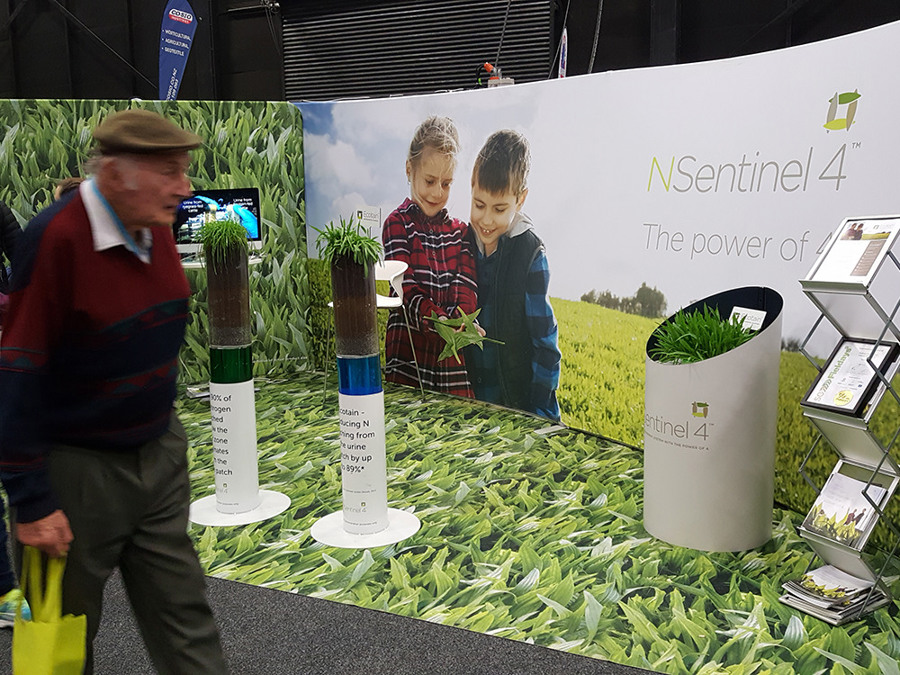
We make our stands in-house at our Sydney production site, from materials and print through to fabrication, finishing and pre-builds. We print the graphics ourselves on fabric, rigid panels or vinyl, up to 3.2m wide in a single piece depending on the material. The 3.2m limit is the width of the print roll, so the other side can be much longer: our 9m SuperWall graphics print in one piece, with no seams. Each stand is assembled and checked before it is sent out. For a typical custom stand, allow four to eight weeks between brief sign-off and the show.
Installation: whose crew turns up?
Ask whether the people installing your stand are the builder's own crew or contractors hired for the day. The crew that built a stand knows how it goes together, and can solve problems at the venue without waiting for someone else.
Venues also expect builders to know their rules. ICC Sydney's Exhibition Manual, for example, says "All custom stand plans require approval from ICC Sydney prior to construction", that "Double storey stands require an engineer's certificate prior to construction and an engineer's signoff once constructed", and that contractors doing high risk works "need to complete an induction prior to the event move in." Every venue sets its own rules, so ask the builder which venues they have worked in and who submits the plans and permits. Our summary of stand rules at Australian convention centres shows what the main venues ask for.
Questions to ask:
- Do you install with your own crews, in every city we exhibit in?
- Who submits stand plans and permits to the venue and organiser?
- Is installation and bump-out included in the quote?
- Who is on call during the show if something needs fixing?
Our own installation crews travel nationwide, and we build at the main convention centres in each capital city, among them ICC Sydney, BCEC in Brisbane and MCEC in Melbourne. For custom stands anywhere in Australia, our quote covers freight to the venue, installation and pack-down after the show. We handle dock bookings and safety forms, and if you're using equipment we supplied, we can help on show days, on site or after hours. See our exhibition stands Sydney and exhibition stands Melbourne pages for those venues.
Storage, refurbishment and reuse
A custom stand that goes to more than one show is an asset, and what happens to it between shows matters as much as how it was built.
Questions to ask:
- Can you store the stand between shows, and where?
- Is it checked, cleaned and repaired before it goes out again?
- Can the layout be adapted to a different space and the graphics swapped for the next show?
- Who keeps track of what is in storage?
Between shows we keep stands in our warehouses in Australia and New Zealand, where every item is scanned in, inspected for wear and brought back to clean, working order before it goes out again. Because our custom stands are designed for reuse, the graphics can be refreshed or replaced and the layout adapted when your next space is a different size.
Project management and a single point of contact
A stand involves design, production, freight, venue paperwork and installation crews, often across several cities. If you have to coordinate all of them yourself, you have become the project manager.
Ask who your one point of contact will be from brief to bump-out, and whether that person can see the design, production and installation schedules. At Displays 2 Go, a dedicated Client Services project manager coordinates your project, manages the timeline and oversees the budget. If the campaign also runs in New Zealand, our sister company in Auckland looks after the logistics there.
Questions to ask before you appoint
| Question | Why it matters |
|---|---|
| Who designs the stand, and will we see 3D renders? | Changes are cheap on screen and expensive on site |
| What is made in-house, and what is outsourced? | More hand-offs mean more chances of delay |
| Is the stand pre-built before it leaves the workshop? | Problems are found in the workshop, not at the venue |
| Whose crew installs it, and in which cities? | The people who built it know how to fix it |
| Who handles venue plans, permits and inductions? | Missing paperwork can stop a build |
| What does the quote include: freight, install, bump-out, storage? | Totals are only comparable when the inclusions match |
| Where is the stand stored, and is it checked before reuse? | Protects the asset between shows |
| Who is our single point of contact? | One person owns the timeline and the answers |
Red flags
- A price with no breakdown. If freight, installation, bump-out and storage aren't itemised, you can't compare quotes or see what's missing.
- No 3D design before production. You will be approving the stand when it arrives at the venue.
- Vague answers on who builds and who installs. "Our partners" can mean anyone.
- No questions about the venue. A builder who doesn't ask about height limits, rigging and the show's deadlines will find out about them on site.
- No mention of the brief. A quote prepared without your objectives and budget is a guess.
Next step
Ask us the same questions. Send us your brief, floor plan and show dates through the enquiry form, or call 1300 240 250, and we'll show you how we'd design, build, install and store your stand. See our custom exhibition stands and design and build pages for more.